
Bladderwort Care Guide
Utricularia graminifolia · Freshwater Plant
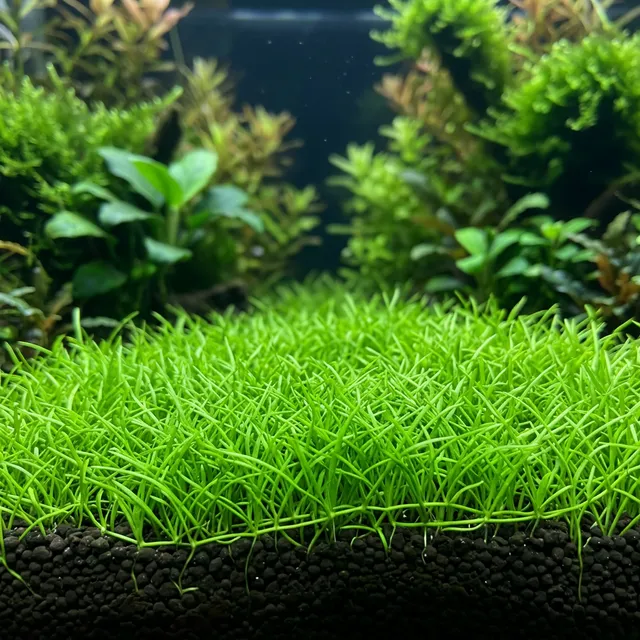
What Bladderwort look like
Utricularia graminifolia, commonly known as Bladderwort, is a remarkable carnivorous aquatic plant characterized by its dense, bright green mat of fine, grass-like leaves that typically reach heights of 1-2 inches. The leaves are extremely narrow and finely textured, contributing to a vivid, lawn-like appearance that carpets the substrate. This species exhibits a creeping growth habit through runners, allowing it to spread effectively across the substrate. The plant possesses tiny, transparent bladder-shaped traps located on its roots, which are nearly imperceptible to the naked eye, serving as its primary means of capturing prey. Although it does not exhibit sexual dimorphism, its unique morphology is defined by the absence of tall growth, broad leaves, or visible trap structures, which distinguishes it from other aquatic plants.
Behavior & temperament
Utricularia graminifolia is primarily a benthic plant, thriving in shallow waters where it can establish a dense carpet on the substrate. This species does not exhibit a social hierarchy as it is not a colonial organism; instead, it grows individually but can form extensive mats through its runners. The plant is primarily a photosynthetic organism, relying on sunlight for energy, but it also captures small aquatic organisms using its specialized traps, showcasing a unique blend of carnivorous behavior. Its temperament is passive, as it does not exhibit aggression or competition with other plants, instead coexisting harmoniously in its aquatic environment.
Diet & feeding
In its natural habitat, Utricularia graminifolia primarily relies on photosynthesis for energy, supplemented by capturing small aquatic organisms such as zooplankton and other minute prey. In captivity, it requires a well-lit environment to facilitate photosynthesis, along with nutrient-rich substrates to support its growth.
Behind the name
Utricularia (from Latin 'utriculus', meaning 'little bag' or 'bladder'); graminifolia (from Latin 'gramina', meaning 'grass', and 'folia', meaning 'leaves').
Plan your tank
Check the numbers before you buy: tank volume, a stocking plan, cycle progress, water changes, and your ongoing care routine.
Keep reading
Diagnose aquarium plant deficiencies by leaf age and symptom: yellowing, pinholes, twisting, and stunting. Read the pattern, then fix it safely.

PAR-first planted tank lighting: choose intensity by what you grow, set photoperiod and spectrum, kill shadows, and hold algae back without overspending.

Aquarium CO₂ injection made safe: how carbon, light, and nutrients balance, which system to buy, and how to dial it in without gassing your fish.
Keeping Bladderwort?
AquaLens identifies your fish and plants from a photo, tracks water chemistry, and flags health issues early — free on iOS and Android.