
Creeping Jenny Care Guide
Lysimachia nummularia · Freshwater Plant
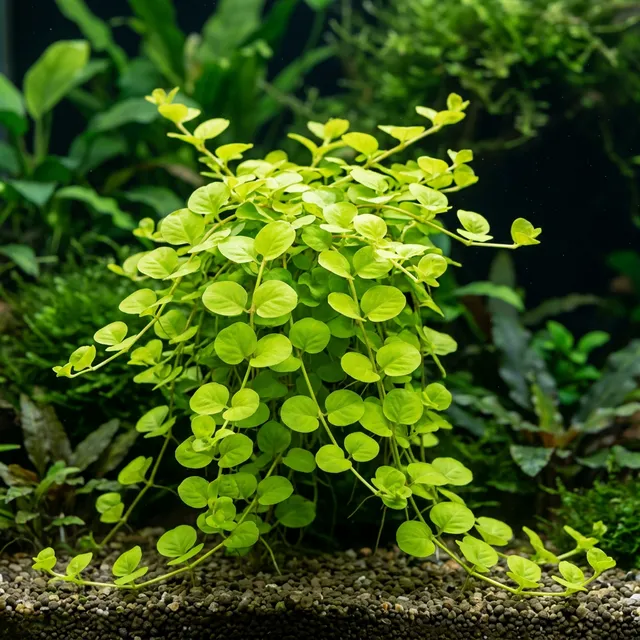
What Creeping Jenny look like
Lysimachia nummularia, commonly known as Creeping Jenny, exhibits a distinctive morphology characterized by its trailing stems that can extend several feet in length. The leaves are notably round, resembling coins, with a diameter of approximately 0.75 inches, and are arranged in opposite pairs along the stems. The foliage displays a vibrant golden-green hue, which can vary slightly depending on light conditions. This plant can grow in both emersed and submersed forms, adapting its morphology accordingly. The stems are slender and flexible, allowing for a creeping growth habit that can cover large areas. Creeping Jenny does not exhibit significant sexual dimorphism, as both forms are visually similar. Its defensive adaptations include a rapid growth rate, which can outcompete other aquatic plants, and the ability to thrive in a variety of water conditions, making it resilient against herbivory.
Behavior & temperament
Creeping Jenny is primarily a benthic plant that thrives in shallow waters, often found in wetlands, along riverbanks, and in moist environments. It exhibits a creeping growth habit, forming dense mats that can provide habitat for various aquatic organisms. This species does not exhibit social hierarchy as it is a solitary plant; however, it can form extensive colonies through vegetative propagation. Creeping Jenny primarily reproduces through vegetative means, with stems rooting at nodes when they come into contact with the substrate. Its growth is vigorous, and it can quickly cover available space, which may lead to competition with other aquatic flora. The plant is generally non-aggressive and coexists peacefully with other species in its habitat.
Diet & feeding
Creeping Jenny is an obligate photosynthetic organism, relying on sunlight to produce energy through photosynthesis. In captivity, it requires bright, indirect light to thrive and maintain its vibrant coloration.
Behind the name
The genus name 'Lysimachia' is derived from the Greek 'lysimachos', which means 'to loosen the battle', while 'nummularia' comes from the Latin 'nummulus', meaning 'coin', referring to the plant's distinctive coin-shaped leaves.
Plan your tank
Check the numbers before you buy: tank volume, a stocking plan, cycle progress, water changes, and your ongoing care routine.
Keep reading
Diagnose aquarium plant deficiencies by leaf age and symptom: yellowing, pinholes, twisting, and stunting. Read the pattern, then fix it safely.

PAR-first planted tank lighting: choose intensity by what you grow, set photoperiod and spectrum, kill shadows, and hold algae back without overspending.

Aquarium CO₂ injection made safe: how carbon, light, and nutrients balance, which system to buy, and how to dial it in without gassing your fish.
Keeping Creeping Jenny?
AquaLens identifies your fish and plants from a photo, tracks water chemistry, and flags health issues early — free on iOS and Android.