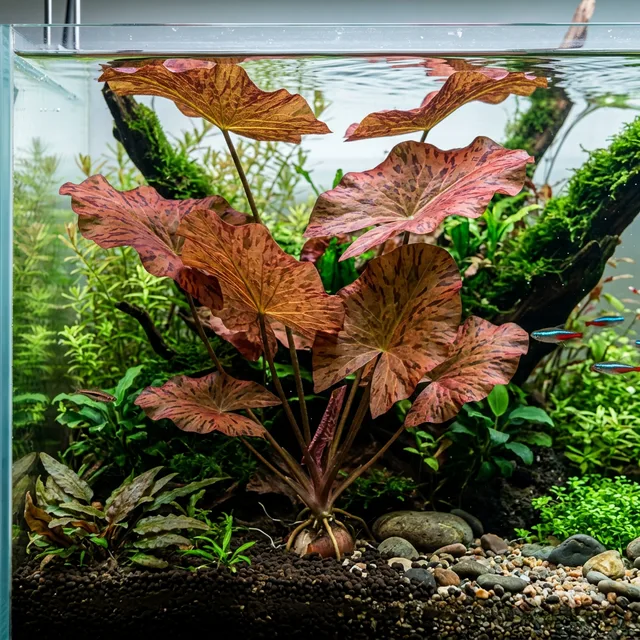
Orchid Lily Care Guide
Barclaya longifolia · Freshwater Plant
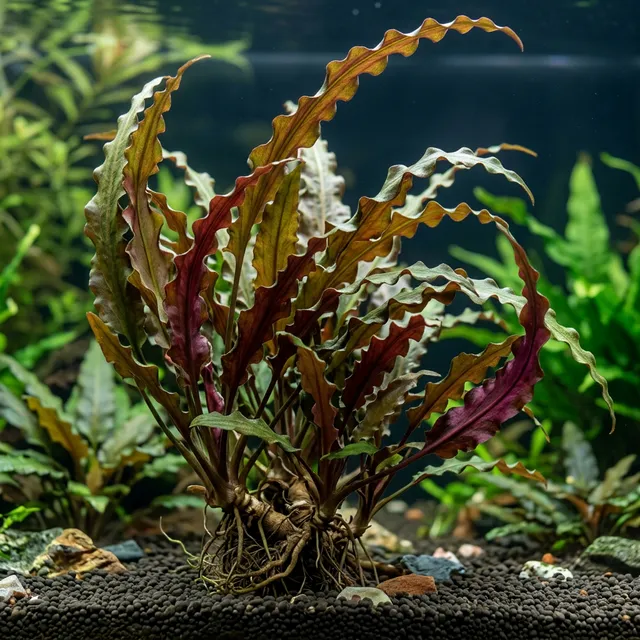
What Orchid Lily look like
Barclaya longifolia, commonly known as the Orchid Lily, exhibits a striking morphology characterized by its rosette growth form and elongated, undulating leaves that can reach lengths of 10 to 16 inches. The leaves are narrow and lanceolate, featuring dramatically wavy, ruffled margins that contribute to its orchid-like appearance. The upper surface of the leaves displays a rich olive green to reddish-bronze coloration, while the undersides are adorned with deep wine-red to burgundy hues, creating a visually captivating bicolor effect. The plant possesses a robust, thick rhizome base that anchors it securely in the substrate. While sexual dimorphism is not pronounced, variations in leaf coloration and size may occur based on environmental conditions. This species does not possess traditional defensive adaptations such as thorns or spines, but its unique morphology may deter herbivory by presenting a less palatable appearance.
Behavior & temperament
In its natural habitat, Barclaya longifolia typically inhabits shallow, slow-moving waters, where it can be found rooted in the substrate, often in a benthic position. This species does not exhibit social hierarchies as seen in animal species; rather, it grows solitarily or in small clusters. The Orchid Lily is primarily a photosynthetic aquatic plant, relying on sunlight for energy and growth. It does not reproduce through traditional means such as flowering or seed dispersal but instead propagates vegetatively through its rhizomes. The plant demonstrates a calm demeanor in its aquatic environment, with no aggressive traits, making it suitable for community aquariums.
Diet & feeding
Barclaya longifolia is an obligate photosynthetic organism, deriving its nutrients primarily from sunlight and carbon dioxide through the process of photosynthesis. In captivity, it requires a nutrient-rich substrate and adequate lighting to thrive, as well as occasional supplementation with liquid fertilizers to promote optimal growth.
Behind the name
The genus name 'Barclaya' is derived from the name of the Scottish botanist William Barclay, while 'longifolia' translates from Latin as 'long-leaved', referring to the plant's elongated leaf structure.
Plan your tank
Check the numbers before you buy: tank volume, a stocking plan, cycle progress, water changes, and your ongoing care routine.
Keep reading
Diagnose aquarium plant deficiencies by leaf age and symptom: yellowing, pinholes, twisting, and stunting. Read the pattern, then fix it safely.

PAR-first planted tank lighting: choose intensity by what you grow, set photoperiod and spectrum, kill shadows, and hold algae back without overspending.

Aquarium CO₂ injection made safe: how carbon, light, and nutrients balance, which system to buy, and how to dial it in without gassing your fish.
Keeping Orchid Lily?
AquaLens identifies your fish and plants from a photo, tracks water chemistry, and flags health issues early — free on iOS and Android.