
Algae and Bacterial Blooms: The Root Cause Playbook
Identify every common aquarium algae and bacterial bloom on sight, understand the biology behind it, and fix the cause instead of scrubbing.
On this page
Almost nobody has an algae problem. They have a light problem, a carbon problem, a flow problem, or a maturity problem, and the algae is just the part you can see. Scrub the glass all you like: if the underlying imbalance is still there, the green is back by the weekend.
This guide treats algae the way a limnologist would treat a lake, which is to say as a readout rather than an enemy. Each organism has a niche. Each one tells you something specific about what your tank is short of, or swimming in. Learn to read the niche and the tank tells you what is actually wrong, usually before your test kit does.
It also covers bacterial blooms, the milky white water that panics new keepers, because the two problems share a trigger and because almost every guide separates them for no good reason. A tank that just got a pulse of dissolved organic carbon and ammonium will often throw both, one after the other.
If you are staring at a black fuzz on your driftwood right now and want the short version: use the field key below, find the section for your organism, fix the one variable it points at, and add the right grazer. That is the whole method. Everything after it is why the method works, and where it stops working.
Start With a Sixty Second Field Key
Work top down. The first branch that matches is your answer.
Is the water itself discolored, so you cannot see the back glass?
- Milky white, grey, or faintly beige, and it appeared within a few days of a new tank, a big feeding, a dead fish, a substrate disturbance, or a bottled bacteria dose. That is a heterotrophic bacterial bloom. Skip to the bacterial bloom section.
- Green, like thin pea soup, and it deepens over a week. That is free floating green algae, covered under Green Water.
- Cloudy grey that settles into a layer of dust within a day of a water change or a new substrate. That is mineral fines, not biology. Ignore it.
- Milky for ten minutes after a water change, clearing from the bottom up. Dissolved gas coming out of solution. Also ignore it.
Are surfaces coated instead? Then feel the growth and pick the closest match.
- Soft brown dust that wipes off with a fingertip and clouds the water. Diatoms.
- Hard green dots that resist a fingernail. Green spot algae.
- Soft green film on the glass that reappears within days of wiping, evenly, like a coat of paint. Green dust algae.
- Slimy sheet that peels off in one piece and smells of swamp mud or fresh cut grass. Cyanobacteria.
- Fine green filaments that wrap around plants and pull off in strands. Hair or thread algae.
- Coarse, wiry green filaments that will not break when you pull, anchored hard, faintly musty. Cladophora.
- Dark grey to black fuzz in tufts on leaf margins, hardscape, and equipment. Black beard algae.
- Stiff grey green strands that fork like antlers. Staghorn.
- Oily looking film sitting on the water surface. Not algae. Protein and bacterial biofilm; fix with a surface skimmer or more surface agitation.
Identification matters more here than in most areas of the hobby, because the treatments actively contradict each other. Green spot algae wants more phosphate. Reef dinoflagellates want more nitrate. Green hair algae usually wants less of both. Guess wrong and you feed the outbreak while you are trying to starve it.
Why Outbreaks Happen at All
Algae is not an infection you caught. It is the default condition of any lit, wet, nutrient bearing surface on this planet. Spores and cells arrived on your plants, in your tap water, on a snail, on your hands. You cannot exclude them and there is no point trying. What you control is whether conditions favor them or favor something else.
Liebig's law, which is most of the guide in one idea
Justus von Liebig worked out in the 1840s that growth is capped not by the total supply of resources but by whichever one runs out first. A plant with abundant nitrogen, light, and potassium but no available carbon grows at the rate carbon allows, and not one bit faster. The surplus of everything else just sits there.
That is the mechanism behind the single most useful sentence in aquarium algae control: algae blooms when plants stall, not when nutrients rise. A planted tank can run 30 ppm nitrate and 3 ppm phosphate and stay spotless as long as the plants are consuming light and nutrients at full tilt. The moment something becomes limiting, usually carbon in a high light tank or iron and micros in a lean one, plant uptake drops but the light keeps arriving. Algae, which is far smaller, far faster to respond, and content on a fraction of the resource, spends what the plants left on the table.
This is why the reflexive fix of cutting nutrients so often makes things worse. You have not removed algae's food. You have removed your competitor's food, and algae is much better at being poor than your Rotala is.
The ammonium trigger
The second mechanism worth knowing is that ammonium seems to act as a germination signal for several nuisance algae, not merely as a nutrient. This is why outbreaks cluster around events rather than around steady state chemistry: a new tank, a filter cleaned too aggressively, a dead fish behind the rock, a heavy dose of fertilizer into a tank with no plant mass, an uprooted carpet releasing a cloud of substrate.
Be aware of the confidence level here. There is decent aquatic plant research behind ammonium as a trigger, and it matches what keepers observe, but the exact dose response in a home aquarium is not pinned down and the claim gets repeated with more certainty than it has earned. Treat it as a strong working rule, not a law. The practical translation is simple enough either way: anything that releases a pulse of ammonium tends to be followed by algae about a week later, so the interesting question after an outbreak is what happened seven to ten days ago.
What is solid, and what is folklore
A guide that pretends everything here is settled science is lying to you. Rough scorecard:
- Well supported. Light drives demand. Limiting factors cap plant growth. Cyanobacteria colonize low flow zones. Diatoms need silicic acid. Red algae respond to oxidizing spot treatments. Blackouts kill organisms without energy reserves.
- Strongly supported by practice, thin on formal evidence. Ammonium as a germination trigger. Green spot algae tracking low phosphate. Black beard algae tracking unstable carbon dioxide rather than the absolute level.
- Repeated far more confidently than it deserves. That healthy plants release compounds which chemically suppress algae. Allelopathy is real in aquatic ecology and some macrophytes do produce inhibitory polyphenols, but in a filtered, water changed, carbon filtered aquarium the concentrations are almost certainly too low to matter, and the competition explanation covers the observation on its own. Also on this list: nitrate or phosphate numbers being directly causal, iron dosing causing black beard algae, and any product claiming to fix the balance of your tank.
What You Are Actually Looking At
The hobby names are all wrong, which matters because the naming hides real biological differences that determine what a treatment will do. Four separate lineages get lumped together as algae here, and one of them is not even a eukaryote.
| Hobby name | What it actually is | Lineage | What its presence usually reports |
|---|---|---|---|
| Brown algae | Diatoms, silica shelled single cells | Bacillariophyceae | Young system, available silicic acid, little competition |
| Green dust algae | Film forming green alga with a motile spore stage | Chlorophyta | High light on bare glass; mostly cosmetic |
| Green spot algae | Disc forming green alga, usually attributed to Coleochaete | Chlorophyta | Phosphate too low for the light level |
| Hair and thread algae | Oedogonium, Spirogyra, Rhizoclonium and relatives | Chlorophyta | Light outrunning carbon, or an ammonium spike |
| Cladophora | Branching filamentous green alga | Chlorophyta | Usually imported on plants; persists on its own |
| Green water | Free floating single cells, often Chlorella or Euglena | Chlorophyta and others | Ammonium spike, raw sunlight, or a nutrient surge |
| Black beard algae | Tufted freshwater red alga, usually called Audouinella | Rhodophyta | Unstable carbon dioxide and dissolved organic waste |
| Staghorn | Compsopogon, also a red alga | Rhodophyta | Same conditions as black beard |
| Blue green slime | Cyanobacteria such as Oscillatoria or Phormidium | Bacteria | Dead spots plus very low nitrate |
| Bacterial bloom | Free swimming heterotrophic bacteria | Bacteria | A pulse of dissolved organic carbon |
Two consequences fall straight out of that table. Cyanobacteria and bacterial blooms respond to antibiotics because they are bacteria; nothing else on the list does. And black beard algae and staghorn respond to the same oxidizing spot treatments and the same carbon dioxide fix because they are close relatives, which is why keepers who solve one often find the other gone too.
The Green Algae
Green dust algae
What it looks like. A fine, even green film on the glass, thickest on the brightest pane. Wipe it and it is back in three or four days, faster than seems reasonable. On plant leaves it looks like a light green haze rather than distinct dots.
What it means. Usually nothing wrong. Green dust algae is the standard occupant of well lit bare glass, and a mature planted tank with strong light will host it more or less permanently. It is not a sign of a chemistry fault.
What it does. Almost nothing. It does not smother plants and it does not harm fish. Purely a viewing pane problem.
The fix. This is the one algae where the counterintuitive move is to stop cleaning. Green dust algae has a motile zoospore stage: scrape the glass and you release a cloud of spores that settle and restart the cycle, which is exactly why it comes back so fast. Leave it completely alone for three weeks and it matures, releases, and sloughs off the glass in sheets on its own. Then wipe the glass, siphon the debris out, and do a water change the same day so the released material leaves the system. Keepers who follow the three week protocol usually report much longer clean intervals afterward.
If you cannot stand three weeks of green windows, just accept a weekly wipe as maintenance. Nerite snails graze it well and are the low effort answer.
Green spot algae
What it looks like. Hard, dark green dots, typically half a millimetre to two millimetres across, on the glass and on slow growing leaves such as Anubias. Fingernails will not shift them. You need a blade on glass and patience on leaves.
What it means. Two things at once, and it is nearly always the second one: strong light, combined with phosphate low enough that plants cannot use that light. Green spot is the most reliable low phosphate indicator in the freshwater hobby.
What it does. Cosmetic on glass. On slow leaves it is a real problem, because a heavily spotted Anubias leaf loses photosynthetic area and the plant, being slow, cannot simply grow past it.
The fix. Dose more phosphate, not less. This still shocks people who came up in the era when phosphate was treated as pure poison. Target a measurable residual, around 1 to 2 ppm PO₄ in a dosed planted tank, and new spots generally stop forming within a couple of weeks. Existing spots do not dissolve; you remove them mechanically or you wait for the leaf to be replaced. If your light is genuinely intense, take intensity down ten to fifteen percent as well, since the ratio is what matters. The nutrient dosing calculator will put a real number on a phosphate target for your volume instead of leaving you to guess, and plant nutrient deficiencies covers what else low phosphate is doing to your plants while you are looking at the glass.
For removal, a razor blade on glass, or a plastic blade on acrylic. On hard leaves, nerite snails are one of the very few grazers whose radula can actually rasp green spot off a surface.
Hair and thread algae
What it looks like. Green filaments, anywhere from short fuzz on leaf margins to long strands drifting in the current. Several genera get this name. Oedogonium forms short bristly tufts anchored to leaf edges. Spirogyra is bright green, slippery to the touch, and breaks apart when you pull it. Rhizoclonium is finer, cottony, often slightly brown, and tends to appear in new high tech setups.
What it means. The classic mismatch: high light with insufficient or unstable carbon dioxide. You have handed the tank the accelerator without the fuel. It also appears after an ammonium spike in a tank that is not fully cycled.
The mechanism, as best it is understood, runs like this. Under strong light with carbon in short supply, RuBisCO, the enzyme that fixes carbon, starts grabbing oxygen instead of carbon dioxide. That process, photorespiration, burns energy for nothing. Meanwhile the light keeps arriving, so the plant has more absorbed energy than it can route into carbon fixation, and stressed tissue leaks organic carbon and ammonium into the water. Algae takes it from there. That chain is plausible and consistent with what keepers see; it has not been demonstrated end to end in an aquarium, so hold it loosely.
What it does. In quantity, it is genuinely destructive rather than merely ugly. Filaments shade the leaves they anchor to, which slows the plant, which frees more resource for algae. Dense mats trap shrimplets and fry, and small fish do occasionally get caught in Spirogyra.
The fix. Rebalance light against carbon, in that order of preference:
- Shorten the photoperiod to six hours and hold it there for two weeks. Free, instant, reversible.
- Drop intensity if the fixture allows it, or raise it further from the water. Light falls off roughly with the square of distance, so a modest lift does more than people expect.
- If you inject carbon dioxide, raise it and stabilize it rather than chasing a number. See the carbon dioxide injection guide and the carbon dioxide calculator.
Physically remove everything you can reach first. A toothbrush twirled into the mass winds filaments up like spaghetti and gets most of it, and manual removal is the only step that actually exports the nutrients rather than recycling them. Then bring in Amano shrimp, which are the undisputed champions here, at roughly one shrimp per two to three gallons. Do not overfeed them, or they will ignore the algae and wait for the pellet.
In a tank under three months old, hair algae usually means the cycle is not finished. Confirm that before you touch anything else.
Cladophora
What it looks like. Coarse green filaments that branch, feel wiry rather than slimy, resist being pulled apart, and smell faintly musty when you get a clump out of the water. If you have ever handled a Marimo moss ball, that is a Cladophora, and it is very often the source.
What it means. Unlike the rest of this section, Cladophora is usually not reporting a chemistry problem. It gets introduced on plants or moss balls and then persists because it is genuinely tough. It does prefer good conditions, which is the irritating part: it thrives in the same clean, well lit, well fed tank you were aiming for.
What it does. Anchors hard to hardscape and plant bases, resists most grazers, and shrugs off treatments that flatten softer algae. It is the most persistent common freshwater algae, black beard included.
The fix. Manual removal, repeatedly and obsessively, because it regrows from fragments. Pull whole clumps rather than tearing them. Spot dose 3 percent hydrogen peroxide directly onto anchored patches with the flow off. Liquid carbon works on it but needs sustained dosing over weeks rather than a single treatment. Amano shrimp will pick at it and will not clear it. If a single affected plant is the source and you can bear to lose it, removing that plant is faster than a month of chemistry. Quarantine and dip new plants to keep it out in the first place, which is far easier than any of the above.
Green water
What it looks like. The water column turns green and opaque over a few days. You lose sight of the back glass. Surfaces may stay perfectly clean, which is the tell that distinguishes it from everything else here.
What it means. Free floating single celled algae, usually a bloom triggered by an ammonium spike, direct sunlight on the tank, or a heavy nutrient surge into a tank without the plant mass to absorb it.
What it does. Here is the surprise: not much, and fish are generally fine in it. Green water is deliberately cultured as a first food for fry. The real risk is the same one that applies to any dense photosynthetic mass, which is the day night oxygen swing described further down, and that only bites in a heavily stocked tank with poor surface agitation.
The fix. Three options, in increasing order of speed and cost.
- Blackout. Three days of total darkness. Free floating cells have no meaningful energy reserves and starve while your plants coast on stored starch. Reliable.
- UV steriliser. The fastest fix by a wide margin, since every cell has to pass the lamp. Slow the flow through the unit down; contact time is what does the killing, and a unit run at full pump speed often disappoints for exactly that reason. It will do nothing whatsoever for algae attached to a surface.
- Fix the trigger. Block direct sun, confirm the tank is cycled, cut feeding back. Skip this step and it returns.
Do not bother with grazers. Snails and shrimp cannot eat what is suspended in the water column, and a mechanical filter will not catch cells that small either.
The Red Algae That Look Black
Black beard algae
What it looks like. Dark grey to black tufts, three to fifteen millimetres, fuzzy like a short beard, on leaf margins, driftwood, filter outlets, and anywhere else that catches flow. The one that makes people quit the hobby.
What it means. Two conditions, usually together: carbon dioxide that swings during the photoperiod, and a high load of dissolved organic waste. Note the emphasis. Black beard algae is a stability problem far more than a level problem, and plenty of tanks with excellent average carbon dioxide are covered in it because the level arrives late, drifts, or crashes when the solenoid cuts.
The organic waste half explains the placement. Tufts concentrate at filter outlets and on hardscape edges because those are the high delivery surfaces, and a neglected filter running slow is quietly a reactor turning trapped detritus into the dissolved organics being delivered there.
What it does. Smothers slow growing leaves permanently, since Anubias and Java fern hold a leaf for a year or more and will carry the infestation for as long as the leaf lives. Coats hardscape. Rarely harms fish directly.
The fix. Stability first, then removal, then a grazer.
- Stabilize carbon. If you inject, the target concentration should be reached before lights on, usually by starting gas one to two hours early, and hold flat all photoperiod. A drop checker lags the real value by an hour or more, so judge it by plant pearling and fish behavior, not just by color. Rock steady at a moderate level beats a high level that spikes and crashes.
- Clean the filter and raise flow. Reduced flow means organics are rotting inside the canister rather than being exported. The filter flow calculator will size turnover to your volume, and the filtration guide covers maintenance intervals that do not wreck your biofilter.
- Increase water change volume temporarily. Organics are the food supply, and water changes are the only real export path. See the water change calculator.
- Spot treat. Turn off the filter and any circulation pumps. Draw 3 percent hydrogen peroxide or liquid carbon into a syringe and apply directly onto the tufts. Wait five to ten minutes, then restore flow. Treated tufts turn red or pink within a day as the phycobilin pigments break down, then bleach white, then die and fall away or get eaten. That color change is a useful confirmation the treatment landed.
- Add a grazer. A Siamese algae eater is the only commonly available fish that reliably eats black beard, and even then mostly while young and mostly when not overfed. It reaches around 15 cm and needs a tank of 40 gallons or more. Check what you are buying: the flying fox is frequently mislabelled as one and will not do the job.
Hardscape and hardy plants can also be pulled and dipped, which is faster than treating in place. See the dip protocol further down.
Staghorn algae
What it looks like. Stiff grey green strands, coarser than hair algae, that fork like small antlers. Often on leaf margins and equipment.
What it means. Effectively the same conditions as black beard: unstable carbon, high organics, frequently an immature tank. Staghorn is Compsopogon, another freshwater red alga, and its response to treatment is nearly identical.
What it does. Similar to black beard, though it rarely reaches the same density.
The fix. Treat it as black beard. The same carbon dioxide stabilization, the same organics reduction, the same peroxide or liquid carbon spot treatment, and the same red to white color change confirming the kill. Grazers largely ignore it, so manual removal matters more here.
Diatoms and the New Tank Brown Phase
What it looks like. Soft brown dust on glass, substrate, hardscape, and lower leaves. Wipes off with a fingertip and clouds the water as it goes.
What it means. Your tank is young. Diatoms build shells, called frustules, out of hydrated silica, so their growth is tied to available silicic acid, which is abundant in new sand and gravel, in many substrates, and in a lot of tap water. They also carry the accessory pigment fucoxanthin, which makes them efficient in dim and spectrally odd light, and they are quick to colonize surfaces before anything else has established. New tank, plenty of silicate, immature biofilter, no competition: diatoms take it.
Nearly every new tank goes brown somewhere in the first one to two months. It is a rite of passage, not a fault. Worth noting that the standard hobby explanation, which is silicate and silicate alone, is probably too simple; low competition and the ammonium available in a cycling tank are doing real work too. The advice does not change either way.
What it does. Nothing much. It is genuinely cosmetic, it does not harm fish, and it wipes off easily.
The fix. Mostly patience. As the biofilter matures, competitors establish, and the easily available silicate is consumed, diatoms fade on their own. Wipe glass at water changes for appearances. A small group of otocinclus will graze it enthusiastically, but only add them to a tank that is at least two to three months old, because they need established biofilm to survive and the import mortality on wild caught fish is already brutal. Six or more, and never as a cleanup crew for a brand new tank.
If a tank well past three or four months keeps producing diatoms, suspect a continuing silicate source. Test your tap water, and if silicate is high, an RO or RO/DI source will solve it permanently. Some substrates also leach for longer than others.
Cyanobacteria: Not Algae at All
What it looks like. A slimy blue green sheet, sometimes with reddish or almost black patches, that peels off in one piece rather than crumbling. It smells strongly of swamp mud, fresh cut grass, or damp earth. Classically it starts on the substrate at the front glass, where detritus settles and water barely moves.
That smell is diagnostic and worth trusting. It comes from geosmin and 2-methylisoborneol, two compounds cyanobacteria produce, and the human nose detects geosmin at a few parts per trillion. If it smells like that, it is cyanobacteria.
What it means. Despite the name, the color, and the hobby label, this is not algae. Cyanobacteria are bacteria, prokaryotes, and their biology explains everything about how they behave in a tank. They glide slowly across surfaces, secrete a polysaccharide matrix that binds the mat together and protects the cells inside it, and tolerate resource conditions that plants cannot.
Two conditions bring them: dead spots where water is essentially still, and very low nitrate, often a measured zero. The nitrate half surprises people. The explanation usually given is nitrogen fixation, and that is only partly right; the mat formers most common in aquariums are generally not the nitrogen fixing genera. The more careful version is that cyanobacteria simply cope with near zero inorganic nitrogen better than your plants do, and their mats create their own anoxic microzones where nitrogen fixation and sulfate reduction can happen regardless. Either way, starving the tank hands them the win.
What it does. This is the one nuisance organism on the list with a real, if modest, health case against it. Several freshwater cyanobacteria produce toxins, including microcystins and anatoxin-a. Whether a given aquarium mat is producing them at meaningful concentration is genuinely unknown without testing, and most keepers see no fish losses, so do not panic. But it is a good reason to remove it rather than tolerate it, and a good reason to wash your hands after working in an affected tank.
The mat itself causes trouble independently of toxins. It is thick and self shading, so its underside goes anoxic, and anoxic organic sediment produces hydrogen sulfide, the rotten egg smell. It also smothers substrate plants and blocks gas exchange at the sediment surface.
The fix. Flow is the root cause, so start there.
- Fix the circulation. Add or reposition a small pump so no corner sits still. You are looking for gentle, complete movement, not a wave machine. Most cyanobacteria outbreaks I have seen trace back to a single stagnant patch behind a rock or under a plant mass.
- Siphon out every sheet you can reach. It comes away in whole pieces, which makes this satisfying and effective. Do it during a water change.
- Raise nitrate if it is at zero. In a starved planted tank, dosing back to 10 to 20 ppm NO₃ helps more than it hurts. Yes, this is the opposite of the usual advice, and yes, it works.
- Blackout if it has overrun the tank. Three days of total darkness, aeration on, feeding minimal.
- Erythromycin as a last resort. Sold as Maracyn in the United States. It works because cyanobacteria are bacteria: the macrolide binds the 50S ribosomal subunit and shuts down protein synthesis. The catch is that your nitrifying bacteria are also bacteria, so expect a dent in biofiltration, watch ammonia daily for a week afterward, and be ready with water changes. A large simultaneous die off also dumps organics and can trigger the bacterial bloom described next. Antibiotic sales for aquarium use are restricted or illegal in several countries, so check local rules before you go looking.
Antibiotics do not fix the flow problem. If you medicate and leave the dead spot in place, the mat comes back, usually within a month, and you have spent your biofilter on nothing.
Bacterial Blooms: When the Water Turns Milky
This is the other half of the cloudy water question, and it gets confused with green water constantly even though the two look nothing alike side by side.
What a bloom actually is
A bacterial bloom is an explosion of free swimming heterotrophic bacteria, the organisms that consume dissolved organic carbon rather than ammonia. They are always present. What changes is their food supply.
The trigger is a pulse of dissolved organic carbon: a new tank with no established grazing and mineralizing community, an overfeeding episode, a fish that died out of sight, a substrate disturbance that released trapped detritus, a filter cleaned so thoroughly that its accumulated organics went into the water column, or a bottled bacteria product dosed into a tank with nothing for the bacteria to eat.
The reason the water goes visibly milky within a day or two comes down to reproductive rates. Heterotrophic bacteria divide in anywhere from twenty minutes to a few hours under good conditions. The nitrifying bacteria you actually want, Nitrosomonas and Nitrospira, take the better part of a day per generation. Given a sudden feast, the heterotrophs win the race by orders of magnitude, reach densities high enough to scatter light, and turn the water white. Then they exhaust the carbon supply and crash almost as fast.
This is also the honest answer to why new tanks bloom and cycled ones usually do not: an established tank has a mature community already consuming organics as they appear, so there is no feast to touch off.
Why it is usually harmless and occasionally lethal
The cloudiness is harmless. What can kill fish is oxygen.
A dense bacterial population has an enormous biochemical oxygen demand. Every one of those cells is respiring, and unlike algae they never produce oxygen to offset it. In a heavily stocked tank with weak surface agitation, a serious bloom can pull dissolved oxygen down far enough to matter, and it will be at its worst in the small hours when nothing is photosynthesizing. Fish at the surface gasping, or hanging in the filter outflow at six in the morning, is the sign that this has stopped being cosmetic.
So: a bloom in a lightly stocked, well aerated tank is a nuisance you wait out. A bloom in a crowded tank with a still surface is a problem you act on tonight.
Telling a bloom apart from everything else
- Bacterial bloom. Milky white to light grey, uniform through the water column, appears over one to three days, usually two to five days after a trigger, and clears on its own in three to ten days. Surfaces stay clean.
- Green water. Green, deepens over a week or more, does not clear on its own, and needs light to persist. A blackout kills it; a blackout does nothing to a bacterial bloom.
- Mineral fines. Grey or tan, appears immediately after adding substrate or during a water change, and settles into a visible dust layer within a day. Purely physical.
- Dissolved gas. Milky, appears the instant you refill, and clears from the bottom upward within five to fifteen minutes. Also purely physical.
- A bloom in a long established tank. Treat this one as an alarm rather than a phase. Something released a lot of organic carbon, and the most common causes are a dead fish you have not found, a failed filter, or disturbed anaerobic substrate. Go and look before you treat anything.
The treatment, which is mostly restraint
The correct response to a typical bacterial bloom is closer to doing nothing than most people can tolerate.
- Increase aeration. This is the only step that is always right, because oxygen is the only real hazard. Add an air stone, raise the outflow to break the surface, run a spare powerhead pointed at the surface. Do it first, before diagnosing anything.
- Stop feeding for two or three days, or cut to a fraction. Uneaten food is the most common carbon source. Fish are fine; adult freshwater fish handle a week without food without difficulty.
- Find and remove the source. Count your fish. Check behind the hardscape. Look for a mulm pile you stirred up.
- Do not tear the filter apart. The bloom is not a filter fault, and a deep clean at this moment removes bacteria you want and releases more organics.
- Do not add clarifiers or flocculants. They bind the particles into clumps that your filter then traps, which addresses the appearance while leaving the oxygen demand and the carbon source untouched. Some also stress fish gills.
- Do not add more bottled bacteria. In a tank already blooming, you are adding more organic load to a system whose problem is organic load.
- Water changes are optional and mildly helpful. They export dissolved organics, which is the actual food supply, so a 25 to 30 percent change does no harm and may shorten things. They will not clear the water, since the remaining bacteria simply reproduce back into the space.
- Test ammonia and nitrite daily while it lasts, especially in a tank that is still cycling. The bloom itself does not produce ammonia, but the conditions that caused it often coincide with an ammonia source, and that is the thing that actually kills fish.
Expect three to ten days. If it has not cleared in two weeks, you have an ongoing carbon source you have not found yet.
The through line back to algae: the same event that feeds a bacterial bloom, whether that is a dead fish, an overfeeding, or a stirred substrate, also releases ammonium. So a bloom is frequently followed a week or so later by hair algae or diatoms. If you have just had one, tighten up light and feeding preemptively rather than waiting for the green to show up. Logging both events in AquaLens makes that lag obvious the second time it happens, which is when it stops feeling like bad luck.
What an Outbreak Actually Does to the Tank
Most algae is cosmetic. It is worth saying plainly, because the panic is usually out of proportion and the panic responses do more damage than the algae. That said, there are five real mechanisms of harm, and they are worth knowing so you can tell which situation you are in.
Shading, and the spiral it starts. Filaments and film on a leaf cut the light reaching it. The plant slows. A slower plant consumes less of the light and nutrients arriving, which leaves more for algae, which shades more leaf. This positive feedback loop is why outbreaks accelerate rather than plateau, and why acting early is worth so much more than acting thoroughly.
Day and night oxygen and pH swings. A large photosynthetic mass, whether that is algae, plants, or green water, drives the chemistry of the whole tank on a daily cycle. Through the photoperiod it strips carbon dioxide from the water and pumps out oxygen, so pH climbs and oxygen can go past saturation. Through the night everything respires and nothing photosynthesizes, so oxygen falls and pH drops back. In a badly overgrown, heavily stocked tank the oxygen minimum an hour before lights on can be low enough to stress or kill fish. If your fish look fine all evening and gasp at dawn, this is what you are looking at, and the fix is surface agitation tonight.
Die off crashes. This is the most common way people harm a tank while treating algae. Kill a large algae mass all at once, with a blackout, an algaecide, or an enthusiastic peroxide dose, and all that biomass decomposes at the same time. Decomposition consumes oxygen and releases ammonium, so you get an oxygen sag and an ammonia spike on top of a tank that is already stressed. Then the released organic carbon feeds a bacterial bloom, and you are reading the previous section. Treat a heavy infestation in stages across a week or two, not in one afternoon, and pair every treatment with a water change and extra aeration.
Toxins and anoxic sediment, specifically from cyanobacteria. Covered above. This is the only common nuisance organism with a genuine, if uncertain, toxicity case.
Entanglement. Dense filamentous mats, Spirogyra especially, trap shrimplets, fry, and occasionally small adult fish. Rare, but real, and a good reason not to leave a hair algae mat to keep growing because you have decided it is only cosmetic.
What algae does not do, contrary to persistent rumor: it does not consume oxygen on net over a full day while it is alive and growing, it does not poison fish other than the cyanobacteria case, and it does not indicate that your water is dirty. Some of the cleanest tanks on the internet are full of green spot algae because their owners run intense light and lean phosphate.
The Treatment Shelf and What Each Item Actually Does
Everything here treats symptoms. None of it fixes a cause. Used to buy time while you correct the real variable, they are all useful; used as the whole plan, they all fail on the same schedule.
Manual removal. Underrated and always first. It is the only intervention that physically exports nutrients from the system rather than recycling them, and it takes effect immediately. Toothbrush for filaments, blade for green spot on glass, siphon for cyanobacteria sheets, and hands for anything anchored to hardscape you can lift out.
Hydrogen peroxide, 3 percent. An oxidizer. It breaks down to water and oxygen within hours, so it leaves nothing behind, which makes it the safest chemical option here. Best used as a spot treatment: pumps off, apply directly by syringe onto the target, wait five to ten minutes, restore flow. If you dose the whole water column, treat about 1 ml of 3 percent solution per US gallon, roughly 0.26 ml per litre, as a daily ceiling and not a starting point. Excellent against red algae including black beard and staghorn, useful on Cladophora, effective on cyanobacteria. Shrimp are more sensitive than fish; do not spot treat directly onto them, and cut the dose in a shrimp tank.
Liquid carbon, meaning glutaraldehyde. Marketed as a carbon source, which is generous. At the concentrations sold, roughly 1.5 to 2.5 percent, it functions mainly as a biocide: glutaraldehyde cross links proteins and nucleic acids indiscriminately. It works well on red algae and reasonably on Cladophora with sustained dosing. Known plant casualties include Vallisneria, Riccia, some mosses, and Elodea and Egeria, all of which can melt at normal doses. Overdosing harms shrimp and fish. If you want carbon for your plants, inject carbon dioxide; if you want an algaecide, this is a decent one, just be honest with yourself about which you are buying.
Dips for hardscape and hardy plants. Faster than treating in place when you can remove the object. Bleach dip: one part unscented household bleach to nineteen parts water, 90 seconds to two minutes maximum, then rinse thoroughly and soak in heavily dechlorinated water before returning. Safe for hardscape and tough plants like Anubias and Java fern; it will destroy delicate stems and mosses. A gentler option is a 3 percent hydrogen peroxide dip for five minutes. Both are also the right way to treat incoming plants so you never import Cladophora or black beard in the first place, which is much easier than removing them later.
Erythromycin. Covered in the cyanobacteria section. Effective, specific to bacteria, and it costs you biofilter capacity. Last resort, and never without a plan for the ammonia afterward.
Copper and simazine algaecides. Broad spectrum, and the breadth is the problem. Copper is lethal to invertebrates at concentrations well below what it takes to kill algae, and it adsorbs to substrate and rock and leaches back for months, which can make a tank permanently unsuitable for shrimp and snails. Simazine products kill algae reliably and also stress plants. There is no situation in a planted freshwater tank where I would reach for these over peroxide and a light adjustment.
UV steriliser. Kills what passes through it, which means free floating organisms only: green water, bacterial bloom cells, some free swimming parasites. It will never touch algae attached to a surface, and any product claiming otherwise is selling you something. Dose is a function of lamp output and contact time, so a slower flow through the unit does more than a bigger lamp at speed. Minor caveat: it oxidises some chelated trace elements, iron in particular, so a permanently running unit on a heavily planted tank may require slightly more micronutrient dosing. Do not let that stop you using one for a green water emergency.
Blackout. The reliable reset for green water and cyanobacteria, and it works because of a real biological asymmetry: plants store energy as starch and coast through several days of darkness, while free floating algae and cyanobacteria have minimal reserves and starve. Procedure below.
| Treatment | Best against | Main risk |
|---|---|---|
| Manual removal | Everything | None, other than stirring up debris |
| Hydrogen peroxide spot dose | Black beard, staghorn, Cladophora, cyanobacteria | Shrimp sensitivity; overdose burns plants |
| Liquid carbon | Black beard, staghorn, Cladophora | Melts Vallisneria, mosses, Elodea |
| Bleach or peroxide dip | Anything on removable hardscape or hardy plants | Destroys delicate plants; needs a full rinse |
| Erythromycin | Cyanobacteria only | Knocks back the biofilter; restricted in some countries |
| Copper or simazine algaecide | Broad | Lethal to invertebrates; persists in substrate |
| UV steriliser | Green water, bacterial bloom | No effect on attached algae; oxidises trace iron |
| Blackout | Green water, cyanobacteria | Die off oxygen sag; delicate plants melt past four days |
The blackout, step by step
- Water change of about 30 percent first, and remove as much algae by hand as you can. Less biomass in the tank means a smaller die off.
- Lights off. Carbon dioxide injection off, since nothing is consuming it and it will only push pH down. Aeration on, and turned up.
- Cover the tank completely with blankets or opaque bags. Total darkness for three full days. Any light leak and you have wasted the effort.
- Feed lightly or not at all. Do not open the cover to check.
- Day four, uncover. Most target organisms will be grey and dying.
- Large water change, about 50 percent, to export the decaying material and any ammonia it released. Test ammonia over the following few days.
- Restart with a shorter photoperiod than before, six hours, and build back slowly if at all.
A blackout treats the symptom. Go back to the same light and carbon mismatch afterward and the outbreak returns, usually faster than the first time, because you have now added a pile of decomposed organics to the tank.
The Cleanup Crew
Animals do not fix causes. No snail is going to save a tank with a broken carbon dioxide system. What a good crew does is graze the constant low level film before it becomes visible, which buys you margin while you correct the real variable, and that is worth a lot.
| Cleaner | Species | Eats | Stocking | Notes |
|---|---|---|---|---|
| Amano shrimp | Caridina multidentata | Hair, thread, soft film, leftover food | 1 per 2 to 3 gallons | The workhorse. Large enough that most fish leave them alone. Stop overfeeding or they ignore algae. |
| Nerite snail | Neritina and Vittina species | Green spot, green dust, diatoms | 1 per 5 gallons | One of the only grazers that rasps green spot off glass. Will not breed in freshwater. Lays harmless white eggs. |
| Otocinclus | Otocinclus species | Diatoms, soft film | Group of 6 or more | Delicate, mostly wild caught, high import mortality. Mature tanks only. |
| Siamese algae eater | Crossocheilus oblongus | Black beard, hair | 1 for tanks 40 gallons and up | The only reliable black beard fish. Reaches 15 cm and gets pushy with age. |
| Bristlenose pleco | Ancistrus species | Green film, diatoms on wood and glass | 1 for tanks 30 gallons and up | Genuinely useful and hardy. May rasp soft leaves. Produces a lot of waste. |
| Ramshorn and bladder snails | Planorbella, Physella | Film, detritus, decaying leaves | Self regulating | Not the plague they are made out to be. Population tracks surplus food, so a boom is a feeding diagnosis. |
Three honest cautions. The Chinese algae eater is a different fish entirely, sold small and charming, that grows large, loses interest in algae, and starts rasping the flanks of its tankmates. Skip it. The flying fox is routinely mislabelled as a Siamese algae eater and does not eat black beard. And no single animal covers the whole range: Amano shrimp plus nerites is the widest practical coverage for a typical community tank, with cherry shrimp as a decent budget substitute for the Amanos if your fish are small enough to leave them alone.
Prevention: The Four Levers
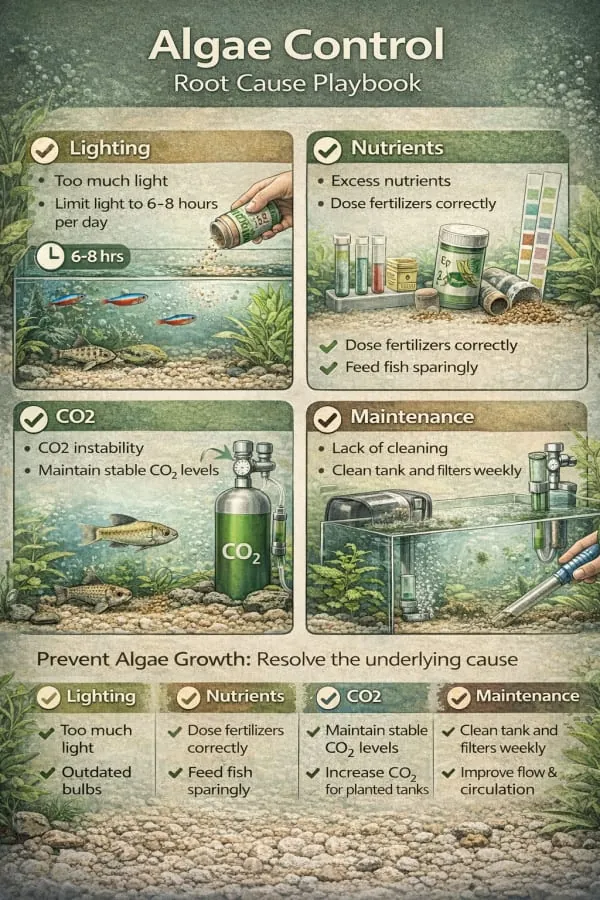
Once the current outbreak is under control, prevention comes down to four variables. Almost every chronically algal tank is out of range on at least one, and usually it is the first.
Light
The biggest single lever and the easiest to overdo, because light is the only input that has no natural ceiling in a home aquarium.
Six to eight hours suits most planted tanks. Running ten or twelve hours so you can see the fish in the evening is one of the most common causes of chronic algae, and if that is your reason, shift the photoperiod later in the day rather than extending it. Intensity matters more than duration once you are above the plants' saturation point, since past that, extra photons are not going into growth at all. A timer is not optional.
The single most reliable predictor of an algal tank is a strong light with no carbon dioxide injection. Plants cannot use light they have no carbon to pair with, and the surplus is what feeds the outbreak. Match one to the other in whichever direction is cheaper for you. The planted lighting guide covers intensity and photoperiod properly.
On the siesta method, meaning a midday break in the photoperiod: keepers report it helps, the usual explanation involving carbon dioxide replenishment during the dark period is shaky for injected tanks, and there is no good controlled evidence either way. Cheap to try, so try it if you like, but fix your light level first.
Carbon
In a high light tank, unstable or insufficient carbon dioxide is the number one algae trigger, black beard especially.
Stability beats magnitude. A tank held at a steady moderate concentration through the whole photoperiod outperforms one that spikes to a high number and crashes daily. Get the gas on one to two hours before lights, off an hour before lights out, and check that distribution actually reaches the far corners of the tank, since a well dialled regulator feeding a dead zone is not helping the plants living in it.
Two practical notes on measurement. A drop checker lags the real concentration by an hour or more, so it tells you about the past. And the pH and KH table for estimating carbon dioxide assumes carbonate is the only thing buffering your water, which is false in any tank with phosphate buffers, tannins from driftwood, or a buffering substrate, so treat its output as a rough guide rather than a number. The carbon dioxide calculator is a better starting point, and the injection guide covers the whole setup.
If you are not injecting, that is completely fine. Keep light modest to match and pick plants that grow without it.
Nutrients
Both extremes cause trouble, and this is the lever people get backwards most often.
Too many nutrients with stalled plants feeds algae. Too few starves the plants and also feeds algae, via green spot from low phosphate and cyanobacteria from zero nitrate. The target is not low, it is matched to what your plants can consume.
For a dosed planted tank, the usual working range is roughly 10 to 20 ppm NO₃ and 1 to 2 ppm PO₄, with potassium and a trace mix alongside. There is a satisfying check on those numbers: 20 ppm nitrate and 2 ppm phosphate works out to about fifteen nitrogen atoms per phosphorus atom, which is essentially the Redfield ratio of 16 to 1 that describes the composition of aquatic biomass generally. That is not a coincidence, and it is a good sanity check when someone tells you to run phosphate at zero.
Be careful reading your own test results. Nitrate test kits measure NO₃, not nitrogen, and the two differ by a factor of about 4.4, which is where a lot of confused dosing comes from. The water test interpretation guide covers what each kit is actually telling you, and the dosing calculator converts a target into grams for your volume.
In a low tech tank with fish, feeding and waste often supply enough nitrogen and phosphorus on their own, and the shortfall is more likely to be potassium or iron. Read the plants rather than the test kit: see plant nutrient deficiencies.
Flow and export
Dead spots breed cyanobacteria, and detritus that sits still rots into the dissolved organics that feed black beard. Aim for gentle, complete circulation with no stagnant corners, not high velocity. Around ten times tank volume per hour in total turnover is a reasonable target for an injected planted tank, less for a low tech one, and the distribution pattern matters more than the number.
Export is the other half. Water changes and manual removal are the only routes by which nutrients actually leave a closed system; everything else just moves them around. Keep up with filter maintenance too, since a clogged filter quietly reduces flow and increases organics at the same time, which is a direct recipe for black beard. Feeding discipline belongs here as well, because uneaten food is both an organic load and an ammonium source: see the feeding guide.
Building resistance in from day one
The most reliable long term defense is a large mass of healthy, fast growing plants, planted heavily on the first day rather than added gradually. A tank planted at 70 percent coverage from the start rarely has a serious algae phase; a tank with six stems and a lot of open substrate almost always does.
Fast growers are what matter early, because they take up nutrients quickly and shade the substrate. Hornwort, Hygrophila, Bacopa, Ludwigia, and Rotala all pull hard in the first month. Floating plants are the strongest early competitors of all, since they have unlimited access to atmospheric carbon dioxide and can outgrow anything submerged: frogbit, salvinia, and duckweed, though duckweed is close to impossible to remove once established, so consider that a commitment.
Slow growers like Java fern, Anubias, and Java moss are excellent plants and poor competitors, so pair them with faster species rather than building a whole tank from them. Choosing aquarium plants matches species to your light and carbon setup, and where to buy aquarium plants covers sourcing healthy specimens, which matters here more than it looks: a melting plant is not competing for anything, it is a nutrient source.
Quarantine or dip incoming plants. Tissue culture plants are the one category that arrives genuinely algae free.
Saltwater and Reef Tanks
The root cause mindset carries straight across. The cast changes.
Green hair algae, usually Derbesia or Cladophora species, is the standard reef nuisance and tracks elevated nutrients, generally from overfeeding, an overwhelmed skimmer, or detritus accumulating in the rockwork. Manual removal, better export, and grazers.
Bryopsis is a siphonous green alga that looks like tiny feathers or ferns and is notably harder to kill than hair algae, partly because a single cell can span the whole structure so fragmentation spreads it. Grazers mostly refuse it. The magnesium method, elevating magnesium to 1600 to 1800 ppm, has a mixed record and appeared to depend on impurities in one specific discontinued product, so do not treat it as a reliable protocol. Fluconazole based treatments have a better track record currently. Emerald crabs will sometimes eat it and sometimes eat your zoanthids instead.
Dinoflagellates are the inverse problem and catch out exactly the people trying hardest. They tend to explode when nutrients bottom out to zero, which is precisely the state ultra low nutrient systems aim for. Brown, snotty, often with visible bubbles trapped in strands, and they typically recede overnight and reappear during the photoperiod. The counterintuitive fix is to feed the tank: bring nitrate up to 5 to 10 ppm and phosphate to around 0.05 to 0.1 ppm, add UV, cut the photoperiod, and stop the aggressive water changes that are stripping what little nutrient is left. Some dinoflagellate species are toxic to fish and invertebrates, so this one deserves prompt action.
Cyanobacteria behave the same as in freshwater, with the same flow and export answers.
The reef cleanup crew is a different set: trochus, astrea, and turbo snails for algae film and hair, cerith snails for the sand bed, nassarius for detritus rather than algae, and a lawnmower blenny or a tang for larger grazing if the display can house one.
Nutrient control through feeding discipline, flow, skimming, and export is the reef equivalent of the plant competition lever, with the important caveat that zero is not the goal. The reef parameters guide and the saltwater hub cover targets for reef systems specifically.
A Two Week Reset
If you want a concrete plan instead of a set of principles, this is the sequence that resolves most freshwater outbreaks. It assumes you have identified the organism from the sections above.
Day 1. Identify the algae. Test nitrate, phosphate, and ammonia and write the numbers down; you need the trend, not the snapshot. Manually remove everything you can reach. Water change of 30 to 50 percent. Clean the filter if it has been more than a month. Cut the photoperiod to six hours on a timer.
Day 2. Correct the one variable the organism points at. Phosphate up for green spot. Nitrate up and flow fixed for cyanobacteria. Carbon stabilized for black beard and staghorn. Light down for hair algae. One variable. If you change four things you will never know which one worked.
Days 3 to 7. Spot treat what remains with peroxide or liquid carbon, working in sections rather than dosing the whole tank at once. Keep aeration up. Add the appropriate grazer if you do not already have one. Do not scrape green dust algae if that is what you have.
Day 7. Water change of 30 to 50 percent. Retest and compare against day one. New growth should have slowed noticeably even if the old growth is still there and still ugly.
Days 8 to 14. Hold everything steady. This is the part people skip. Changing settings again during week two is the single most common reason resets fail, because you never let the correction take effect long enough to read.
Day 14. Assess. New growth stopped means you found the right variable, so hold the new setting for a month before touching anything. New growth continuing means you picked the wrong lever, so go back to the identification and the second most likely cause. Existing algae still present but not spreading is a win, since old growth does not vanish, it gets removed or grazed off.
Doing This With AquaLens
Algae control is a diagnosis problem before it is a treatment problem, and diagnosis is where the app earns its place.
Photograph the outbreak and AquaLens identifies the organism, with honest uncertainty when a tuft genuinely could read two ways, then points you at the cause behind it rather than at a product. That skips the step where you spend a week treating hair algae that turns out to be Cladophora.
Then scan your test kit and every reading logs itself into a trend line. This is what finally makes green spot algae click for people: you look back over a month and see phosphate has been sitting at zero the whole time, which no single test result would ever have told you. Same for the pattern behind bacterial blooms, where the useful information is what happened three days before the water went cloudy, not what the water looks like now. Cause and symptom end up on one screen, in order.
Get AquaLens free and start logging before your next test, so the history is already there when an outbreak starts.
Frequently Asked Questions
Why does my aquarium keep getting algae?
Persistent algae almost always means one variable is out of balance: too much light for the plants you have, unstable or insufficient carbon dioxide, a nutrient extreme in either direction, or dead spots with no flow. The underlying principle is that algae blooms when plants stall, not when nutrients rise, because whatever light and nutrient the plants stop consuming is left available for something else. Scrubbing removes the symptom, so it returns. Identify the organism, match it to its trigger, and correct that single variable.
What is the difference between a bacterial bloom and green water?
Colour and cause. A bacterial bloom is milky white or light grey, appears within one to three days of a pulse of organic waste such as overfeeding or a dead fish, and clears on its own in three to ten days. Green water is free floating algae, so it is green, it deepens over a week or more, and it will not clear by itself. A three day blackout kills green water and does nothing at all to a bacterial bloom, which is a quick way to confirm which one you have.
Is a bacterial bloom dangerous to my fish?
The cloudiness itself is harmless. The risk is oxygen, because a dense bacterial population has a large oxygen demand and produces none in return, and the low point comes in the early hours before dawn. In a lightly stocked tank with good surface movement a bloom is a nuisance you wait out. In a crowded tank with a still surface it can pull dissolved oxygen low enough to kill. Increase aeration first, before anything else, and treat fish gasping at the surface at dawn as urgent.
Should I do a water change during a bacterial bloom?
It helps a little and it will not clear the water. Water changes export the dissolved organic carbon feeding the bloom, so a change of about 25 to 30 percent may shorten it, but the remaining bacteria simply reproduce back into the space you made. The steps that matter more are increasing aeration, cutting feeding for a few days, and finding the source such as a dead fish or a disturbed layer of detritus. Avoid clarifiers, avoid adding more bottled bacteria, and do not strip the filter down.
How do I get rid of black beard algae?
Black beard algae is a freshwater red alga driven by carbon dioxide that swings during the day and by a high load of dissolved organic waste, so start by stabilising carbon dioxide, cleaning the filter, and raising water change volume. For existing tufts, switch off all pumps and apply 3 percent hydrogen peroxide or liquid carbon directly onto them with a syringe, wait five to ten minutes, then restore flow. Treated tufts turn red or pink within a day, then bleach white and die. Siamese algae eaters are the only common fish that reliably eat it.
Is brown algae in a new tank normal?
Yes. Brown algae is diatoms, single celled organisms that build silica shells, so they thrive while a new tank still has plenty of available silicate from fresh substrate or tap water, an immature biofilter, and no competition. Nearly every tank goes through a brown dusty phase in its first one to two months and it fades on its own. Otocinclus catfish graze it well, but only add them once the tank is two to three months old and has established biofilm, because they starve otherwise.
Will more nutrients cause more algae?
Not by themselves. A planted tank can run 30 ppm nitrate and 3 ppm phosphate and stay spotless as long as the plants are growing hard, because growth is capped by whichever resource runs out first rather than by the total supply. Several nuisance organisms actually appear when nutrients are too low: green spot algae tracks low phosphate and cyanobacteria colonises tanks sitting at zero nitrate. The goal is nutrients matched to what your plants can consume, not starvation.
Is blue-green slime algae dangerous and how do I remove it?
Blue green slime is cyanobacteria, which are bacteria rather than algae, and some freshwater species produce toxins including microcystins, so it is worth removing rather than tolerating even though most keepers see no fish losses. It colonises dead spots with very low nitrate, so the real fix is circulation, with no corner of the tank left still. Siphon the sheets out, raise nitrate if it is reading zero, and use a three day blackout if it has overrun the tank. Erythromycin kills it outright but also damages your biofilter, so keep it as a last resort and test ammonia daily afterwards.
How does a blackout kill algae without killing my plants?
Plants store energy as starch and can coast through several days of complete darkness, while free floating algae and cyanobacteria hold almost no reserves and starve. Remove as much algae as you can by hand first so the die off is smaller, turn carbon dioxide off and aeration up, then cover the tank so no light enters for three full days. Uncover on day four and do a water change of about 50 percent to export the decaying material and any ammonia it released. It is an emergency reset that treats the symptom, so the underlying cause still needs fixing.
Diagnose It, Don't Just Scrub It
AquaLens photo-identifies the algae, auto-logs your test readings, and charts the nutrient and carbon dioxide trends behind an outbreak, so you can see the cause instead of guessing at it. Fix the imbalance once and the algae stays gone.
Keep reading
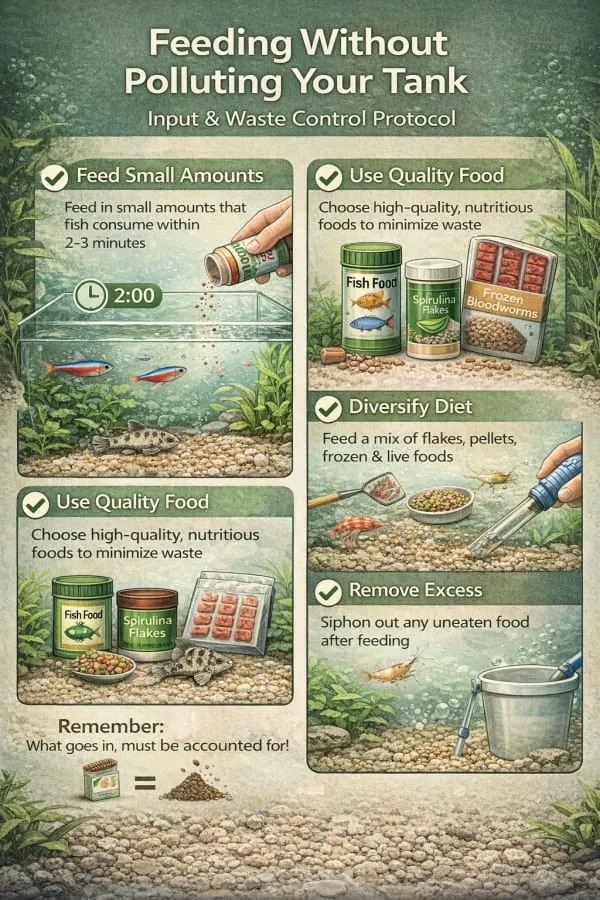
How much and how often to feed aquarium fish, why overfeeding causes cloudy water, algae, and ammonia spikes, and how to stop meals becoming pollution.
Diagnose aquarium plant deficiencies by leaf age and symptom: yellowing, pinholes, twisting, and stunting. Read the pattern, then fix it safely.
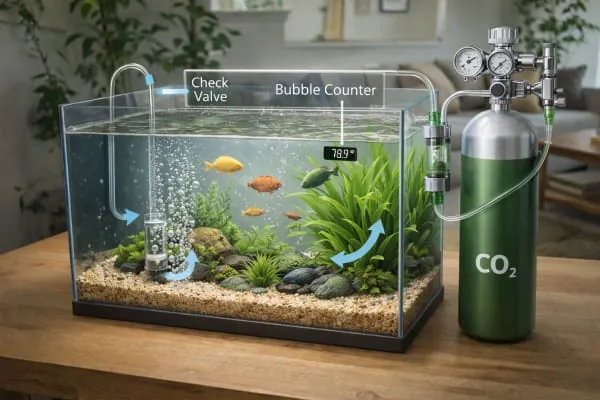
Aquarium CO₂ injection made safe: how carbon, light, and nutrients balance, which system to buy, and how to dial it in without gassing your fish.