
Start Here: Your First Aquarium
A beginner's guide to your first aquarium: what to buy, how to cycle before any fish arrive, which numbers to watch, and the weekly routine.
On this page
The short version: buy a slightly bigger tank than you think you need, cycle it before any fish arrive, test the water weekly, stock slowly, and feed less than you want to. Everything else is detail.
This page is the beginner path: the whole first-tank journey in reading order, with a deeper guide linked at every step. Follow it top to bottom and you will skip the mistakes that end most first aquariums within a few months. None of it is hard. The only real skill a new fishkeeper needs is patience, and you only need it twice: once while the tank cycles, and once while you stock it. If you want the mindset behind everything below in one sitting, Aquarium Basics: You Keep Water, Not Fish is the companion read.
Buy the right things first
Counter-intuitively, a bigger tank is easier to keep, not harder. More water means mistakes dilute instead of spiking: a pinch of overfeeding that would poison a 5-gallon tank barely registers in a 29. Temperature and chemistry also drift more slowly in a larger volume, which buys you time to notice a problem and fix it before anything gets hurt. If you can, start at 20 gallons (about 75 litres) or larger. Tiny tanks are the expert-mode option, not the beginner one; experienced keepers run them successfully only because they already know how fast a small volume goes wrong. If you are not sure what a tank actually holds, the tank volume calculator converts dimensions to gallons and litres in seconds.
Your core shopping list is short:
- The tank and a real stand. Water weighs a little over 8 pounds per gallon, so a filled 20-gallon setup with glass and substrate comes in well over 200 pounds. Furniture that merely looks sturdy is the classic failure here. Use a purpose-built stand, or something you would trust to hold a person.
- A filter. Its real job is not catching debris. It is housing the beneficial bacteria that keep the water safe, and those bacteria live on the media inside it. Pick one rated at or above your tank size, and read Choose the Right Filter and Flow before you buy, because the media inside matters more than the brand on the box.
- A heater and a separate thermometer. Most tropical fish want stable warmth somewhere in the 74 to 80 °F range, and stability matters more than any exact number. The heater size calculator matches wattage to your tank and room. The separate thermometer is there because heaters eventually fail, and you want to find out before your fish do.
- A liquid test kit that reads ammonia, nitrite, nitrate, and pH. This is the purchase beginners most often skip and most often regret. You will use it every week for the life of the tank, and every day or two while it cycles.
- Dechlorinator. Tap water is treated with chlorine or chloramine, which burn fish gills and kill the beneficial bacteria you are about to spend weeks growing. Every drop of new water gets treated, every time, forever.
Add substrate, some hardscape, and ideally a few live plants. Hardy species like Anubias, Java fern, and cryptocorynes actively consume the waste compounds you are trying to control, and they make a tank harder to destabilise, not easier. The Ultimate Guide to Choosing Aquarium Plants matches species to your light and budget, and Where to Buy Aquarium Plants covers getting healthy ones.
Notice what is not on the list: fish. They come weeks from now, and that wait is the difference between a tank that works and one that quietly fails.
For saltwater keepers: this path is written for freshwater, which is the right first tank for most people. Marine tanks change the equipment list, the cycling process, and the budget. If reef is the goal, start with Saltwater Aquarium Setup and the saltwater hub instead.
Set up and cycle, with no fish in the tank
Rinse everything in plain water (never soap, which leaves residues that are toxic to fish), add your substrate and decor, fill the tank, dose dechlorinator, and get the filter and heater running. The water may turn cloudy for a day or two. That is a harmless bacterial bloom, and it clears on its own.
Then comes the step most new keepers skip, and the single most important idea in fishkeeping: the nitrogen cycle. Fish constantly excrete ammonia (NH₃), which is toxic at surprisingly low concentrations. In an established aquarium, one group of bacteria converts ammonia into nitrite (NO₂⁻), which is also toxic, and a second group converts nitrite into far-less-harmful nitrate (NO₃⁻). Those bacteria live mostly on your filter media, and growing a colony big enough to process a tank full of fish takes several weeks. There is no product that truly skips this; bottled starters can shorten it, but the colony still has to prove itself against real ammonia before any fish depend on it.
Doing this before fish arrive is called a fishless cycle: you add a measured ammonia source to the empty tank and feed the growing colony until it can clear a full dose of ammonia and nitrite within about a day. No animal ever has to live in toxic water while you wait. The alternative, adding fish on day one, is why "new tank syndrome" kills so many first fish in weeks two and three, right after everything looked fine. Cycle Your Tank Safely walks the whole process step by step, and the cycle calculator handles the dosing math. If you read only one other guide on this site, make it that one.
This stage is also where AquaLens starts earning its keep: its cycle tracker reads each test photo, logs the result, and tells you which phase your cycle is in and what to do next, which turns a confusing month of numbers into a checklist.
Learn what the numbers mean
You do not need a chemistry degree. You need four numbers, and a sense of what each one is telling you:
- Ammonia, target 0. Any detectable ammonia in a cycled, stocked tank means the bacterial colony has fallen behind its workload. Ammonia's true toxicity also rises with pH and temperature, which is why the same reading can be an emergency in one tank and merely urgent in another.
- Nitrite, target 0. Nitrite binds to fish blood and stops it carrying oxygen, so poisoned fish effectively suffocate in oxygen-rich water. Fish gasping at the surface while ammonia reads zero is a classic nitrite signature.
- Nitrate, keep it low and watch the trend. Nitrate is the end product that slowly accumulates. Under 40 ppm is a common rule of thumb, and many keepers aim for 20 or less. Your weekly water change is, above all, a nitrate-export mechanism.
- pH, stability beats perfection. A steady pH your fish are used to is far better than chasing an "ideal" number with chemicals, which usually produces exactly the swings that stress fish. Behind pH sits KH, your water's buffering capacity: when KH runs out, pH can crash suddenly, which is why experienced keepers test KH too.
Water Chemistry Basics explains what is actually happening in the water, and Water Tests Made Easy turns results into decisions, including how to tell a real trend from ordinary test noise. Logging matters as much as testing: one reading is a snapshot, but a series tells you where the tank is heading. AquaLens reads test strips and liquid-kit vials straight through your phone camera, so every result lands in your tank's logbook and trend charts automatically instead of on a sticky note you will lose.
Choose fish that actually fit
Pick fish for the tank you have, not the one you wish you had. Before any fish goes in the cart, check three things: its adult size, its temperament, and its group needs. Plenty of common shop fish fail at least one. A tiny common pleco grows past a foot long, "it will only grow to the size of the tank" is a myth (stunted fish are sick fish, not small ones), and schooling species kept in groups that are too small become stressed, timid, or nippy. Every species deserves a quick check in the species library, which has care guides for over 1,700 fish, plants, and invertebrates.
Then stock slowly, and here is the why: your bacterial colony is sized to the waste your tank currently produces. Double the fish overnight and ammonia production doubles instantly, while the colony needs days to catch up. So add a few fish, wait a week or two while testing, and only add more once ammonia and nitrite are holding at zero.
Stocking Guide: Choose Compatible Fish covers building a community that works, the stocking planner and schooling calculator sanity-check your numbers, and the Build My Tank wizard turns your actual tank size into a full compatible plan before you spend anything. When the bag finally comes home, the acclimation guide covers the float-and-drip routine that keeps day one calm.
Feed lightly
Overfeeding is the most common avoidable beginner mistake, and it rarely looks like overfeeding. It looks like fish "begging", and fish are shameless opportunists that beg whether they are hungry or not. A fish's stomach is roughly the size of its eye. Feed once or twice a day, only as much as your fish finish within a couple of minutes, and remove anything left over, because uneaten food breaks down into the same ammonia you spent weeks learning to eliminate, plus phosphate that feeds algae.
A skipped day now and then does healthy adult fish no harm; many experienced keepers deliberately fast their fish one day a week to aid digestion. Feeding Without Polluting Your Tank goes deeper on portioning, food variety, and feeding bottom-dwellers so everyone actually eats. If consistency is your weak spot, or the tank is shared with family members who each "just feed them a little", AquaLens feeding reminders put the schedule on one phone and log every feed so nobody doubles up.
Settle into a weekly routine
A stable tank runs on a boring, repeatable rhythm:
- Test the water once a week and record the results. The record is the point: trends catch problems while they are still cheap to fix.
- Do a partial water change, around a quarter of the volume, with dechlorinated, temperature-matched water. This exports nitrate, tops up the KH minerals that hold pH stable, and removes the dissolved organics no filter can. The water change calculator tells you exactly how much to change to hit a target nitrate.
- Rinse filter media, when flow drops, in the tank water you removed. Never under the tap: chlorinated water kills the bacterial colony that is doing all the real work.
- Watch your fish at feeding time. Appetite and behaviour changes are your earliest warning sign, usually days ahead of anything visible on the body.
New Tank Plan: First 90 Days lays this rhythm out week by week for the whole stabilisation window, including what is normal to see (a diatom phase, a little melt on new plants) and what is not.
When something goes wrong
At some point a fish will look off, or a test will read high. Do not reach for a bottle of medicine first. Most problems trace back to water quality, so the correct first move is almost always: test the water, and then do a partial water change, which is the safest response to nearly any bad reading. Medicating a tank with bad water treats the symptom while the cause keeps working.
Emergency Help: First 60 Minutes gives you a calm, ordered checklist for exactly what to do and in what order, and the help page is there if you get stuck. Bookmark the emergency guide now, while nothing is wrong.
Doing This With AquaLens
A first tank asks for patience in exactly two places, the cycle and the slow stocking that follows, and both go better with a record than a memory. AquaLens's cycle tracker reads each test photo, calls which phase your fishless cycle is in, and tells you when it is safe to add the first fish, so the confusing weeks come with a checklist. After that, every weekly test you scan auto-logs into a trend chart, which turns "is nitrate creeping up?" into a glance and quietly builds the history a healthy tank runs on.
It is free to start, and core logging needs no account at all. Get AquaLens free and let your first tank keep its own records from day one.
Frequently Asked Questions
What size aquarium is best for a beginner?
A 20 gallon tank, roughly 75 litres, or larger is the easiest starting point. More water dilutes mistakes and keeps temperature and chemistry stable, so problems develop slowly enough for you to catch them. Very small tanks are harder, not easier, and are best left until you have some experience.
How long does it take to cycle a new aquarium?
Most fishless cycles take four to eight weeks, depending on temperature, pH, and whether you seed the tank with bottled bacteria or media from an established filter. The cycle is finished when the tank can clear a full dose of ammonia and nitrite to zero within about 24 hours. Adding fish before that point exposes them to toxic water.
Can I add fish the same day I set up my tank?
No, and this is the most important rule for a new keeper. A brand new tank has none of the beneficial bacteria that convert toxic fish waste into safer compounds, so early fish are slowly poisoned by their own ammonia. Cycle the tank first without fish, which takes a few weeks and costs the fish nothing.
How often should I test my aquarium water?
Test every day or two while the tank is cycling, then once a week for the life of the tank. Track ammonia, nitrite, nitrate, and pH, and record the results so you can see trends over time. In a healthy cycled tank, ammonia and nitrite should always read zero.
How many fish can I add to a new tank at once?
Add just a few small fish at a time, then wait one to two weeks while testing the water before adding more. The bacteria that process fish waste grow to match the current load, so a sudden jump in stocking causes an ammonia spike. Slow stocking lets the colony keep pace.
How often should I feed aquarium fish?
Once or twice a day, and only as much as your fish finish within about two minutes. A fish’s stomach is roughly the size of its eye, and uneaten food decays into ammonia that pollutes the water. Healthy adult fish are also fine with an occasional skipped day.
How much water should I change each week?
About 25 percent of the tank volume weekly is a solid default for most freshwater tanks. Water changes remove nitrate and dissolved organics and replenish the minerals that keep pH stable. Always treat the new water with dechlorinator and match its temperature to the tank.
What should I do first if my fish look sick?
Test the water before you treat anything, because most fish problems trace back to water quality. If ammonia or nitrite read above zero, or nitrate is high, do a partial water change immediately. Only reach for medication once the water is confirmed good and you have identified the actual disease.
Follow the path
- Cycle Your Tank Safely (No Fish Needed)
- Water Chemistry Basics (pH, KH, GH)
- Water Tests Made Easy: What the Numbers Mean
- Stocking Guide: Choose Compatible Fish
- Stocking Planner tool
- Build My Tank wizard
- Feeding Without Polluting Your Tank
- New Tank Plan: First 90 Days
- Emergency Help: First 60 Minutes
- AquaLens App Handbook
Start Your First Tank Right
AquaLens tracks your cycle, reads your test kits by camera, and logs every result to trend charts, so your first aquarium runs on data instead of guesswork.
Keep reading
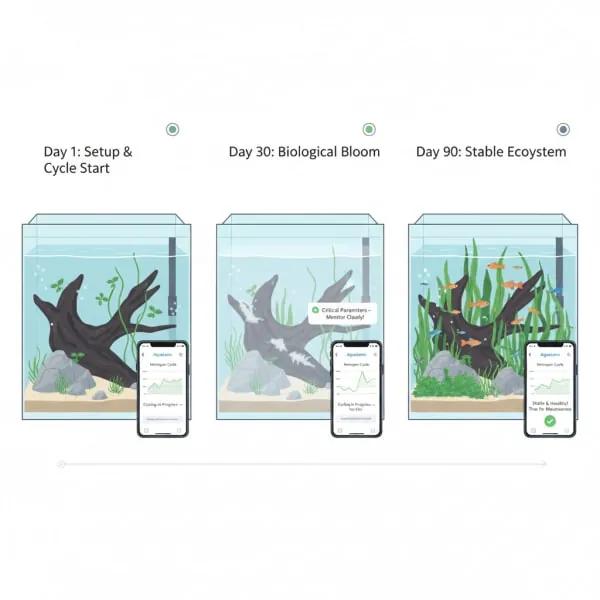
A calm, week-by-week plan for a new aquarium: cycle the filter, stock in waves, and reach a stable tank by day 90 without the beginner crashes.
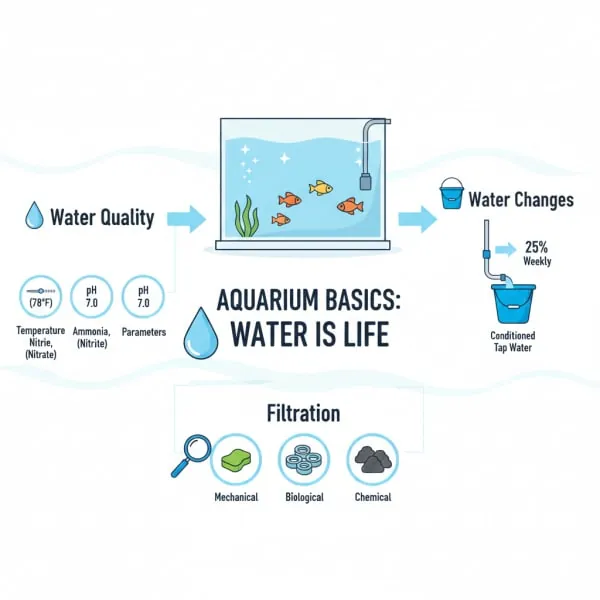
Aquarium basics for beginners: why you keep water not fish, plus tank size, filtration turnover, the nitrogen cycle, and a steady maintenance rhythm.
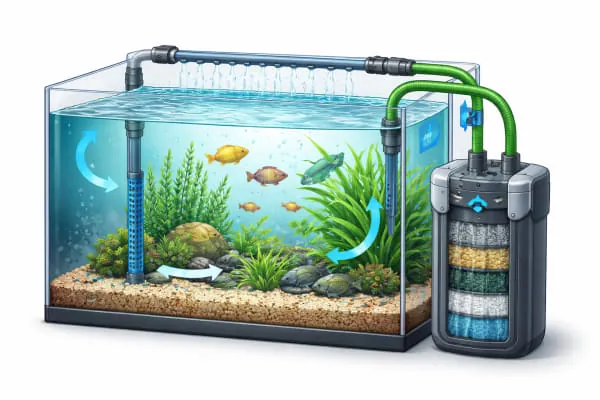
How aquarium filters work, how to pick the right type and flow for your tank, and how to clean the media without crashing your cycle.