
Water Tests Made Easy: What the Numbers Mean
Aquarium water test results explained: read ammonia, nitrite, nitrate, pH, KH, GH, and temperature as one system, and what to do when a number spikes.
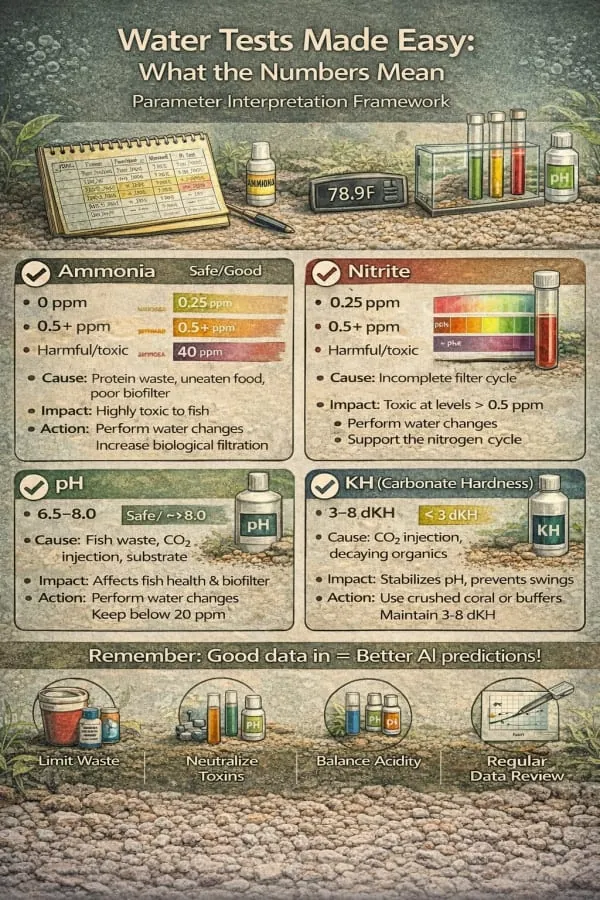
On this page
Anyone can run a test. The hard part, and the part that keeps fish alive, is knowing what a number means once you have it. A pH of 6.8 is either perfectly fine or an early warning, depending entirely on what your KH is doing. Ammonia at 0.25 ppm is a minor concern in one tank and an emergency in another, depending on temperature and pH. The number by itself is only half the story.
This guide teaches you to read your water like a system, not a scorecard. We will go parameter by parameter (what each one is, what is safe, and the nuance that catches people out), then put them back together so you can recognize patterns and choose the safest next action instead of panicking or over-correcting. Freshwater is the main focus, with notes for saltwater and reef keepers where the chemistry diverges.
If your fish are visibly distressed right now, stop reading and go to the emergency first 60 minutes guide and the help center. Come back here once things are stable.
First principle: toxicity, then stability, then optimization
When something is wrong, interpret your panel in a fixed priority order. Chase the thing that kills fastest first, then the thing that destabilizes, then the thing you would merely like to improve.
- Temperature and oxygen behavior. Gasping at the surface or rapid gilling trumps everything. Low oxygen and heat stress kill in hours.
- Ammonia (NH₃). The most acutely toxic waste product in most freshwater tanks.
- Nitrite (NO₂⁻). Suffocates fish from the inside by disabling their blood.
- pH and KH together. A collapsing buffer means a pH crash is coming.
- Nitrate (NO₃⁻). Rarely an acute killer, but a reliable readout of long-term load.
- GH and minerals. A slow-health parameter, important but rarely urgent.
Burn this order into your habits. It stops you from, say, fussing over a slightly high nitrate while your fish are actually suffocating from a spent buffer.
The nitrogen trio: ammonia, nitrite, nitrate
These three are one story told over time. Fish and decay produce ammonia, one colony of bacteria turns ammonia into nitrite, a second colony turns nitrite into nitrate, and you remove nitrate with water changes. That chain is your biofilter, and reading these three together tells you exactly where the chain is healthy and where it is broken. If any of this is new, the fishless cycling guide walks through building that bacterial chain from scratch, and the cycle calculator estimates how far along you are.
Ammonia (NH₃/NH₄⁺)
Ammonia is the first and most urgent toxin. It appears from overfeeding, dead plants or livestock, a sudden jump in stocking, or a biofilter that got disrupted (a filter left off too long, over-rinsed media, a big medication dose).
| Reading | Meaning |
|---|---|
| 0 ppm | Ideal. A cycled tank should sit here nearly always. |
| 0.1 to 0.25 ppm | Caution. Something is producing more than the filter can process. |
| Above 0.25 ppm | Danger. Act today. |
| Above 1.0 ppm | Emergency. Act now. |
The nuance that catches everyone out: your test kit measures total ammonia, but only the un-ionized form (NH₃) is highly toxic, and the fraction that takes the toxic form climbs sharply with higher pH and higher temperature. The same 0.5 ppm total ammonia is far more dangerous at pH 8.2 and 82°F than at pH 6.8 and 76°F. This is why a soft, acidic tank can tolerate a small ammonia blip that would be lethal in a hard, alkaline African cichlid setup. It is also why a common water conditioner that detoxifies ammonia buys you time without changing what the test reads: the ammonia is still there on the strip, just temporarily bound into its safer form.
What to do when ammonia is up: stop feeding for 24 hours, increase surface agitation and aeration, do a measured 30 to 50 percent water change with dechlorinated, temperature-matched water (larger if severe), dose your conditioner as directed, and re-test in one to three hours. Do not tear apart your filter or replace all the media, because that bacteria is the thing fixing the problem.
Nitrite (NO₂⁻)
Nitrite is the mid-cycle toxin. It binds to fish hemoglobin and blocks oxygen transport, which is why the classic sign is a fish gasping even in well-aerated water: the water has oxygen, but the blood cannot carry it. This is often called brown blood disease.
| Reading | Meaning |
|---|---|
| 0 ppm | Ideal. |
| 0.1 to 0.25 ppm | Caution. Your second bacterial colony is lagging. |
| Above 0.25 ppm | Danger. |
Nitrite almost always means one of two things: you are mid-cycle and the nitrite-eating bacteria have not caught up yet, or an established biofilter was disrupted. A useful field trick: a small amount of chloride (from aquarium salt, where livestock tolerate it) competes with nitrite at the gills and reduces its toxicity while the colony recovers. That is a stopgap, not a fix.
What to do: increase aeration, do a 25 to 50 percent water change, cut feeding, confirm your filter is running and the biomedia is intact, and re-test daily until it reads zero.
Nitrate (NO₃⁻)
Nitrate is the end of the line, and the least acutely toxic of the three. In a cycled tank it slowly accumulates between water changes, so it is less a poison alarm and more a fuel gauge for waste and maintenance pressure.
- Typical community tank: aim to keep it under 20 to 40 ppm.
- Sensitive livestock (shrimp, discus, wild-caught fish): aim lower, often under 20 ppm.
- Heavily planted tanks: may deliberately run a managed range because plants consume nitrate as fertilizer.
Chronically high nitrate is the single most common readout of a tank that is overfed, overstocked, or under-maintained, and it is closely tied to persistent algae. If it climbs faster than you can hold it down, the fix is upstream: less food, fewer fish, more plant mass, or cleaning the detritus traps (substrate dead zones, prefilter sponges, hardscape pockets) rather than only doing bigger water changes. The water change calculator tells you exactly what percentage change moves nitrate from your current reading to your target, which beats guessing.
For saltwater and reef keepers: the nitrogen cycle works the same way, but reef tanks often run nitrate deliberately low, and many reefers watch phosphate (PO₄) alongside nitrate as a paired nutrient readout. Bottoming both out to zero can actually starve corals and trigger nuisance algae like dinoflagellates, so reef targets are a managed low band, not zero. See the reef parameters guide.
pH and KH: read them as a pair, never alone
This is the mistake that sinks more tanks than any single wrong number: treating pH as a target to hit instead of a value to keep stable. For the great majority of aquarium fish, a stable pH they are not adapted to is safer than a "perfect" pH that swings. Rapid swings stress the osmotic system and can kill; a steady reading a little off the textbook ideal usually does not.
pH
pH measures how acidic or basic your water is. A small daily rhythm is normal (pH often dips overnight as CO₂ builds up and rises during the day when plants photosynthesize). What you are hunting for is not the number itself but the trend: a slow, one-directional drift downward over days or weeks is the dangerous signal, and it almost always points at KH.
KH (carbonate hardness, the buffer)
KH is your pH shock absorber. It is the reserve of carbonates that neutralizes the acids your tank produces every day from fish waste, nitrification, and CO₂. As long as you have KH, your pH holds steady. When KH runs out, pH does not drift gently, it falls off a cliff, sometimes overnight. This event, a pH crash, is one of the fastest tank-wide killers there is, and it is entirely predictable if you watch KH.
The golden rule: a low and falling KH with a slowly dropping pH is a crash warning. Do not correct it by dumping in pH-up chemicals, which whipsaw the pH and make things worse. Fix the buffer, gradually, with consistent remineralization or a small increase in water-change frequency using harder source water, and the pH stabilizes on its own. The full mechanics live in the water chemistry guide.
GH (general hardness)
GH measures dissolved calcium and magnesium, the minerals fish use for osmoregulation and that shrimp and snails need for shells. It is mostly a long-term health parameter, not an emergency one. Soft-water species (many tetras, wild bettas) stress in very high GH; hard-water species (livebearers, African cichlids, most shrimp) suffer in very low GH. Match it to your livestock and change it gradually, never in a single big swing. GH and KH are independent: you can have one high and the other low, which is exactly why you test both.
Temperature: the multiplier
Temperature is not just a comfort setting, it silently scales two of the dangers above. Warmer water holds less dissolved oxygen while raising fish metabolism (so demand goes up as supply goes down), and it shifts more of your ammonia into the toxic NH₃ form. A tank running a few degrees hot turns a marginal ammonia reading into a dangerous one without the ammonia number changing at all. Keep temperature in the species-appropriate range and, just as importantly, avoid sudden shifts, including during water changes.
Choosing a test kit: strips, liquid, and digital
Good interpretation starts with trustworthy numbers, and not all kits give you the same quality of number.
| Kit type | Strengths | Weaknesses | Best for |
|---|---|---|---|
| Test strips | Fast, cheap, test many parameters at once | Least precise, color pads fade, notoriously sensitive to humidity and expiry | Quick daily screening and trend-watching |
| Liquid reagent kits | Accurate, granular, the hobby standard | Slower, more steps, color-matching is subjective in poor light | Confirming a problem and precise readings |
| Digital testers and photometers | Objective numeric readout, repeatable | Costly, parameter-specific, need calibration | Reef chemistry and anyone who wants numbers, not color guesses |
A practical strategy most experienced keepers land on: screen often and cheaply with strips to catch changes, then confirm anything alarming with a liquid kit or digital tester before you act on it. Two rules regardless of kit: check the expiry date (expired reagents and damp strips read wrong, and a false zero is worse than no test), and follow the timing and shaking instructions exactly, because the nitrate reagent in particular fails silently if the second bottle is not banged and shaken hard enough.
Drift versus noise: the skill that separates keepers
Here is the single most useful interpretive habit: learn to tell a trend from scatter. Every reading has noise. Color-matching, lighting, the exact drop count, the time of day you tested, all of it jiggles the number a little. One nitrate reading of 30 when last week said 20 might be a real climb, or it might be you matching the chart under a warmer light bulb.
The answer is never to trust a single reading and never to react to one data point. You are looking for direction across several tests: three readings that march 20, 25, 30 are a trend worth acting on; readings that bounce 20, 30, 22, 28 around the same center are noise you can ignore. This is exactly why logging matters more than any single test, and why testing at a consistent time of day (especially for pH) removes a huge source of false alarms. The better logging guide makes the case that your tank's history, not any one number, is the real diagnostic tool.
Reading the whole panel: common patterns
Once you have all your numbers, they form recognizable pictures. Here are the ones you will meet most.
Ammonia present, nitrite zero, nitrate slowly rising. Your first bacterial colony is being outrun, often by overfeeding or a recent bioload jump, before conversion catches up. Reduce feed, boost oxygen, do a partial water change, and monitor daily.
Ammonia zero, nitrite present. Classic mid-cycle. Your ammonia eaters are established but the nitrite eaters are lagging. Water change, keep filter flow and media intact, and keep testing. This is the normal, expected middle of a cycle.
Ammonia zero, nitrite zero, nitrate gradually rising. This is a healthy, cycled tank. Nothing is wrong. Set your water-change interval to hold nitrate in your target band and carry on.
pH trending down over days, KH low or falling. Buffer depletion, and a crash risk. Stabilize KH gradually and look at your source water and buffering routine before the pH falls off a cliff. Do not chase it with acid or buffer chemicals.
High nitrate, persistent algae, ammonia normal. Chronic nutrient accumulation. The tank is cycling fine but carrying too much waste. Improve maintenance cadence, review feeding and stocking, and rebalance light and nutrients. The algae control guide treats the cause, not just the symptom.
Fish clearly distressed, but every number looks fine. Trust the fish over the strip. Standard kits do not measure dissolved oxygen, chlorine breakthrough, temperature spikes, or many toxins, and they never detect disease. Increase aeration first, verify temperature, inspect equipment, then look at livestock health. If it points to illness, the fish health and quarantine guide is the next stop (and marine keepers should see the marine quarantine guide, because saltwater diseases like ich and velvet behave differently).
Decide what to do right now
When a reading crosses a line, act in this order and then log what you did so the next test tells you whether it worked.
Ammonia above 0.25 ppm: stop feeding 24 hours, increase aeration, do a 30 to 50 percent temperature-matched dechlorinated water change, dose conditioner, re-test in one to three hours.
Nitrite above 0.25 ppm: increase aeration, 25 to 50 percent water change, cut feeding, confirm filter and media, re-test daily.
Nitrate above target: increase water-change volume or frequency, clean detritus traps, reassess feeding and stocking, and track the weekly trend rather than one reading.
pH unstable: test KH and GH, do not chase pH with fast chemical swings, stabilize buffering gradually, and re-test at the same time each day.
Cloudy water: a quick read
Cloudy water is a visual test in its own right. White haze in a new setup is usually a harmless bacterial bloom that clears on its own. Gray or brown turbidity is suspended detritus or disturbed substrate. Green water is a free-floating algae bloom driven by light and nutrients. In every case, check ammonia and nitrite first (a bloom can accompany a cycle problem), keep aeration up, cut overfeeding, and only do a water change if toxins are actually present.
Doing This With AquaLens
The one skill above that a phone genuinely does better than you is telling drift from noise, and it only works on a clean run of readings taken the same way each time. AquaLens builds that run for you:
- Scan a finished test (strips and liquid vials by camera, digital testers like Hanna checkers by OCR), confirm the value, and it logs to that tank's journal, then lands on one trend chart of pH, ammonia, nitrite, nitrate, KH, GH, PO₄, and the full reef suite, so three scattered nitrate readings resolve into an obvious upward line or a flat wobble you can ignore.
- The nitrogen cycle tracker reads each panel and names the phase, so "ammonia present, nitrite zero" becomes a plain status instead of a puzzle.
Get AquaLens free to start the history that makes trends readable.
The bottom line
A well-managed tank is not one with flawless numbers every single day. It is one where dangerous values get caught early, corrections are measured instead of panicked, and the trends get steadier month over month. Interpret toxicity first, stability second, optimization third; read the panel as one system; trust trends over single readings; and never chase a number in isolation. Do that and the water stops being a mystery and starts being a story you can read.
Frequently Asked Questions
What is a safe ammonia level in a fish tank?
In a cycled, healthy aquarium ammonia should read 0 ppm nearly all the time. Anything from 0.1 to 0.25 ppm is a caution sign that waste is outrunning your filter, and above 0.25 ppm calls for action the same day. Ammonia is also more toxic at higher pH and temperature, so the same reading is more dangerous in a warm, hard, alkaline tank than a cool, soft one.
Why is my pH crashing overnight?
A sudden pH drop almost always means your KH, the carbonate buffer that neutralizes daily acids, has run out. As long as KH is present, pH holds steady; when KH is depleted, pH can fall off a cliff overnight. The fix is to rebuild the buffer gradually with remineralization or harder source water, not to dump in pH-up chemicals, which only cause more swings.
What is the difference between KH and GH?
KH is carbonate hardness, the buffer that keeps your pH stable, while GH is general hardness, the dissolved calcium and magnesium fish and invertebrates need for health. They are independent, so a tank can be high in one and low in the other. That is why you should always test both rather than assuming one number tells you about the other.
Are test strips or liquid test kits more accurate?
Liquid reagent kits are more accurate and granular than strips, which are fast and cheap but less precise and very sensitive to humidity and expiry. A good strategy is to screen often with strips to catch changes, then confirm anything alarming with a liquid kit or a digital tester before you act. Always check the expiry date, because degraded reagents can give a false zero.
How often should I test my aquarium water?
During a cycle or after a problem, test daily until things stabilize. An established, healthy tank usually needs only a weekly full panel of ammonia, nitrite, nitrate, pH, KH, GH, and temperature, plus extra tests after any big change like new stock, filtration changes, or dosing. Testing at a consistent time of day, especially for pH, removes a major source of false alarms.
My fish look sick but the water tests are fine. What is wrong?
Standard test kits do not measure dissolved oxygen, chlorine breakthrough, temperature spikes, or disease, so fish can suffer while every number reads normal. Trust the fish over the strip: increase aeration first, verify the temperature, and inspect your equipment. If the water genuinely checks out, look at livestock health and consider quarantine and disease, which no water test detects.
What should nitrate be in an aquarium?
For a typical community tank, aim to keep nitrate under 20 to 40 ppm, and lower, often under 20 ppm, for sensitive species like shrimp or discus. Heavily planted tanks may deliberately run a managed range because plants use nitrate as fertilizer. Chronically high nitrate usually means overfeeding, overstocking, or under-maintenance rather than a cycling problem.
How do I tell a real trend from normal test noise?
Every reading carries noise from color-matching, lighting, and timing, so never react to a single data point. Look for direction across several tests: readings that march steadily in one direction are a real trend worth acting on, while readings that bounce around the same center are just noise. Logging your results and testing at a consistent time of day makes the difference obvious.
Is a slightly off pH bad for fish?
For most aquarium fish, a stable pH they are not perfectly adapted to is far safer than a textbook-ideal pH that swings. Rapid swings stress fish and can kill, while a steady reading a little off the ideal usually does not. Focus on stability and watch the trend rather than trying to hit an exact number, and always read pH alongside KH.
Can AquaLens read my test kit results automatically?
Yes. AquaLens scans test strips and liquid-kit vials with your phone camera and reads digital testers like Hanna checkers by OCR, then lets you review the reading before it auto-logs it to that tank. Every reading feeds chemistry trend charts over 7 days to a year, and Pro predictive alerts can warn you when a parameter is trending toward trouble before it crosses a line.
Stop Guessing at Your Test Results
Scan any test strip, liquid kit, or digital tester with your phone and AquaLens reads it, auto-logs it, and charts the trend, so drift toward danger shows up long before it becomes an emergency. Free to start, no account needed.
Keep reading
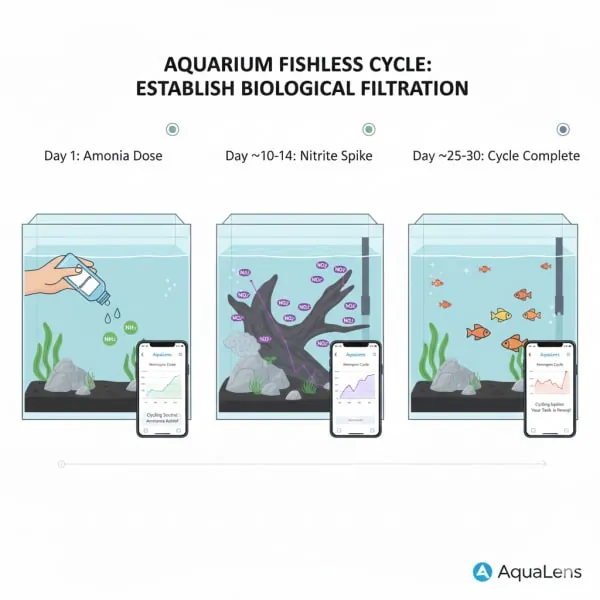
The chemistry under aquarium cycling: why pH decides how toxic your ammonia reading is, and why nitrification quietly consumes your carbonate hardness.
A step-by-step fishless cycle: dose ammonia, read the two spikes, and prove your filter is ready before a single fish goes in.
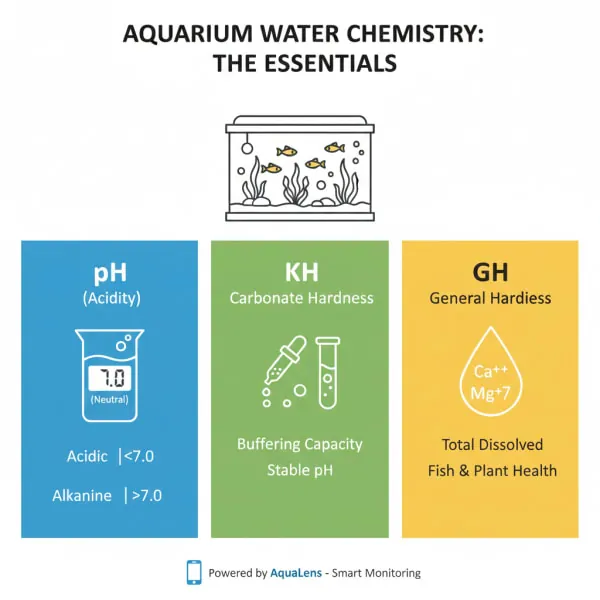
Aquarium water chemistry made simple: what pH, KH, and GH do, why stability beats chasing numbers, and how to keep them steady between water changes.