
Cycle Your Tank Safely (No Fish Needed)
A step-by-step fishless cycle: dose ammonia, read the two spikes, and prove your filter is ready before a single fish goes in.
On this page
A new aquarium is not ready for fish the day you fill it, even if the water is crystal clear and the heater is glowing. What is missing is invisible: a living colony of bacteria that turns the toxic waste fish produce into something far less harmful. Growing that colony before you add any animals is called a fishless cycle, and it is the single kindest, most reliable way to start a tank.
The payoff is simple. When your cycle is finished, you can add fish and the water stays safe. Skip it, and you are running what old-timers call a fish-in cycle, where your first fish become the ammonia source and often pay for it with burned gills, stress, and disease. Fishless cycling takes patience, usually three to six weeks, but it asks nothing of a living creature. This guide walks you through every step, explains what is actually happening in the water, and shows you how to know, with proof, that you are done.
What "Cycling" Actually Means
Fish constantly excrete ammonia (NH₃) through their gills and waste. Uneaten food and decaying plant matter release it too. Ammonia is acutely toxic: even a small amount damages gill tissue and can kill within days. In a mature aquarium you never see it, because two groups of bacteria eat it as fast as it appears.
The conversion runs in two stages:
- Ammonia-oxidizing bacteria (often Nitrosomonas) convert ammonia (NH₃) into nitrite (NO₂⁻).
- Nitrite-oxidizing bacteria (often Nitrospira) convert nitrite (NO₂⁻) into nitrate (NO₃⁻).
Nitrite is also highly toxic to fish. Nitrate, the end product, is far safer and is removed by ordinary water changes and taken up by live plants. So the whole job of cycling is to grow enough of both bacteria groups that the chain runs to completion, quickly, with nothing toxic left in between:
Ammonia (NH₃) → Nitrite (NO₂⁻) → Nitrate (NO₃⁻)
These bacteria are not free-floating. They colonize surfaces, above all your filter media, along with substrate, rock, and decor. That is why the filter, not the water, is the true heart of a cycled tank. If you understand only one thing, understand this: you are not cleaning the water, you are farming bacteria on your filter. For the wider picture of how these bacteria fit into aquarium water quality, see the water chemistry guide.
AquaLens's nitrogen cycle tracker is built around exactly this chain: it reads your daily tests, tells you which phase you are in, and estimates how far you have to go.
Why Fishless, Not Fish-In
For decades, the standard advice was to add a few "hardy" fish and let their waste feed the bacteria. It works in the narrow sense that a colony does grow. But during the weeks it takes, those fish swim in measurable ammonia and nitrite. The damage is real even when it is not immediately fatal: chronic gill irritation, weakened immunity, and a much higher chance of disease outbreaks in the first months.
Fishless cycling removes the animal from the equation entirely. You supply the ammonia yourself, from a bottle, and let the bacteria bloom to full strength against a load you control. When you finally add fish, the filter is already capable of neutralizing their waste on day one. It is more humane, and it is genuinely easier, because you are never scrambling to rescue a fish mid-cycle with emergency water changes.
There is one situation where fish-in cycling is the responsible choice: you already have fish (a rehomed tank, an emergency move) and cannot wait. If that is you, this is not your guide yet. Prioritize daily testing, heavy dechlorinator dosing, and frequent partial water changes to keep ammonia and nitrite near zero, and read the emergency guide if a fish is in acute distress.
What You Need Before You Start
Gather these first. Missing one mid-cycle is the most common reason people stall out.
- A liquid test kit for ammonia, nitrite, and nitrate. This is non-negotiable. A fishless cycle is a measurement exercise, and cheap paper test strips are frequently too imprecise to trust for the fine readings you will need, especially at the low end. A liquid master kit costs more up front and pays for itself immediately. AquaLens scans the color of a liquid test tube (or a strip, or a digital tester's screen) with your camera and logs the reading automatically, which removes the guesswork of matching colors by eye under bad lighting.
- A pure ammonia source. The two good options are ammonium chloride (NH₄Cl) drops, sold specifically for cycling, or a small amount of plain high-protein fish food left to rot. Ammonium chloride is far more precise and does not foul the water, so it is the recommended choice. If you buy household ammonia, it must be pure ammonia with no surfactants, perfumes, or colorants; anything labeled "sudsy" or scented will poison the tank.
- A heater. Nitrifying bacteria reproduce fastest in warm water. Even if your future fish prefer cooler water, run the tank warm during the cycle to speed things up.
- A dechlorinator (water conditioner). Tap water chlorine and chloramine kill the very bacteria you are trying to grow. Treat every drop of water that goes in.
- Your filter, running the whole time. The bacteria need oxygen and flow. A filter that is off is a bacteria colony suffocating.
Optional but helpful: a bottled nitrifying bacteria starter, and a handful of media, gravel, or a filter sponge squeezed from an established, healthy tank. A genuine "seed" of live bacteria from a friend's mature filter is the single biggest accelerator available and can cut weeks off the process.
The Fishless Cycle, Step by Step
Step 1: Set up and stabilize (Day 1)
Fill the tank with dechlorinated water and turn on everything: filter, heater, and an air stone or good surface agitation for oxygen. Set the heater to about 82°F (28°C). Warmer water holds less oxygen but drives bacterial division much faster, and the tradeoff is worth it during cycling as long as you keep the surface moving. Let the system run for 24 hours so the temperature settles and the dechlorinator neutralizes any chlorine.
If you are planting the tank, this is a fine time to add plants. Live plants absorb ammonia directly and carry their own beneficial bacteria, which can smooth out the spikes. A heavily planted tank sometimes cycles so gently you barely see the classic curves. See the planted tank guide for setup, and note that plants complement the cycle rather than replacing it.
Step 2: Add ammonia to your target
Dose your ammonia source until an ammonia test reads between 2 and 4 ppm. Start conservatively; it is easy to add more and impossible to remove. With ammonium chloride, add a few drops, wait an hour for it to mix, then test and adjust. Write down exactly how much product it took to hit your target, because you will re-dose to the same level many times and knowing your "dose" saves testing every time.
Why 2 to 4 ppm and not more? You want a load that reflects a real stocked tank, enough to grow a robust colony, but not so much that ammonia or the nitrite it becomes climbs to levels that actually poison your bacteria and stall the cycle. More is not better here.
The cycle calculator helps you translate a target ppm into a starting dose for your tank volume, and if you are unsure of your volume, the tank volume calculator gets you an accurate number from your dimensions.
Step 3: Test daily and log everything
From here on, cycling is a daily habit: test ammonia, nitrite, and nitrate, note the pH and temperature, and record it. This is where the whole thing lives or dies, because the pattern of numbers over days, not any single reading, tells you where you are.
Logging by hand in a notebook works. But the trend is what matters, and reading a trend off scattered notes is hard. This is the exact job AquaLens was built for: scan each test, and every reading auto-logs into that tank's journal with a timestamp, then the chemistry charts draw your ammonia, nitrite, and nitrate curves over time so the two spikes and their crossover are obvious at a glance. If you want the deeper argument for why this history is worth keeping, the logging guide makes the case. For help reading what each number means, the water test interpretation guide goes parameter by parameter.
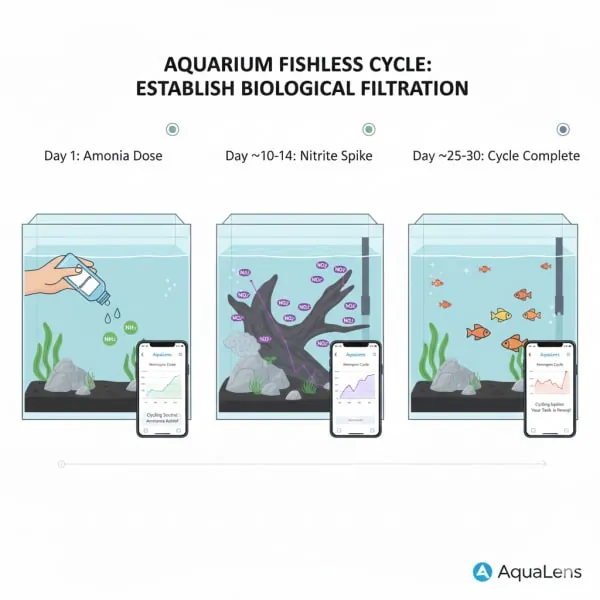
Step 4: The lag phase (roughly days 1 to 10)
For the first week or so it will look like nothing is happening. Ammonia stays high, nitrite reads zero, and it is tempting to think you did something wrong. You did not. This is the lag phase, when the first bacteria are colonizing your filter and beginning to multiply. Bacterial populations double on a schedule, so early growth is invisibly small before it becomes visibly fast.
Your only job now: keep ammonia in the 2 to 4 ppm band. If it drops, that is your first sign of life, so re-dose back up to target. If it holds steady, do nothing but wait and test.
Step 5: The nitrite spike (roughly days 10 to 25)
One day your ammonia will start falling on its own, and at the same time nitrite (NO₂⁻) will appear and then climb, often shooting off the top of the test chart into deep purple. This is the milestone that means your first bacteria group is established and working. It also means the second group, the nitrite eaters, has just gotten its food source and is beginning to grow.
Keep feeding the first colony: continue dosing ammonia to keep a supply coming, but you can ease to a slightly lower target (around 1 to 2 ppm) to avoid pushing nitrite dangerously high. If nitrite pins off the chart for a long stretch, a partial water change to bring it back into a readable range is worthwhile, because extremely high nitrite can actually inhibit the very bacteria trying to consume it and stall your progress. The water change calculator sizes the change for you.
This phase tests your patience most. Nitrite-oxidizing bacteria grow noticeably slower than the ammonia eaters, so nitrite can stay high for a week or two with no apparent movement. Hold the line. It breaks suddenly.
Step 6: Nitrite crashes, nitrate appears (roughly days 25 to 40)
Then, often almost overnight, nitrite plummets to zero and nitrate (NO₃⁻) shows up as a clear reading, frequently high (40 to 80+ ppm). That is the full chain running to completion. Both bacteria groups are now present in force: ammonia becomes nitrite becomes nitrate, with nothing toxic lingering in between.
You are close, but not quite finished. One clean day is promising; you want proof the colony can handle a full load reliably.
Step 7: The 24-hour proof test (your final exam)
This is how you know, rather than hope, that the tank is ready.
- Dose ammonia back up to 2 ppm.
- Wait 24 hours. Do not test in between.
- Test ammonia and nitrite.
You pass if, after 24 hours:
| Parameter | Target | Meaning |
|---|---|---|
| Ammonia (NH₃) | 0 ppm | First colony clears a full dose in a day |
| Nitrite (NO₂⁻) | 0 ppm | Second colony keeps pace, no toxic intermediate left |
| Nitrate (NO₃⁻) | above 0 ppm | The chain completed |
If your tank processes 2 ppm of ammonia into pure nitrate within 24 hours, with zero nitrite left behind, your biofilter is fully operational and sized for a normally stocked tank. If ammonia or nitrite still linger, the colony needs a few more days. Keep dosing and re-test.
Step 8: The big water change, then stock slowly
A finished cycle usually leaves nitrate very high from weeks of accumulation. Before adding fish, do a large water change, commonly 50 to 80 percent, to bring nitrate down to a safe level (under about 20 to 40 ppm for most freshwater fish). Match temperature and dechlorinate the new water.
Then add fish gradually, not all at once. Your bacteria colony sized itself to the ammonia you were dosing, and it adjusts its population to match the actual load over a few days. Dumping a full stock list in at once can briefly outpace the colony and cause a small "mini-cycle." Add a few fish, wait a week or two while you keep testing, then add more. Your acclimation guide covers getting each new fish safely into the water, and the stocking compatibility guide plus the stocking calculator help you avoid overloading the tank you just worked so hard to prepare.
How Long Does It Take, Really?
A typical fishless cycle runs three to six weeks. Several things move that number:
- Temperature. Warm water (78 to 82°F) is faster; cold water can double the time.
- A bacteria seed. Used media or gravel from a healthy established tank is the biggest accelerator; it can shorten a cycle to a week or less. Bottled starter cultures help but vary in quality.
- pH. Nitrifying bacteria struggle in acidic water. Below about pH 6.5 the cycle slows; below 6.0 it can nearly stop. If your cycle stalls with high ammonia and no nitrite for a long time, check pH.
- Oxygen and surface agitation. These are aerobic bacteria. More dissolved oxygen means faster growth.
- Chasing the numbers. Overdosing ammonia, letting nitrite pin off the chart, or forgetting to dechlorinate all set you back. Steady beats aggressive.
Resist the urge to declare victory early. A single zero reading is not a cycle; the 24-hour proof test is.
For Saltwater and Reef Keepers
The biology is the same: you are growing the same kinds of nitrifying bacteria to run ammonia to nitrite to nitrate. The differences are practical. Marine bacteria live largely on and in live rock or dry rock and the sand bed rather than mostly in a filter, so a reef cycle is often driven by rock rather than a canister. Ammonia sources and target ranges are similar, and the 24-hour proof test logic still applies. Marine tanks then layer on parameters freshwater keepers never touch, such as alkalinity, calcium, and magnesium. Start with the dedicated saltwater cycling guide and, once you are stocking corals, the reef parameters guide. AquaLens tracks the full reef chemistry suite alongside the nitrogen cycle.
Doing This With AquaLens
A fishless cycle is one long measurement exercise, and the pattern only makes sense when you can see it drawn out. Two features carry that weight:
- The two-spike chart. Scan each test and your ammonia, nitrite, and nitrate readings auto-log to the tank's journal, then plot as chemistry curves. The ammonia spike, the nitrite spike, and the crossover where nitrite finally crashes to zero are obvious on a chart and nearly invisible in scattered notes.
- The cycle tracker. It reads those same readings, tells you which phase you are in, and estimates how much longer you have, for both fishless and fish-in cycles, so the 24-hour proof test is the only thing left to confirm.
When cycling is done, that journal becomes the tank's running history, which is what makes the first 90 days go smoothly. Get AquaLens free and start logging from your very first ammonia dose.
A Few Common Snags
- "Ammonia won't drop after weeks." Check pH (acidic water stalls bacteria), confirm your heater is on and the water is warm, and make sure your dechlorinator is not chlorine-based in a way that keeps sterilizing the tank. Verify your test kit is not expired.
- "Nitrite has been off the chart forever." Normal for this phase, but do a partial water change to pull it into a readable range, because very high nitrite inhibits the bacteria you need.
- "I added fish and ammonia came back." A mini-cycle from adding stock too fast. Test daily, do small water changes to keep ammonia and nitrite near zero, and stop adding fish until it clears.
- "Can I speed this up?" Real used media from a healthy tank is the only dramatic shortcut. Everything else (heat, oxygen, patience) helps at the margins.
Good fish for a first stocking after a solid cycle include hardy, forgiving schoolers like the zebra danio or white cloud mountain minnow; browse the full species library or plan a whole build with Build My Tank. New to all of this? The aquarium basics guide covers the fundamentals, and help is there if you get stuck.
Cycling is the least glamorous part of the hobby and the most important. Do it patiently, prove it with the 24-hour test, and your fish start their lives in water that was safe before they ever arrived.
Frequently Asked Questions
How long does a fishless cycle take?
Most fishless cycles take three to six weeks. Warm water, good oxygen, and a seed of media from an established tank speed it up, while cold or acidic water slows it down. A seeded filter can finish in a week or less, but you should always confirm with the 24-hour proof test rather than a calendar.
What ammonia level should I dose to when cycling a tank?
Aim for 2 to 4 ppm of ammonia. That is enough to grow a robust bacteria colony sized for a normally stocked tank, but low enough that it will not build up to levels that poison the bacteria and stall the cycle. Dose conservatively and adjust, since it is easy to add more and impossible to remove.
How do I know when my tank is cycled?
Dose ammonia to 2 ppm and wait 24 hours without testing. If ammonia and nitrite both read zero and nitrate reads above zero after that day, the cycle is complete. One clean reading is not proof; the 24-hour test is what confirms the colony can clear a full load reliably.
Can I cycle a tank without fish?
Yes, and it is the recommended way. You supply an ammonia source yourself, such as ammonium chloride drops, so no living animal is exposed to toxic water while the bacteria grow. It is more humane than a fish-in cycle and usually easier because you never have to rescue a struggling fish mid-cycle.
Why is my ammonia not dropping during cycling?
The most common causes are low pH, cold water, or a dechlorinator or chlorine source that keeps killing the bacteria. Nitrifying bacteria slow down below about pH 6.5 and nearly stop below 6.0. Check that your heater is running warm, your water is dechlorinated, and your test kit has not expired.
What is the difference between a fishless and a fish-in cycle?
In a fishless cycle you add ammonia from a bottle to feed the bacteria, so no animals are harmed. In a fish-in cycle, living fish produce the ammonia, which means they swim in measurable toxins for weeks. Fish-in cycling only makes sense when you already have fish and cannot wait, and it requires frequent water changes to protect them.
Do I need a liquid test kit or are strips good enough?
A liquid test kit for ammonia, nitrite, and nitrate is strongly recommended for cycling. Paper strips are often too imprecise for the fine low-end readings you need, especially when confirming that ammonia and nitrite have truly reached zero. A liquid master kit costs more but pays for itself in accuracy over a cycle.
Should I do a water change after cycling before adding fish?
Yes. A finished cycle usually leaves nitrate very high from weeks of buildup, so do a large water change, often 50 to 80 percent, to bring nitrate down to a safe level before stocking. Match the temperature and dechlorinate the new water, then add fish gradually rather than all at once.
Will live plants help my tank cycle?
Live plants absorb ammonia directly and carry their own beneficial bacteria, which can soften the ammonia and nitrite spikes. A heavily planted tank sometimes cycles so gently you barely see the classic curves. Plants complement the process but do not replace it, so still confirm the cycle with the 24-hour proof test before stocking.
Cycle Your Tank the Easy Way
AquaLens scans each ammonia, nitrite, and nitrate test, auto-logs it, and tells you which phase your cycle is in and how close you are to safely adding fish.
Keep reading
The chemistry under aquarium cycling: why pH decides how toxic your ammonia reading is, and why nitrification quietly consumes your carbonate hardness.
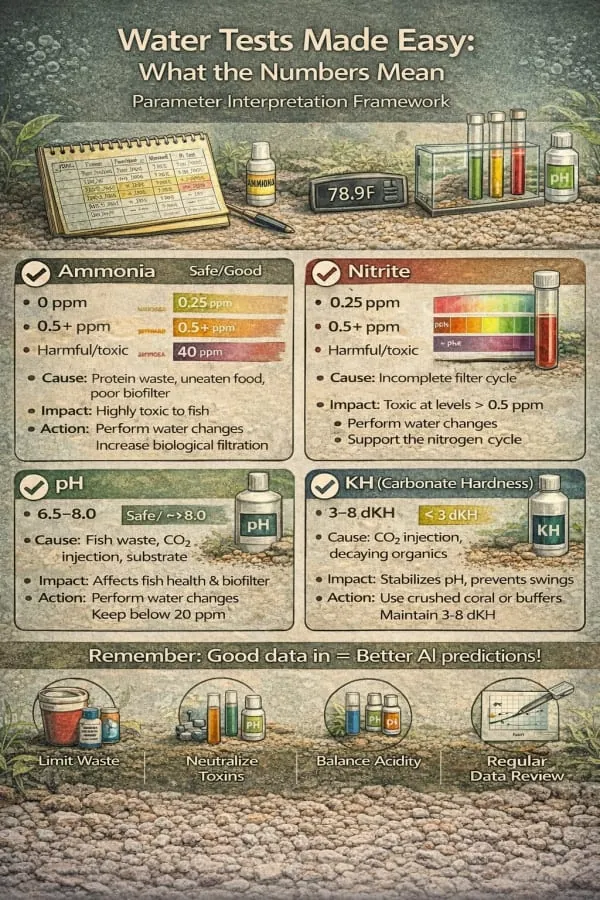
Aquarium water test results explained: read ammonia, nitrite, nitrate, pH, KH, GH, and temperature as one system, and what to do when a number spikes.
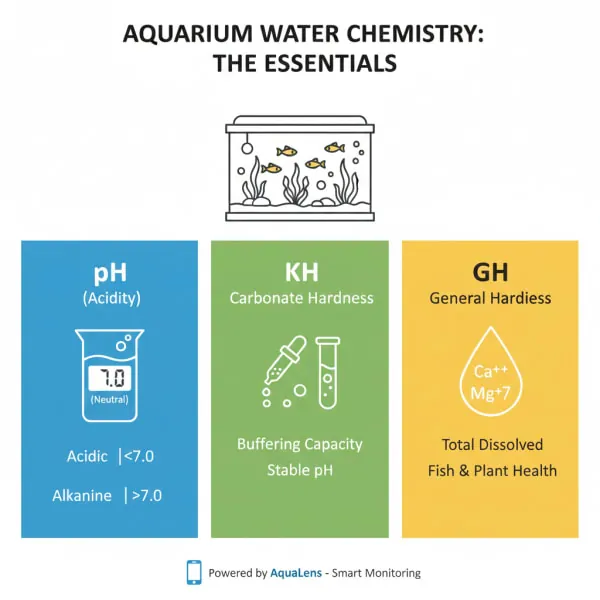
Aquarium water chemistry made simple: what pH, KH, and GH do, why stability beats chasing numbers, and how to keep them steady between water changes.