
Water Chemistry Basics (pH, KH, GH)
Aquarium water chemistry made simple: what pH, KH, and GH do, why stability beats chasing numbers, and how to keep them steady between water changes.
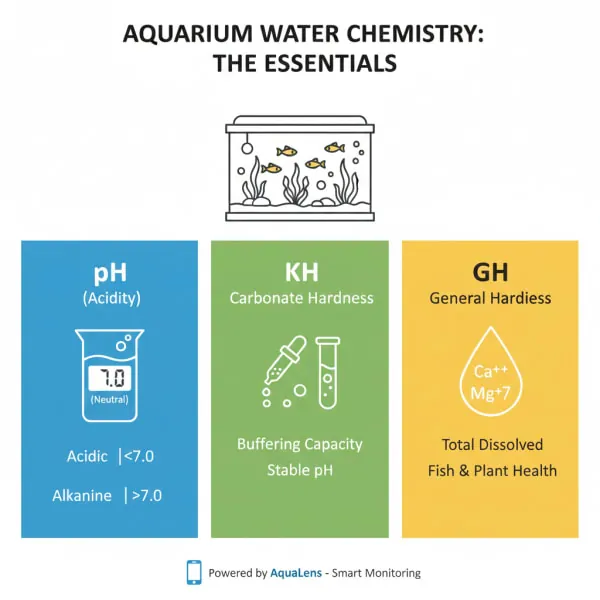
On this page
Water chemistry is where a lot of new aquarists freeze up. It sounds like something you need a lab coat for, and the internet is full of people arguing about decimal points of pH. Here is the reassuring truth: you do not need to be a chemist to keep fish alive and thriving. You need to understand three related numbers, know which one actually matters most, and build a routine that keeps them steady.
That last word, steady, is the whole game. Most fish are far more forgiving of a pH they were not born in than they are of a pH that lurches around from week to week. If you take one thing from this guide, take that. Stability beats perfection.
This guide covers the freshwater chemistry that sits underneath everything else you do: the three core parameters, how they relate, how to get your tap water safe to use, and how to hold the whole system stable over months and years. Reef keepers have an additional layer (calcium, alkalinity, magnesium) that we point to along the way, but the fundamentals here apply to every tank with water in it.
The Three Numbers That Matter
Water is never just H₂O in an aquarium. It is a solvent carrying dissolved gases and mineral ions, and those dissolved substances are what your fish, plants, snails, and bacteria actually live in. Three measurements describe the parts that matter most: pH, KH, and GH. They are related, but they are not the same thing, and confusing them is the single most common beginner mistake.
Here is the quick mental model before we go deep:
| Parameter | What it measures | What it controls | Why you care |
|---|---|---|---|
| pH | How acidic or alkaline the water is | The chemical environment fish live in | Big fast swings are dangerous; a stable off-target value usually is not |
| KH | Carbonate buffering capacity | How resistant your pH is to change | Low KH lets pH crash; it is your safety net |
| GH | Dissolved calcium and magnesium | Osmoregulation, shells, plant and invert health | Too low harms shrimp and snails; too high suits hard-water fish |
Read that table twice. If you understand that KH is the thing protecting pH, and GH is a completely separate mineral measurement, you are already ahead of most hobbyists.
pH: acidity, and why swings kill
pH measures how acidic or alkaline the water is, on a scale from 0 to 14 where 7.0 is neutral. Below 7 is acidic, above 7 is alkaline (also called basic). Most community freshwater fish are comfortable somewhere between about 6.5 and 7.8.
The part that trips people up is that the scale is logarithmic. Each whole number is a tenfold change in acidity. A drop from pH 7.0 to pH 6.0 is not a small nudge, it is water that is ten times more acidic. A drop from 7.0 to 5.0 is one hundred times more acidic. Fish sense that as a chemical assault, and a fast swing can trigger osmotic shock, damaged gills, and death within hours.
This is why chasing a specific pH number is usually a beginner trap. Say your tap water sits at 7.6 and an online care sheet says your fish "prefer" 6.8. The instinct is to add pH-down chemicals. The problem is those products fight your buffer, the pH bounces back overnight, and now your fish are riding a daily rollercoaster that is far more harmful than the "wrong" but stable 7.6 would ever have been. Most aquarium fish sold today are captive-bred and have adapted to a range of conditions. A steady value they were not born in beats a target value you cannot hold.
There are real exceptions. Wild-caught soft-water species like some discus and blue rams genuinely do better in soft, acidic water, and hard-water fish like African Rift Lake cichlids need high pH and hardness. But for those cases you change the water source and buffering deliberately and permanently, you do not dose a bottle every few days. When you are matching fish to your water in the first place, our stocking and compatibility guide and the stocking calculator help you pick species that suit what comes out of your tap, which is far easier than bending your water to the fish.
The single best pH strategy for a beginner: test your tap water, accept its stable value, and stock fish that are happy in that range. Let stability do the work.
KH: the buffer that protects your pH
KH stands for carbonate hardness, and it is more useful to think of it as your pH's shield or safety net. Technically it measures the concentration of carbonate and bicarbonate ions in the water, but functionally it measures buffer capacity: how much acid the water can absorb before its pH starts to move.
Here is the mechanism. Your tank is constantly producing acid. The nitrogen cycle (see our fishless cycling guide for how that gets established) generates acid as bacteria process ammonia and nitrite. Fish respiration adds CO₂, which forms carbonic acid. Driftwood and some substrates leach tannins and acids. All of this pushes pH down over time. Carbonates in your water neutralize those acids, and every time they do, a little KH is consumed. KH is a consumable buffer, and it slowly gets used up between water changes.
When KH runs out, the safety net is gone. With nothing left to neutralize the incoming acid, pH does not drift gently, it plummets. The water can crash below pH 5.0 in a day, which stalls or kills your beneficial bacteria and shocks your fish. This is the classic mechanism behind Old Tank Syndrome, where a long-neglected tank slowly exhausts its buffer and then crashes hard. It looks sudden, but it was months in the making.
The rule of thumb: keep KH at or above 3 to 4 dKH (degrees of carbonate hardness, roughly 54 to 72 ppm) for a stable pH. If your KH is naturally low, you can raise it with a small amount of crushed coral in the filter or substrate, or with a purpose-made buffer. If you keep soft-water fish and want low KH on purpose, that is fine, but you accept a higher-maintenance tank that needs closer monitoring and more frequent water changes to stay stable.
GH: minerals for life
GH stands for general hardness, and it measures dissolved divalent mineral ions, primarily calcium (Ca²⁺) and magnesium (Mg²⁺). This is what people mean casually by "hard" or "soft" water, and it is a completely separate measurement from KH. You can have soft water that is high in carbonates, or hard water low in them, though in most tap supplies they tend to rise and fall together.
GH matters because those minerals are biologically essential. Fish use calcium and magnesium for osmoregulation, the constant work of balancing the salts and fluids inside their bodies against the water outside. Snails and shrimp need calcium to build and maintain their shells and exoskeletons, and magnesium plays a supporting role. Plants draw on both.
When GH is too low, you see the consequences in your most sensitive residents first. Shrimp struggle to molt, sometimes getting stuck mid-molt in a fatal condition. Snail shells develop pits and thin, eroded edges. Livebearers like guppies and mollies, which evolved in hard water, show stunted growth and weaker color. If you keep crystal red shrimp or other invertebrates, GH is one of the parameters you watch most closely, and it is often the fix when a shrimp colony fails to thrive for no obvious reason.
Target GH depends entirely on what you keep. Soft-water community fish are happy around 4 to 8 dGH. Livebearers, most snails, and Rift Lake cichlids want more, often 8 to 15 dGH or higher. Shrimp keepers frequently remineralize pure RO water to an exact GH with a dedicated shrimp mineral, because precision matters for breeding.
For saltwater keepers: GH as freshwater aquarists measure it is not how you manage a reef. Marine and reef systems track calcium, magnesium, and alkalinity individually, in the hundreds of ppm, because corals consume them constantly to build skeletons. That is its own discipline covered in our reef parameters guide, and the reef dosing calculator handles the two-part math. The idea that dissolved minerals are essential carries over; the specific parameters and targets do not.
Getting the Numbers: How to Test
You cannot manage what you do not measure, and eyeballing water tells you nothing about chemistry. You need to test.
For pH, KH, and GH, liquid reagent test kits (the kind where you count drops and match a color) are more accurate and far more economical over time than paper test strips. Strips are fine for a quick screen and are convenient, but they degrade with humidity and are easy to misread. For the parameters that matter, especially when you are diagnosing a problem, trust a liquid kit. Our water test interpretation guide goes deep on kit types, reading drift versus real change, and what each result is actually telling you.
A practical testing rhythm for a stable, established tank: test pH and KH every week or two, check GH monthly or when you add sensitive livestock, and always test before and after a water change while you are learning your tank's rhythm. New tanks that are still cycling need much closer attention, daily during the active cycle.
AquaLens's test-kit scanning lets you point your phone at a finished strip, a liquid kit vial, or a digital tester (including Hanna checkers via OCR), and it reads the result, lets you confirm it, and logs it automatically to that tank's history. That last part matters more than it sounds, because chemistry problems almost always show up as trends before they show up as emergencies.
Conditioning Tap Water: The Toxicology of the Faucet
Here is something most new keepers do not realize: the water coming out of your tap is engineered to be hostile to microbial life. That is a feature for drinking water and a hazard for an aquarium. Before tap water goes anywhere near your fish, it has to be conditioned.
Chlorine versus chloramine
Municipal water is disinfected with one of two chemicals, and knowing which yours uses changes how you treat it.
Chlorine is a gas dissolved in the water. Left in an open, aerated bucket for 24 hours, much of it will off-gas on its own. This is why old advice says to let water "sit out" overnight.
Chloramine is different and increasingly common, because most modern treatment plants have switched to it. It is a stable compound of chlorine bonded to ammonia, and it does not evaporate. You can let chloramine-treated water sit for a week and it will still be toxic. Worse, if you use a conditioner that only breaks the bond, you release free ammonia into your tank. You can call your water utility or check your annual water quality report to find out which one you have; when in doubt, treat as if it is chloramine.
How to condition correctly
Use a quality water conditioner (dechlorinator) with every drop of tap water you add, every single time. The active ingredient, usually sodium thiosulfate, neutralizes chlorine instantly. Better conditioners go further: they break the chlorine-ammonia bond in chloramine and then temporarily detoxify the released ammonia for around 24 to 48 hours, giving your biofilter time to process it. That ammonia-binding property is why keepers reach for those conditioners during emergencies and fish-in cycling.
Dose for the full volume of new water you are adding, following the label. Overdosing modestly is generally safe with reputable conditioners; underdosing leaves chlorine in the tank. If you fill directly from a hose or Python-style system into the tank, add conditioner for the whole tank volume before you start refilling, so the incoming water is neutralized as it arrives.
A note on RO and RO/DI water: Some keepers, especially shrimp breeders and reef aquarists, skip tap water entirely and use reverse osmosis water, which is stripped of nearly everything. Pure RO water has essentially no GH and no KH, so it is chemically unstable and unsafe on its own. It has to be remineralized back up to your target GH and KH before use. RO gives you total control over your water, at the cost of extra equipment and a remineralizing step.
Keeping It Stable: Water Changes and Long-Term Chemistry
Everything above is about understanding the numbers. This section is about the routine that keeps them where you want them, indefinitely. In a closed system, matter does not disappear. Fish food becomes waste becomes ammonia becomes nitrite becomes nitrate (NO₃⁻), and nitrate keeps accumulating until you physically remove it. At the same time, your KH buffer is slowly consumed and minerals concentrate as water evaporates. The water change addresses all of this at once.
The fractional water change
The solution to pollution is dilution. Regular partial water changes export accumulated nitrate, replenish consumed KH and GH from fresh water, and reset the slow chemical drift of a maturing tank.
The standard starting point is changing 15 to 30 percent of the tank volume every week. The exact amount depends on your stocking density, feeding, and how heavily planted the tank is; a lightly stocked planted tank needs less, a crowded tank needs more. The math is simple and worth internalizing: if your nitrate reads 40 ppm and you replace 50 percent of the water, you cut nitrate to roughly 20 ppm. Change 25 percent and you drop it to about 30 ppm. The water change calculator does this for you, including the exact volume to swap to hit a target nitrate.
Two stability rules make water changes safe rather than shocking:
- Match temperature. Get the new water within a couple of degrees (about ±2°F) of the tank before it goes in. A sudden temperature drop stresses fish and is a classic trigger for ich (white spot disease) outbreaks in freshwater tanks.
- Match, or gently bridge, chemistry. If your new water is conditioned tap that matches your tank's pH, KH, and GH, you can change a large volume safely. If your source water is very different from your tank (for example, remineralized RO going into an established tank), keep individual changes smaller so the shift is gradual.
Substrate vacuuming
A lot of your nitrate factory lives in the substrate as detritus: decaying food, waste, and dead plant matter. During water changes, use a gravel vacuum (a siphon) to pull water up through the substrate, lifting out the light brown sludge while the heavier gravel drops back. Your goal is to remove the organic waste without deep-scouring the beneficial bacteria that live on surfaces throughout the tank. In a planted tank, vacuum lightly and mostly in open areas, since disturbing rooted plants and the substrate biology causes more harm than the detritus does.
Old Tank Syndrome and hardness creep
Two slow failure modes catch people who let their routine slide.
Old Tank Syndrome is the KH-crash scenario from earlier, played out over months. Skipped water changes let acids build and slowly exhaust the buffer, nitrate climbs to extreme levels, and the tank limps along looking stable until a small disturbance (a big water change with mismatched water, say) tips it into a pH crash. The fish that adapted to the slowly degrading water then die from the correction. The fix is prevention: consistent water changes so the buffer and nitrate never reach that edge.
Hardness creep is the opposite drift. As water evaporates, minerals stay behind and concentrate, while you top off with more mineral-bearing tap water. Over months, GH and TDS (total dissolved solids) climb. This is why you top off evaporation with plain dechlorinated water or RO, but replace water you have removed with your normal mineralized water. Watching TDS trend upward over time is one of the clearest signals that your maintenance needs adjusting.
Doing This With AquaLens
The whole point of this guide is that chemistry shows up as a trend before it shows up as a crisis, and a slow line is easy to miss in a paper log. Scan each test (strip, liquid vial, or a digital tester read by OCR), confirm the value, and AquaLens logs it, then plots KH, pH, GH, nitrate, and TDS on one timeline from a week to a year. A buffer sliding toward a pH crash reads as a gentle downward KH line you can act on, and hardness creep shows as TDS climbing month over month, so Old Tank Syndrome becomes a chart you watch instead of a tank you lose. Get AquaLens free and start building that history.
The Short Version
If this guide felt like a lot, here is what actually matters day to day:
- Stability over target numbers. A steady pH your fish were not born in beats a "perfect" one that swings.
- KH is your safety net. Keep it at 3 to 4 dKH or higher so your pH cannot crash. Watch it decline between water changes.
- GH feeds your inverts. Low GH is the usual culprit behind failing shrimp and pitted snail shells.
- Condition every drop of tap water, and treat it as chloramine unless you know otherwise.
- Change 15 to 30 percent weekly, temperature-matched, and vacuum the substrate to export nitrate.
- Stock fish that suit your tap water instead of fighting your water chemistry with bottles. Start with the stocking guide or plan a whole build in Build My Tank.
Do those six things and your water chemistry is handled. The numbers stop being scary and become something you glance at, confirm are steady, and move on from.
New to all of this? The aquarium basics guide and the first 90 days guide put chemistry in the context of setting up and maturing a brand-new tank.
Frequently Asked Questions
What is the ideal pH for a freshwater aquarium?
There is no single ideal pH, because it depends on your fish. Most community fish do well anywhere between about 6.5 and 7.8. Far more important than hitting a specific number is keeping the pH stable, since fish tolerate a steady off-target value much better than a value that swings. Test your tap water and stock fish that suit it rather than trying to force a number.
What is the difference between KH and GH in an aquarium?
They measure completely different things. KH, or carbonate hardness, measures the water's buffering capacity, meaning how well it resists changes in pH. GH, or general hardness, measures dissolved calcium and magnesium, the minerals fish, snails, and shrimp need for their bodies and shells. A tank can be low in one and high in the other, so always test them separately.
Why does my aquarium pH keep dropping?
A steadily falling pH almost always means your KH buffer is being used up. The nitrogen cycle, fish respiration, and driftwood constantly produce acids that consume carbonates. When KH runs low, pH starts to slide and can eventually crash. Regular water changes replenish the buffer, and keeping KH at or above 3 to 4 dKH prevents the crash.
Is it safe to use pH-down products in my aquarium?
For most keepers, chemical pH adjusters cause more harm than good. They fight your water's natural buffer, so the pH often bounces back within a day, subjecting fish to repeated swings that are more dangerous than a stable but slightly off pH. If you genuinely need soft, acidic water for specialized fish, it is safer to change your water source and buffering permanently rather than dosing bottles.
How often should I change my aquarium water?
A common starting point is 15 to 30 percent of the tank volume every week. The right amount depends on your stocking level, feeding, and whether the tank is planted. Regular changes export accumulated nitrate and replenish the KH and GH that get consumed over time, which is the main thing that keeps water chemistry stable.
Do I really need to use a water conditioner every time?
Yes, unless you are using remineralized RO water. Tap water contains chlorine or chloramine to kill microbes, and both are toxic to fish and beneficial bacteria. A conditioner neutralizes them instantly. Chloramine in particular does not evaporate, so letting water sit out overnight is not a reliable substitute for treating it.
What causes shrimp to have trouble molting?
The most common cause is water that is too soft, meaning GH is too low. Shrimp need dissolved calcium and magnesium to build a new exoskeleton and molt successfully, and without enough minerals they can get stuck mid-molt, which is often fatal. Shrimp keepers usually target a specific GH, frequently by remineralizing RO water to an exact value.
What is Old Tank Syndrome?
Old Tank Syndrome describes a neglected tank whose KH buffer has been slowly exhausted and whose nitrate has climbed very high over months. The tank looks stable because the fish adapted gradually, but the buffer is nearly gone. A disturbance, such as a large water change with mismatched water, can then trigger a sudden pH crash that kills fish. Consistent water changes prevent it.
How do I raise KH in my aquarium?
You can raise KH by adding a small amount of crushed coral or aragonite to your filter or substrate, which dissolves slowly and buffers the water, or by using a purpose-made carbonate buffer product. Baking soda raises KH temporarily but is harder to control. Raise it gradually and retest, since sudden large changes in buffering can shift pH quickly.
Does water chemistry work the same way in a saltwater reef tank?
The core idea that dissolved minerals matter carries over, but reef tanks track different parameters. Instead of freshwater GH, reef keepers monitor calcium, magnesium, and alkalinity individually because corals consume them to build skeletons. Salinity and specific gravity replace much of the freshwater focus. The stability principle is even more important in reef tanks, where corals are sensitive to swings.
Make Water Chemistry Predictable
Scan any test kit with your phone and AquaLens logs pH, KH, GH, and nitrate automatically, then charts the trends so a buffer decline or hardness creep shows up long before it becomes a crash. Free to start, no account needed.
Keep reading
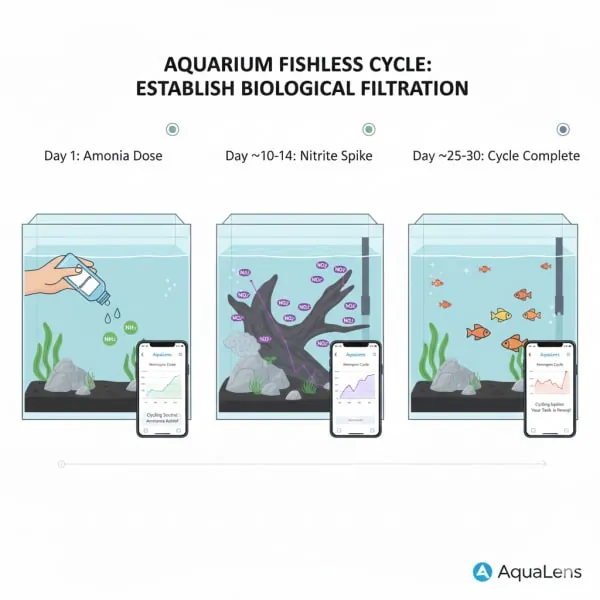
The chemistry under aquarium cycling: why pH decides how toxic your ammonia reading is, and why nitrification quietly consumes your carbonate hardness.
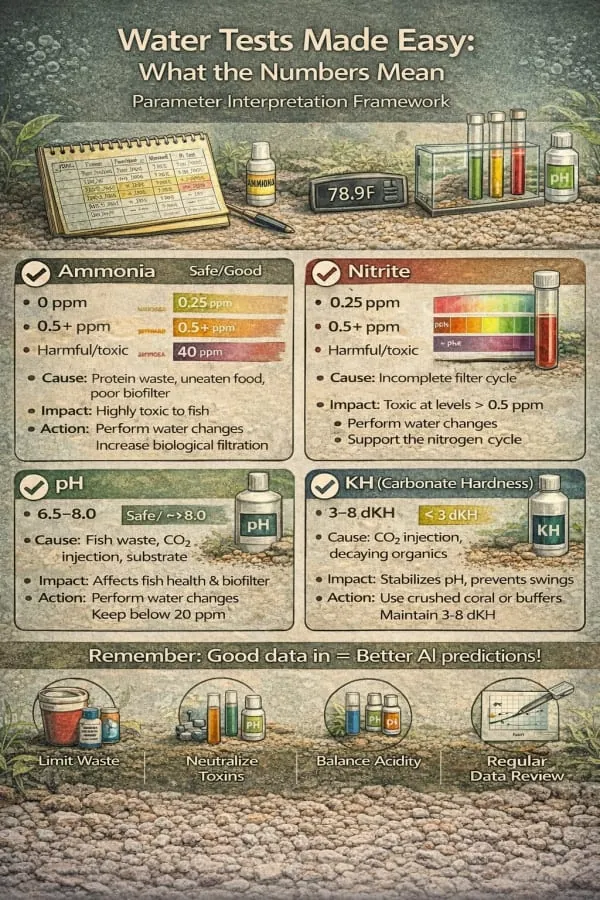
Aquarium water test results explained: read ammonia, nitrite, nitrate, pH, KH, GH, and temperature as one system, and what to do when a number spikes.
A step-by-step fishless cycle: dose ammonia, read the two spikes, and prove your filter is ready before a single fish goes in.