
Aquarium Basics: You Keep Water, Not Fish
Aquarium basics for beginners: why you keep water not fish, plus tank size, filtration turnover, the nitrogen cycle, and a steady maintenance rhythm.
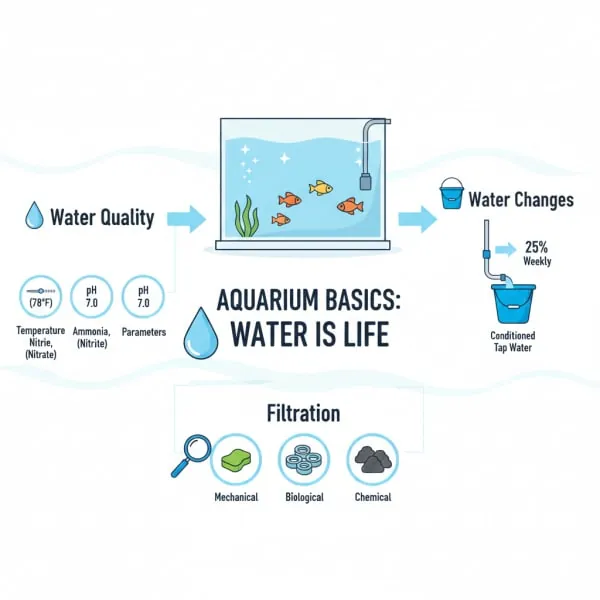
On this page
Here is the single most useful thing anyone can tell you before you buy a tank: you are not going to keep fish. You are going to keep water. If the water is biologically and chemically sound, healthy fish are almost a byproduct. If it is not, no amount of premium food, pretty decor, or good intentions will save them.
This sounds like a slogan, but it is the actual mechanism behind nearly every beginner success and failure. In a lake or river, waste is diluted by enormous volumes of water and processed by vast colonies of bacteria. Your aquarium is a sealed box in your living room. Nothing dilutes, nothing flows away, and nothing gets processed unless you build the machinery to do it. This guide covers that machinery: what it is, why it works, and the small set of habits that keep it running. Everything else in the hobby builds on this foundation.
Bigger Is Easier: Why Volume Buys You Time
New keepers almost always assume a small tank is the easy option. Small to clean, small to fill, small commitment. Ecologically, it is the opposite. The larger the volume of water, the more inertia the system has, and inertia is what forgives your mistakes.
- Dilution capacity. Suppose a fish dies behind a rock and you miss it for a day, or you overfeed before a weekend away. In a 5-gallon tank, the resulting ammonia spike is concentrated and can turn lethal within hours. In a 20-gallon tank, the identical event is diluted to a quarter of the concentration, which often buys you a full day or more to notice and intervene. Same mistake, completely different outcome.
- Thermal stability. A small volume of water heats and cools quickly. A sunny afternoon or a drafty window can swing a 3-gallon tank several degrees in hours, and temperature swings stress fish more than most beginners realize. Larger volumes change temperature slowly, smoothing out the room around them.
- Chemical stability. pH, hardness, and dissolved waste all drift more violently in small volumes. Evaporation alone concentrates minerals faster in a nano tank.
This is why experienced keepers tell beginners that a 20-gallon tank is genuinely easier to keep healthy than a 5-gallon one. It is not gatekeeping, it is physics. If your space or budget truly limits you to a small tank, you can succeed, but understock it heavily and test more often.
One practical warning before you fill anything: water weighs roughly 8.3 pounds per gallon, so a 20-gallon setup exerts well over 200 pounds of static load once you add glass, substrate, and hardscape. Make sure the furniture underneath is rated for it and sits level, because an unlevel stand twists the glass and stresses the seams. If you are unsure what your tank actually holds, the free tank volume calculator works from dimensions, including bowfront and cylinder shapes.
The Hardware That Matters
You can spend endlessly on aquarium gear. Only three pieces genuinely decide whether your water stays healthy: the filter, the heater, and the light. Here is what each one actually does, and how to size it.
Filtration: your life support system
A filter does two jobs. The visible one is mechanical: it traps particles so the water looks clear. The invisible one is the job that keeps fish alive: the filter media is the primary home of the bacteria that detoxify waste. Clear water and safe water are not the same thing, and the second job is the one that matters.
Bigger is not automatically better. What you are really shopping for is turnover rate, the number of times your full tank volume passes through the filter each hour. Useful rules of thumb:
- Standard community tank: 4 to 6 times total volume per hour.
- Planted tank: 5 to 8 times, so CO₂ and nutrients reach every leaf.
- Heavy-waste fish such as goldfish and large cichlids: 10 times or more.
- Low-flow species such as bettas and shrimp: 2 to 4 times, because strong current physically exhausts them.
Two traps to avoid. First, manufacturers rate flow with an empty filter and zero resistance; once the media is loaded and slightly dirty, expect to lose 20 to 30 percent of the advertised number, so buy with headroom. Second, the opposite failure is real too: an enormous canister filter on a small tank creates what hobbyists call the washing machine effect. A filter pushing 46 times turnover on a 20-gallon tank will keep the water spotless while the fish spend every waking moment fighting the current. The free filter flow calculator checks your candidate filter against your tank and stocking before you spend the money, and the full filtration guide covers media choices, flow patterns, and maintenance in depth.
Heating: stability beats precision
Most tropical fish want somewhere in the mid 70s Fahrenheit, and the exact number matters far less than how steady it stays. A heater that is too small for the room cycles constantly and loses ground on cold nights; one that is far too large overshoots. Size it to your tank volume and the difference between room temperature and target, which is exactly what the heater size calculator computes. Buy a separate thermometer rather than trusting the heater dial, and place it at the opposite end of the tank from the heater so you are measuring the water, not the appliance. Some hardy species, such as white cloud mountain minnows, thrive unheated in normal room temperatures, which is worth knowing if you want to skip the heater entirely.
Lighting: it grows things, whether you want it to or not
Light is energy input, and something in your tank will use it. If that something is plants, you get a beautiful, more stable system. If you have bright light and no plants, the only thing photosynthesizing is algae.
Brightness as your eye sees it is not the useful measure. What matters to plants is PAR, photosynthetically active radiation, and water absorbs it aggressively as depth increases. As a rough illustration of the gradient: a fixture delivering around 250 PAR at the surface may deliver only about 75 PAR at 12 inches, which is comfortable for most plants, and around 30 PAR at 24 inches, where only true low-light species like Anubias and Java fern still grow well. The practical takeaways: deep tanks need stronger fixtures than they look like they need, high light without plants or CO₂ is an algae subscription, and a simple timer running 6 to 8 hours a day prevents most lighting problems before they start. When you are ready to go deeper, the planted lighting guide covers spectrum, intensity, and photoperiod properly.
The Nitrogen Cycle: The Invisible Engine
This is the part of the hobby nobody can see and everybody depends on. Fish excrete ammonia continuously, through their gills and their waste, and uneaten food and decaying plant matter add more. In a new, biologically sterile tank, that ammonia simply accumulates until it poisons the inhabitants. This is why the classic story, new tank on Saturday, fish on Sunday, dead fish by the following weekend, is so common it has a name: new tank syndrome.
The fix is to cultivate the bacteria that process waste, a chain called the nitrogen cycle:
- Ammonia (NH₃) is the starting toxin, damaging gills and nervous tissue at well under 1 ppm. Bacteria in the Nitrosomonas group colonize your filter media and surfaces and oxidize it.
- Nitrite (NO₂⁻) is their byproduct, and it is not much friendlier: it binds to the blood of fish so it can no longer carry oxygen, suffocating them in oxygen-rich water. A second group, Nitrospira, consumes it.
- Nitrate (NO₃⁻) is the end product, far less toxic, tolerable for most fish at moderate levels. Nothing in a basic tank removes it except plants and your water changes.
Two details worth knowing beyond the beginner version. First, ammonia exists in equilibrium with ammonium (NH₄⁺), and the balance shifts with pH and temperature: the same total reading is far more dangerous in warm, high-pH water than in cool, acidic water. That is why a reading that panics one keeper is survivable for another. Second, these bacteria live attached to surfaces, overwhelmingly in your filter media, not floating in the water. This is why replacing filter media or rinsing it under chlorinated tap water can crash an established tank overnight: you just threw away the engine. Rinse media gently in removed tank water, and never replace it all at once.
Your tank is cycled when tests show 0 ppm ammonia, 0 ppm nitrite, and measurable nitrate. Getting there before any fish are involved is called fishless cycling, it typically takes 3 to 6 weeks, and it is the single kindest thing you can do for your future fish. The complete walkthrough is in the fishless cycling guide, and the free cycle calculator estimates where you are in the process from your readings. If you would rather have the process managed for you, AquaLens includes a nitrogen cycle tracker that reads each test photo, tells you which phase your tank is in, and guides dosing for both fishless and fish-in cycles.
Water Chemistry: Stability Beats Perfect Numbers
Beginners often chase a textbook pH, nudging it with chemicals until it lands on 7.0. Experienced keepers almost never do this, because fish adapt well to a stable pH slightly outside their ideal range and adapt terribly to a pH that bounces around. The values worth understanding early:
- pH is acidity. Most community fish are fine anywhere from about 6.5 to 7.8 as long as it holds steady.
- KH (carbonate hardness) is your buffer, the chemical shock absorber that stops pH from swinging. Low KH tanks can crash in pH suddenly; this is the hidden cause of many mystery deaths.
- GH (general hardness) is dissolved minerals, which matter for osmotic balance, shrimp molting, and some sensitive species.
The deeper chemistry, including CO₂ and the pH/KH relationship, lives in the water chemistry guide, and learning to read your test results like a keeper instead of a lab tech is the whole point of the test interpretation guide. Whatever kit you use, the habit that matters is testing regularly and keeping the history: a single reading is a snapshot, but a trend tells you where the tank is heading. AquaLens can scan strips, liquid kits, and digital testers by camera, then auto-log each reading into per-tank trend charts, which turns testing from a chore into a two-minute habit.
Plants: The Easiest Upgrade You Can Make
Live plants are not decoration, they are equipment. They consume ammonia and nitrate directly, compete with algae for nutrients, oxygenate the water, and give shy fish cover that visibly changes their behavior. A handful of hardy species (Anubias, Java fern, Cryptocoryne) will grow under modest light with zero special care. If plants interest you, start with the guide to choosing aquarium plants to match species to your light and maintenance style, and the plant buying guide for where to actually get healthy ones.
Stocking: Patience Pays Compound Interest
Every fish you add is a load on the biological machinery you just built, so add that load gradually. A newly cycled tank has exactly enough bacteria for the ammonia it was fed during cycling, no more. Add your fish in small groups over several weeks, letting the colony grow to meet each increase. Research adult sizes, temperaments, and schooling needs before you buy, because the fish store rarely will: the stocking and compatibility guide covers the reasoning, the stocking calculator sanity-checks your plan, and the Build My Tank planner assembles a compatible community from scratch. Browse the species library for care details on 1,750 species before any purchase, and when you bring fish home, acclimate them properly rather than dumping the bag straight in (the acclimation guide shows how).
The Maintenance Rhythm
In nature, currents constantly replace the water around a fish. In your closed box, you are the current. The core habit is the partial water change: 15 to 20 percent of the volume every 1 to 2 weeks for a normally stocked tank. It does two jobs at once, exporting the nitrate your cycle produces and replenishing the KH minerals that keep pH stable. Skip it for months and you get old tank syndrome: nitrate creeps up, KH depletes, pH sags, and the fish adapt slowly to conditions that would kill a new arrival instantly, which is why everything seems fine right up until you add a fish and it dies. The water change calculator tells you exactly how much a given change will reduce nitrate. Alongside water changes: feed lightly (the feeding guide explains why less is almost always more), rinse mechanical media in old tank water, and top off evaporation with dechlorinated water. AquaLens reminders put the schedule on your phone and auto-log each water change and dose when you confirm it, so your logbook builds itself.
When Something Goes Wrong
It eventually will, even in well-run tanks. The rule: do not panic-dose chemicals, and do not deep-clean everything, because both usually make it worse. Test first, then act on what the numbers say. A large water change with temperature-matched, dechlorinated water is the safest first response to almost any chemistry emergency. Keep the emergency first 60 minutes guide bookmarked before you need it, and the first 90 days guide explains which wobbles in a young tank are normal.
For Saltwater Keepers
Every principle here transfers: volume buys stability, the nitrogen cycle is identical biology, and stability beats chasing numbers. Salt adds a second layer, salinity and reef chemistry (alkalinity, calcium, magnesium), and raises the stakes on stability. Marine fish also tolerate ammonia less well than most hardy freshwater species. If the ocean side calls to you, start at the saltwater hub and the saltwater setup guide rather than adapting freshwater advice on the fly.
Doing This With AquaLens
This whole guide comes down to managing water you cannot watch changing, and that is where a running record earns its keep. Scan a test strip or liquid kit and AquaLens reads it, asks you to confirm, and files the result into that tank's trend charts. Because pH, KH, ammonia, and nitrate stack up over weeks, you can catch a KH quietly sagging toward a pH crash long before the fish feel it, which is the one slow failure this guide keeps warning about.
It is free to start, with no account needed for core logging. Get AquaLens free.
Where to Go Next
You now have the mental model that separates keepers whose tanks thrive from keepers who quit in month two: manage the water and the fish manage themselves. From here, follow the beginner path for the step-by-step version, which turns everything above into an ordered checklist for your first setup.
Frequently Asked Questions
What size aquarium is best for a beginner?
A 20-gallon tank is the sweet spot for most beginners. Larger volumes of water dilute waste and hold temperature and chemistry steadier, so your mistakes are far more forgiving than in a 5-gallon tank. Small tanks are actually harder, not easier: if you must go small, stock very lightly and test more often.
How long before I can add fish to a new aquarium?
Typically 3 to 6 weeks. A new tank must first grow the bacteria that convert toxic ammonia into nitrite and then nitrate, a process called the nitrogen cycle. The tank is ready when tests show zero ammonia, zero nitrite, and measurable nitrate. Adding fish before then exposes them to poisoning known as new tank syndrome.
What is the nitrogen cycle in an aquarium?
It is the bacterial process that detoxifies fish waste. Fish produce ammonia, which is highly toxic. One group of bacteria converts ammonia to nitrite, which is also dangerous, and a second group converts nitrite to nitrate, which is far less harmful and is removed by water changes and plants. These bacteria live mainly in your filter media and take weeks to establish in a new tank.
How often should I change aquarium water?
Change 15 to 20 percent of the water every 1 to 2 weeks for a normally stocked tank. This is a rule of thumb, not a law: heavily stocked tanks need more, lightly stocked planted tanks may need less. Water changes remove accumulated nitrate and replenish the minerals that keep pH stable, two jobs nothing else in a basic tank performs.
Do I really need a filter and heater?
Almost always yes. The filter is not mainly for clear water: its media houses the bacteria that detoxify fish waste, making it the tank's life support system. A heater matters for tropical fish because steady temperature is more important than any exact number. A few coldwater species like white cloud mountain minnows can live unheated at normal room temperature.
Why did my fish die a few days after setting up the tank?
Almost certainly new tank syndrome. A brand new tank has none of the bacteria that process fish waste, so ammonia from the fish builds up and poisons them within days. The fix for next time is to cycle the tank without fish first, which takes a few weeks, and confirm zero ammonia and nitrite on a test kit before any fish go in.
Should I adjust my aquarium pH with chemicals?
Usually no. Most community fish adapt well to a stable pH anywhere from about 6.5 to 7.8, but they handle sudden swings poorly, and pH adjuster products tend to cause exactly those swings. A steady, slightly imperfect pH is far safer than a bouncing perfect one. Focus instead on keeping carbonate hardness, KH, from depleting, since low KH is what lets pH crash.
How many fish can I put in my aquarium?
Fewer than the fish store implies. Stocking depends on adult size, waste output, temperament, and swimming space, not just tank volume, so per-gallon rules are only rough guides. Add fish in small groups over several weeks so the bacterial colony can grow to match the new waste load. When in doubt, understock: lightly stocked tanks are dramatically easier to keep healthy.
Keep Your Water Honest
AquaLens reads your test kits by camera, logs every result automatically, and charts the trends that reveal trouble before your fish feel it. Free to start, no account needed.
Keep reading
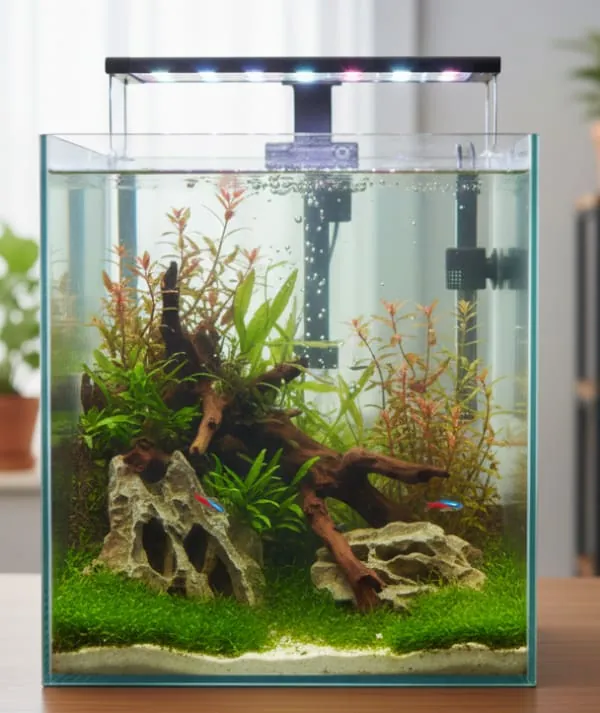
A beginner's guide to your first aquarium: what to buy, how to cycle before any fish arrive, which numbers to watch, and the weekly routine.
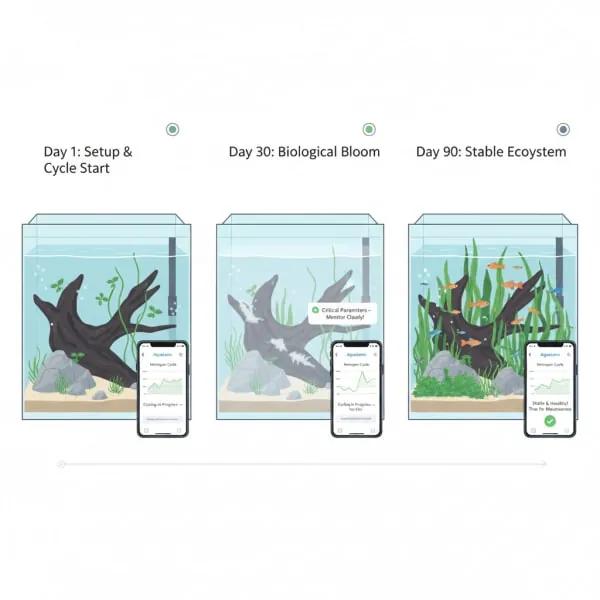
A calm, week-by-week plan for a new aquarium: cycle the filter, stock in waves, and reach a stable tank by day 90 without the beginner crashes.
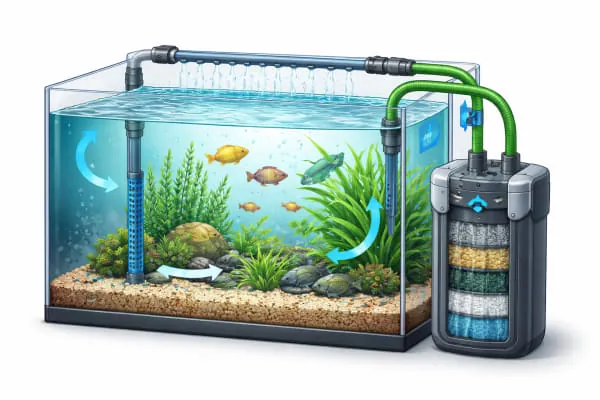
How aquarium filters work, how to pick the right type and flow for your tank, and how to clean the media without crashing your cycle.