
Stocking Guide: Choose Compatible Fish
Choose compatible fish: school sizes, swimming zones, aggression, temperature and hardness matching, and honest bioload math for a peaceful community.

On this page
A beautiful, peaceful aquarium is not luck. It is the result of a dozen small decisions you make before you ever hand over money at the store. Get the stocking list right and the tank mostly runs itself: fish color up, they behave naturally, disease is rare, and your maintenance stays predictable. Get it wrong and you inherit a slow-motion problem, chronic stress, nipped fins, a fish that outgrows the tank, ammonia spikes, and the sinking feeling that something is off but you cannot name it.
This guide walks you through how to think about compatibility the way experienced keepers do. Not a memorized list of "good" and "bad" fish, but the underlying rules: space, social needs, temperament, water chemistry, and bioload. Once you understand the rules, you can evaluate any fish you have never heard of, which is exactly the skill that keeps you out of trouble at the store.
If you would rather plan visually first, the Build My Tank planner walks you through tank size, water type, and goals and hands you a starting stock list you can refine.
Research Before You Buy: The One Habit That Prevents Most Problems
Impulse buying is the single most common way beginners wreck an otherwise healthy tank. A fish in a store cup tells you almost nothing about what it will become. That cute two-inch oscar grows into a twelve-inch, dinner-plate-sized waste machine that will eat every tankmate it can fit in its mouth. The tiny "algae eater" is often a common pleco that reaches eighteen inches and produces a startling amount of waste.
Before any fish comes home, you want three numbers and two words in your head:
- Adult size, not the size in the tank at the store.
- Minimum group size, because many fish are miserable and unhealthy alone.
- Adult temperament, which often differs from juvenile behavior (the red tail shark is peaceful as a youngster and territorial as an adult).
- Its temperature and water-hardness range, so it matches your tank and your other fish.
Every one of AquaLens's 1,750 species care guides leads with exactly these fields, and the app flags conflicts the moment you add a fish to a tank's stock list. But the habit matters more than the tool: never buy a fish you cannot describe as an adult.
Space: Volume Buffers Chemistry, Footprint Determines Behavior
Beginners obsess over gallons. Gallons matter, but they are only half the story. Volume is your chemical buffer: more water dilutes waste and slows the swings in temperature and pH that stress fish. Footprint, the length and width of the tank floor and the surface area, is what actually governs behavior and how many fish can breathe.
Swimming style versus tank shape
Active swimmers are athletes. Zebra danios and most tetras sprint back and forth for hours a day. They are small, but they need horizontal distance, which is why a 20-gallon "long" suits them far better than a 20-gallon "high" or a tall hexagon of the same volume. Confine an active swimmer to a tall, narrow box and you get stress, stunted muscle development, and glass-surfing.
Territorial fish care about floor space, not water column. Cichlids and many gouramis claim ground-level territory. On a short, tall footprint there are fewer defensible territories, so aggression climbs. Two identical volumes can produce a peaceful tank or a war zone depending on the footprint.
Stack your fish vertically
One of the oldest tricks for fitting more life into a tank peacefully is to choose fish that occupy different levels of the water column, so they rarely compete for the same space.
- Top dwellers: hatchetfish, guppies, and other surface feeders.
- Mid-water: tetras, rasboras, and rainbowfish, the schooling swimmers most people picture.
- Bottom dwellers: corydoras, loaches, and plecos that patrol the substrate.
Spreading residents across the top, middle, and bottom reduces visual crowding, lowers competition, and makes even a modest tank feel full and calm.
Social Needs: Why Numbers Are Not Optional
This is the rule beginners break most often, usually to save money, and it is the one that quietly causes the most suffering.
Schooling fish need a real school
Most popular community fish, tetras, rasboras, danios, corydoras, are prey animals in the wild. Their entire nervous system is wired to survive by being one of many. A tight school confuses predators and tells each fish it is safe. Take that away and you get a chronically frightened animal.
The practical minimum for most schooling species is six of the same species, and many look and behave far better at ten or more. Buy only two or three and they live in a state of constant stress: hiding, washed-out color, suppressed appetite, and a weakened immune system that opens the door to disease. People often blame "bad fish" or bad water when the real cause was a group that was too small.
A few important notes that trip people up:
- Six of one species beats two each of three species. Split schools do not comfort each other; each small group still feels exposed.
- "Schooling" (swimming together) and "shoaling" (living loosely in a group) both still require numbers. Corydoras shoal rather than tightly school, but a lone cory is still a stressed cory.
- Some species, like tiger barbs, are actively dangerous in small numbers because they redirect their nipping onto tankmates. A large group keeps their attention on each other.
Not sure how many of a given species you need, or how that group changes your bioload? The schooling calculator gives you a species-aware minimum instead of a guess.
Reading temperament honestly
Compatibility charts sort fish into rough bands. They are a starting point, not gospel, because individuals vary and context (space, hiding places, group size) shifts behavior. Still, the bands are useful:
- Peaceful community fish largely ignore their neighbors: guppies, platies, most small tetras and rasboras, honey gouramis.
- Fin nippers damage slow, long-finned tankmates: tiger barbs and serpae tetras will shred the trailing fins of a betta or angelfish. This is often a numbers problem, but not always.
- Semi-aggressive and aggressive species defend territory or actively hunt: many cichlids will kill anything they can corner or swallow.
The classic mistakes come from mixing bands: a betta with fin nippers, fast feeders like danios with slow feeders like a betta that never gets to the food, or a peaceful community built around a fish that becomes a bully as it matures.
The centerpiece question
Many aquarists want one standout fish to anchor the tank. Good choices earn attention without terrorizing the room: a single honey or dwarf gourami, a betta housed with peaceful bottom dwellers, a pair of dwarf cichlids like Apistogramma cacatuoides. Poor choices are the ones sold small and cheap that grow large or mean: a common pleco, a red tail shark in a peaceful community, or any "it stays small in a small tank" fish (they do not; they just get sick).
Water Chemistry: The Invisible Compatibility
Two fish can have perfect personalities and still be incompatible because they want different water. This is the layer beginners forget, and it causes the slow, mysterious declines that are so hard to diagnose.
Temperature
Every fish has a temperature range where its metabolism and immune system work properly. Mixing tropical and coldwater fish guarantees that one of them is always stressed.
- Tropical species want a heater and roughly 75 to 80°F: bettas, most tetras, guppies, gouramis.
- Coldwater species prefer 60 to 70°F and no heater: goldfish, white cloud mountain minnows.
The common heartbreak is goldfish kept with tropical fish. Someone runs the heater for the tetras, and the goldfish lives permanently too warm; or they skip the heater for the goldfish, and the tetras slowly weaken. There is no compromise temperature that keeps both healthy.
Hardness and pH
Fish evolved in specific water, and long-term health follows that water. Soft-water fish like cardinal tetras and many wild-caught species do best in soft, slightly acidic water. Livebearers like guppies, mollies, and platies want harder, more alkaline water. You can bend these ranges, and captive-bred stock is often more forgiving, but the further you push a fish from its native chemistry, the more you tax its immune system.
The single most useful move here is to test your tap water first and stock to it, rather than fighting your water forever with chemicals. If you do not yet know your numbers, the water chemistry guide explains what to measure and why, and AquaLens logs each test so you can see your true baseline instead of one lucky reading.
Substrate and habitat
Bottom dwellers interact with your floor constantly, so the substrate is part of compatibility too. Corydoras hunt with delicate barbels (whiskers) that sharp gravel erodes over time, leading to infection and starvation, which is why sand or smooth, rounded gravel is strongly preferred for them. Many loaches like to burrow and need soft substrate or tubes to feel secure. Provide the wrong floor and an otherwise perfect fish slowly declines.
Bioload: The Math That Keeps the Water Safe
Everything above assumes the fish get along. Bioload is the other half: whether your filter and water changes can keep up with the waste your stock produces. This is where the tank crashes if you get it wrong.
Kill the "inch per gallon" myth
You will still hear "one inch of fish per gallon." It is dangerously wrong. Waste production does not scale with length; it scales closer to body mass and metabolic rate. A single ten-inch fish can produce many times the waste of ten one-inch fish of the same total length, because a fat-bodied fish has vastly more mass than a slender one, and larger fish eat more. A goldfish is a notorious bioload bomb for exactly this reason.
Think in terms of headroom
A more useful mental model: your tank has a waste-processing capacity set by your filter's biological media, your plants, and your water-change schedule. Every fish spends some of that capacity. A good target for a stable, forgiving tank is to stock to roughly 75 percent of capacity, leaving 25 percent of headroom. That buffer is what absorbs an accidental overfeed, a skipped water change, or a heat wave without tipping into an ammonia or nitrite spike. A tank stocked to the brim has no margin for the inevitable bad day.
Bioload also drives your maintenance. A tank of twenty guppies and a tank with one large goldfish can carry similar biomass and still need completely different water-change schedules, because their waste output and feeding differ. When you are ready to size that routine, the water change calculator turns your tank volume and stocking into a concrete percentage and cadence.
Stock slowly, not all at once
Even a well-planned list should go into the tank in stages. Your biological filter (the colony of bacteria that converts toxic ammonia to nitrite to far-safer nitrate) grows to match its food supply. Add every fish on day one and you can outrun the bacteria, producing a deadly ammonia spike, the "new tank syndrome" that kills so many first tanks. If your tank is brand new, cycle it first: the fishless cycling guide shows you how to build that bacterial colony before any fish arrives, and the filtration guide explains how to give those bacteria a home.
Put It Together: A Simple Stocking Method
Here is the order experienced keepers actually work in.
- Start with your water and your tank shape. Test your tap water for hardness and pH, and note your footprint. These constraints eliminate a surprising number of fish before you fall in love with them.
- Pick one centerpiece or theme. A betta, a small cichlid pair, a specific tetra you love. Build around it.
- Choose tankmates by zone. Add a mid-water school, a bottom crew, and maybe a surface fish, all matched to your temperature and hardness.
- Set the group sizes. Six-plus for each schooling species, and honestly count them into your plan.
- Check the bioload. Total it against your tank and filter, aim for that 75 percent, and confirm your water-change schedule can hold it.
- Check every pairing for aggression and fin nipping. One incompatible fish can undo the whole plan.
- Buy and add in stages, letting your filter catch up between additions, and quarantine new arrivals so one sick fish never infects the whole community.
The stocking calculator runs steps four and five for you, checking group sizes and estimating bioload against your specific tank so you are not doing the arithmetic in a store aisle.
For Saltwater and Reef Keepers
The same principles apply in a reef, but the stakes and the details shift. Marine fish are far more territorial per gallon, aggression is often keyed to body shape and color rather than species, and you generally add the most peaceful fish first and the boldest last. Adult size and swimming needs matter even more: a yellow tang needs a long tank and open swimming room, while a six line wrasse can turn on later, more timid additions. Compatibility also includes your corals and inverts, since some otherwise-desirable fish nip coral or hunt shrimp.
If you are planning a marine community, start with the saltwater setup guide for stocking order, quarantine, and the reef-specific compatibility rules, and use the salinity and reef tools to dial in the environment those fish need.
Doing This With AquaLens
Every rule above, group size, temperament, thermal and hardness matching, and bioload headroom, is a check you can run before you spend a cent at the store.
Add your wishlist to a tank in AquaLens and each fish pulls from the same 1,750-species library, so the app already knows adult size, temperament, temperature and hardness ranges, and minimum group size. It flags the conflicts that matter: a schooling species with too few individuals, a fin nipper next to long-finned tankmates, a thermal mismatch, or a bioload that overruns your tank and filter. You fix the plan on your phone instead of discovering the problem three weeks later, and because that same list drives your expected waste output, the water tests you log afterward read against a stock plan the app already understands.
Get AquaLens free and plan your stock list before your next store trip.
Common Stocking Mistakes to Avoid
- Buying a fish because it looks nice in the cup, without checking its adult size.
- Keeping schooling fish in twos and threes to save money, then blaming their poor health on bad luck.
- Mixing coldwater and tropical fish under one heater.
- Trusting "inch per gallon" instead of thinking about mass and metabolism.
- Adding every fish on day one to a brand-new, uncycled tank.
- Ignoring your tap water's hardness and pH, then fighting it forever with additives.
- Putting a fin nipper in with a betta or angelfish and hoping for the best.
- Choosing a fish that is peaceful as a juvenile without checking what it becomes as an adult.
Get these eight right and you are ahead of most keepers. For the wider picture of how a tank comes together in its first months, the first 90 days guide puts stocking in context alongside cycling, feeding, and maintenance, and the feeding guide helps keep bioload and water quality under control once the fish are home.
Frequently Asked Questions
How many fish can I put in my aquarium?
Forget the old one-inch-per-gallon rule, because waste depends on a fish's body mass and metabolism, not its length. A good target is to stock to about 75 percent of your tank and filter's capacity, leaving headroom so a missed water change or overfeeding does not spike ammonia. A stocking calculator that accounts for your specific tank and species is far more reliable than any single rule of thumb.
How many fish should be in a school?
Most schooling and shoaling species need a minimum of six of the same species, and many look and behave better at ten or more. Kept in twos and threes they become chronically stressed, hide, lose color, and get sick more easily. Six of one species is always better than two each of three different species, because split groups do not comfort one another.
What fish are not compatible with a betta?
Avoid fin nippers like tiger barbs and serpae tetras, which shred a betta's long fins, and fast feeders like danios that outcompete a betta for food. Other bettas and aggressive or territorial fish are also poor choices. Bettas do best with calm, peaceful tankmates such as small bottom dwellers and non-nipping schooling fish in a well-planted tank.
Can I keep goldfish with tropical fish?
Generally no. Goldfish are coldwater fish that prefer roughly 60 to 70°F, while most tropical community fish want 75 to 80°F, so one species is always thermally stressed. Goldfish also produce a very heavy bioload and can grow large enough to eat small tankmates. It is far safer to keep goldfish in their own coldwater setup.
Why do my fish keep dying even though the water looks fine?
Water that looks clear can still be wrong for your fish. Common hidden causes are a temperature or hardness mismatch between species, chronic stress from schooling fish kept in numbers that are too small, aggression from an incompatible tankmate, or an uncycled tank with invisible ammonia. Testing your water regularly and matching every fish to your parameters and social needs usually reveals the real problem.
What does bioload mean in an aquarium?
Bioload is the total amount of waste your fish and other livestock produce, which your filter and water changes must process into safer compounds. It scales with body mass, feeding, and metabolism rather than simple fish length, so one large fish can outweigh many small ones. Keeping bioload comfortably below your system's capacity is what keeps ammonia and nitrite at zero.
Do I need to add fish slowly to a new tank?
Yes. Your biological filter is a bacterial colony that grows to match the waste it is fed, and it cannot expand instantly. Adding many fish at once can overwhelm the bacteria and cause a toxic ammonia spike known as new tank syndrome. Cycle the tank first, then add fish in small batches over several weeks so the bacteria can keep pace.
What are the best beginner community fish?
Hardy, peaceful, adaptable species make the best starting communities: guppies, platies, and mollies among livebearers, plus small tetras, harlequin rasboras, zebra danios, and honey gouramis. Corydoras and small plecos make good bottom crews. Match everything to the same temperature and hardness range, keep schooling species in groups of six or more, and confirm none of them grows too large for your tank.
How do I know if two fish are compatible?
Check five things: adult size, temperament, swimming zone, temperature range, and water hardness. Fish are compatible when their temperament bands do not clash, when they can share the tank without one being nipped or eaten, and when they want the same water. Compatibility charts are a useful starting point, but always verify each species' real adult behavior rather than judging by how it looks in the store.
Does aquarium shape matter for stocking?
Yes, footprint matters as much as volume. Active swimmers like danios and many tetras need horizontal length, so a long tank suits them far better than a tall one of the same gallons. Territorial fish care about floor space for defensible territories. Two tanks of identical volume can house very different fish depending on their length, width, and surface area.
Plan a Stock List That Actually Gets Along
Add your wishlist to AquaLens and it checks school sizes, temperament, temperature, and bioload against your exact tank before you buy, then auto-logs your water tests so the community stays stable.
Keep reading
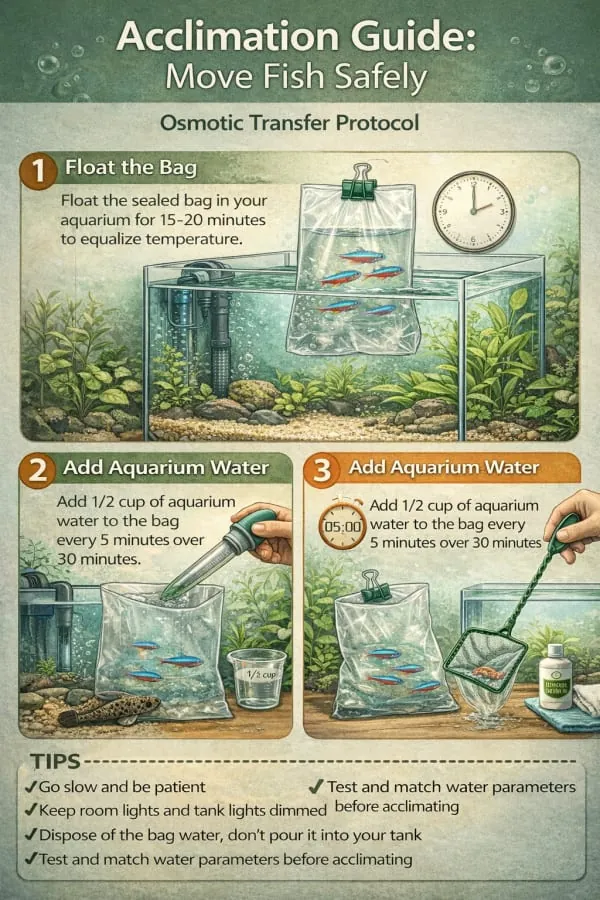
Acclimate new fish, shrimp, and coral safely: temperature floating, drip acclimation, plop-and-drop for shipped livestock, and the first 24 hours.
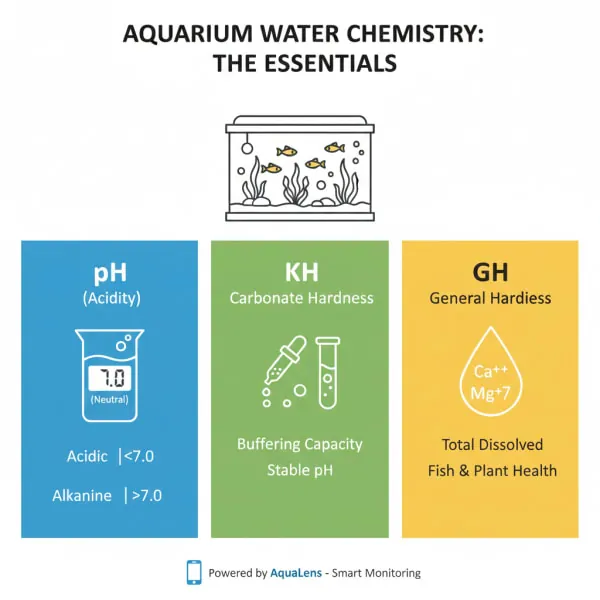
Aquarium water chemistry made simple: what pH, KH, and GH do, why stability beats chasing numbers, and how to keep them steady between water changes.
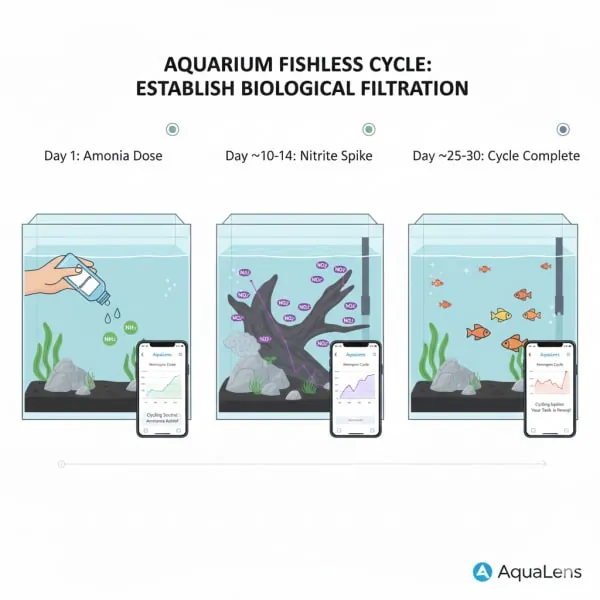
A step-by-step fishless cycle: dose ammonia, read the two spikes, and prove your filter is ready before a single fish goes in.