
Feeding Without Polluting Your Tank
How much and how often to feed aquarium fish, why overfeeding causes cloudy water, algae, and ammonia spikes, and how to stop meals becoming pollution.
On this page
Feeding is the most enjoyable part of fishkeeping. It is also the single largest input of pollution your aquarium will ever receive, and the way you handle it decides more about your water quality than any filter, additive, or gadget. Cloudy water, stubborn algae, creeping nitrate, and mysteriously sick fish almost always trace back to the food tin. The good news: feeding well is simple once you understand what food actually becomes after it hits the water. This guide covers how much, how often, and what to feed, plus how to handle community tanks, vacations, and the warning signs that you are putting in more than your tank can process.
Every Meal Is a Water Quality Decision
The core concept is blunt: food equals ammonia. Every gram of food you add to the tank ends up as dissolved waste, and it gets there by one of two routes.
- If a fish eats it: protein is digested, and the nitrogen in that protein is excreted, mostly as ammonia straight from the gills, plus solid waste that decomposes into more ammonia.
- If a fish misses it: the food sinks, rots, and releases the same ammonia directly into the water, along with phosphate that feeds algae.
There is no third option. Fish food is protein-dense by design, and protein is roughly one-sixth nitrogen by weight. Whether it passes through a fish first or decays on the gravel, that nitrogen becomes ammonia (NH₃), which your beneficial bacteria must convert to nitrite (NO₂⁻) and then nitrate (NO₃⁻). If that chain is new to you, the water chemistry guide explains it in full, and the fishless cycling guide covers how the bacterial colony gets established in the first place.
Here is the part that catches people out. Your biological filter is not a fixed-size machine. The bacterial colony grows and shrinks to match your average daily feeding, and it adjusts slowly, over days, not minutes. Feed a steady amount and the colony sits in equilibrium with it. Suddenly double the food (a generous guest, a new "treat" food, a heavy hand before vacation) and the bacteria cannot multiply fast enough to process the excess. Ammonia spikes, fish gasp, and you are firefighting. The filtration guide covers how to give that colony room to live, but no filter can outrun a feeding habit.
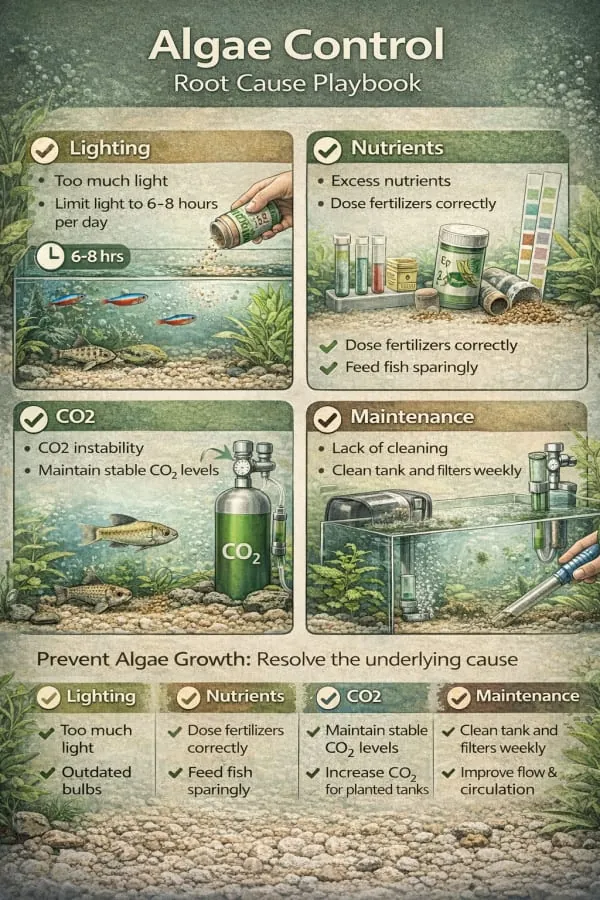
Overfeeding also loads the tank with phosphate, the other half of the algae equation. If you are fighting green water or hair algae, cut feeding before you buy chemicals; the algae control guide starts from exactly this point.
Rule of thumb: your fish will survive underfeeding for weeks. Your tank may not survive overfeeding for days.
How Much: The Eye-Size Rule
Fish are opportunistic feeders. In the wild, meals are unpredictable, so fish evolved to eat everything available, every time. They do not stop when they are full in any meaningful sense; they stop when the food is gone. Begging behavior at the glass is not hunger, it is conditioning. This means portion control is entirely your job.
Three practical guides, from smallest to largest scale:
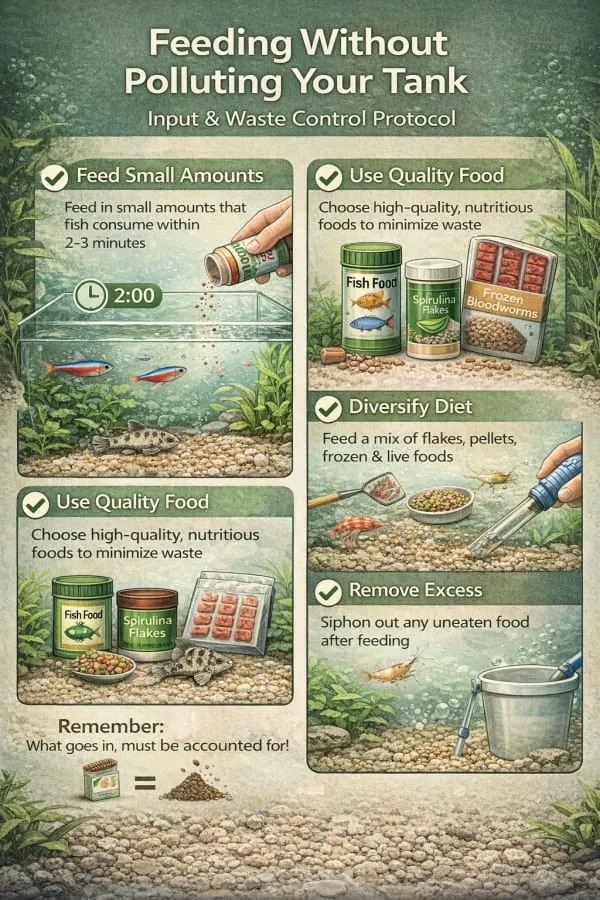
- The eye rule. A fish's stomach is roughly the size of its eye. This is a rule of thumb, not anatomy-textbook precision, but it calibrates you correctly: a neon tetra needs a few crumbs, not a pinch. For a school of six neons, the total portion for the whole group is about the size of one pea.
- The 60-second rule. Feed only what the fish finish in about a minute. Slow grazers like otocinclus and some bottom-dwellers are an exception (more on them below), but for midwater community fish, 60 seconds is the ceiling.
- The floor test. If flake food is reaching the substrate before the fish intercept it, you fed too much. Vacuum it out rather than trusting "the catfish will get it": a cory catfish is not a garbage disposal, and rotting flake under the gravel line is invisible ammonia.
Experienced keepers eventually stop measuring and start reading the fish: a healthy, well-fed fish has a gently convex belly, not a bulge and not a concave profile. Feed to the fish in front of you, not to the size of the container or the enthusiasm of the begging.
One deliberate exception to the floor test: sinking foods for bottom-dwellers are supposed to reach the floor. Wafers and sinking pellets dropped for corydoras or plecos are intentional. The test for those is time: anything not eaten within a few hours comes out.
How Often: The Power of an Empty Stomach
Fish are ectotherms. Their metabolism runs on water temperature, not internal heating, so digestion is far slower than a mammal's, and their energy needs are a fraction of what our feeding instincts assume.
- Once per day is a complete diet for most adult community fish. Many keepers split the same total amount into two smaller feedings, which suits small, fast-metabolism species and reduces the risk of any single overdose. Either pattern works; the total input is what matters.
- Fry and very small nano fish are the exception. Growing fish genuinely need several small feedings a day. This is one of the few times "feed more often" is correct advice.
- Skip one day per week entirely. A weekly fasting day lets the digestive tract clear completely. Chronic constipation is a leading trigger of swim bladder problems, the classic "fish floating sideways" complaint, and a fasting day is the cheapest prevention available. It also gives your filter and plants a catch-up day on dissolved waste. If a fish is already showing buoyancy trouble, the fish health guide covers what to do next.
- Temperature changes the math. A tank running cool digests slower. Unheated or cold-water setups need lighter, less frequent feeding than a 78°F community tank, and feeding heavily in cold water is a direct route to digestive trouble.
Consistency beats cleverness here. A fixed routine, same time, same measured amount, keeps your bacterial colony in equilibrium and makes any deviation visible. If remembering is the hard part, AquaLens's feeding reminders put the schedule on your phone and log each feeding automatically, so a shared household never double-feeds the same tank.
What to Feed: Reading the Label Like a Keeper, Not a Shopper
Not all brown flakes are created equal. The gap between a quality food and a cheap one is not the picture on the tin, it is the first three ingredients on the label.
- Look for named whole ingredients: whole fish, Antarctic krill, insect larvae (black soldier fly is increasingly common and excellent), spirulina.
- Be wary of generic fillers up front: wheat flour, corn, soybean meal, and vague "fish meal" as the lead ingredient. Fish digest grain fillers poorly, and what a fish cannot digest, it expels as bulky solid waste that clogs filters and drives nitrate up. You pay for cheap food twice: once at the register and again in water changes.
Quality food is more digestible, so fish extract more nutrition from less volume, and less of your feeding becomes pollution. It is one of the few upgrades in this hobby that improves water quality and fish health simultaneously.
The main food types, and how to use each well
- Dry foods (flakes and pellets). The convenient backbone of most feeding routines. Match pellet size to mouth size, and soak pellets in a cup of tank water for a minute before feeding: dry pellets swell as they absorb water, and it is far better for that to happen in the cup than in the stomach. Keep dry food sealed and replace it within a few months of opening; the vitamins degrade long before the food looks bad.
- Frozen foods (the gold standard for condition). Blister packs of bloodworms, brine shrimp, daphnia, and mysis are close to a natural diet: high protein, high moisture, minimal filler. One technique matters: thaw in a cup of tank water and pour it through a fine net before feeding. The packing liquid is rich in phosphate and dissolved organics; feed the meat, discard the juice.
- Live foods. Baby brine shrimp, microworms, and daphnia trigger natural hunting behavior and offer the highest nutritional value, especially for conditioning breeders and feeding fry. Prefer home-cultured or reputable commercial cultures; wild-collected live food can carry parasites into the tank.
- Vegetables and herbivore foods. Algae eaters and grazers like otocinclus and bristlenose plecos need vegetable matter, not leftover flake. Blanched zucchini, spirulina wafers, and repashy-style gel foods keep them genuinely fed rather than merely surviving. A "cleanup crew" that only gets scraps slowly starves.
Rotate two or three foods rather than feeding one forever. No single food is complete for every species, and variety covers the gaps. It also means a discontinued product never leaves you with a fish that refuses everything else.
Feeding a Community Tank Fairly
In a mixed tank, "feed the tank" really means "feed several different animals with different mouths, speeds, and schedules." A few tactics keep the fast eaters from taking everything:
- Feed sinking food for the bottom-dwellers deliberately, ideally a moment after the surface feeders are occupied with flake at the other end of the tank, or after lights out for nocturnal species.
- Feed at two points at once when you keep both bold and shy species, so the timid ones eat before the greedy ones arrive.
- Count pellets for solo fish. A betta does well on a few pellets per meal; free-pouring flake for a single fish is how most betta bloat starts.
- Shrimp and snails need almost nothing extra. They graze biofilm and leftovers; a small piece of wafer a few times a week is plenty in an established tank.
Getting the species mix right in the first place makes feeding dramatically easier, which is one more reason to plan stocking before you buy: the stocking and compatibility guide and the Build My Tank planner both help you avoid combinations that cannot be fed fairly.
For Saltwater and Reef Keepers
The nitrogen math is identical in salt water, but the tolerances are tighter: a reef running elevated nitrate and phosphate shows it as browned-out corals and nuisance algae long before fish suffer. A few marine-specific notes:
- Some marine fish genuinely need frequent feeding. Anthias and other zooplanktivores do best with several small feedings a day; a single daily feed is a freshwater habit that does not transfer.
- Rinse frozen mysis and brine exactly as described above. The packing juice is a phosphate dose your reef does not need.
- Target-feed corals sparingly. Feeding LPS corals directly helps growth, but broadcast-feeding the whole tank "for the corals" is the fastest way to drive nutrients out of range. See the coral placement, flow, and lighting guide for how feeding fits coral care.
- Watch the trend, not the day. Overfeeding in a reef shows up as a slow NO₃ and PO₄ climb over weeks. The reef parameters guide covers target ranges, and if you are still setting up, start with the saltwater setup guide.
Vacation: The Counterintuitive Answer Is "Feed Nothing"
The instinct before a trip is to feed extra, or to drop in a "vacation feeder block." Both are mistakes.
- Feeder blocks are a pollution device. They dissolve on their own schedule regardless of whether anything eats them, releasing a continuous stream of waste into a tank nobody is watching. A crashed tank after a holiday is very often a feeder block story.
- Healthy adult fish comfortably go 7 to 10 days without food. Wild fish do this routinely. Fasting is dramatically safer than uncontrolled feeding. Fry, seahorses, and some delicate specialists are exceptions and need a real plan.
- If the trip is longer, control the dose. An automatic feeder can work, but only if you run it for a full week before you leave, on deliberately stingy portions, and guard it against humidity clumping. If a friend is feeding, pre-portion each day's food into a labeled pill organizer and hide the main container. Well-meaning helpers overfeed; it is the single most common vacation failure.
- Do a water change before you go, so the tank starts the week with maximum headroom. The water change calculator will size it for you.
The Signs You Are Overfeeding (and the Fix)
Overfeeding rarely announces itself at the moment it happens. It shows up later, as a pattern:
- Cloudy or hazy water a few hours after meals, or an oily film on the surface.
- Nitrate climbing faster between water changes than it used to.
- Algae gaining ground despite unchanged lighting.
- Sudden booms of detritus worms, planaria, or snails: populations of scavengers expand to match the food supply, and an explosion means the supply grew.
- Fish with permanently distended bellies, long trailing feces, or buoyancy trouble.
The fix is procedural, not heroic: halve the portion, vacuum the substrate thoroughly, do a solid water change, reinstate the weekly fasting day, and then test daily until the numbers settle. If you are unsure how to read those tests, the water test interpretation guide walks through what each number means and which changes are real versus noise. Scanning each test with AquaLens's camera takes the color-matching guesswork out of it and drops every reading into your log automatically.
Doing This With AquaLens
The trouble with feeding discipline is timing: an overfed tank looks fine on day one and shows it on day thirty, which is exactly the stretch of time people are worst at tracking. AquaLens covers both ends of that gap.
- Reminders that log every feeding. Set the schedule and the weekly fasting day once; each confirmed feeding records itself in the tank's journal, so a family or a vacation helper can see at a glance what has already been fed and nobody double-feeds.
- A nitrate line that catches overfeeding early. Scan your test kit and the reading auto-logs, and over a few weeks the nitrate trend turns a slowly heavier hand into a visible rising line, weeks before it would surface as an algae bloom.
If you want to go deeper on why a consistent log is the highest-leverage habit in the hobby, the logging guide makes the full case.
Feed less than you think, feed better than the bargain bin, skip a day a week, and let the trend line tell you the truth. Your fish, your filter, and your future self doing water changes will all thank you.
Frequently Asked Questions
How often should I feed aquarium fish?
Once per day is a complete diet for most adult community fish, and many keepers split the same total into two smaller feedings. Skip one day per week entirely so the digestive tract can clear, which helps prevent constipation and swim bladder problems. Fry and very small nano fish are the exception and need several small feedings a day.
How much should I feed my fish?
Feed only what your fish finish in about 60 seconds. A useful rule of thumb is that a fish's stomach is roughly the size of its eye, so a school of six neon tetras needs a total portion about the size of one pea. If flake food is reaching the gravel before the fish catch it, you fed too much.
How long can aquarium fish go without food?
Healthy adult fish comfortably go 7 to 10 days without food, and fasting is much safer for the tank than uncontrolled feeding while you are away. Fry, seahorses, and some delicate specialist species are exceptions and need a real feeding plan. Wild fish routinely go days between meals.
Should I use a vacation feeder block?
No. Feeder blocks dissolve on their own schedule whether or not anything eats them, releasing a continuous stream of waste into an unwatched tank, and they are a common cause of crashed tanks after holidays. For trips up to about 10 days, letting healthy adult fish fast is safer. For longer trips, use a tested automatic feeder on small portions or pre-portion daily doses for a helper.
What happens if you overfeed fish?
Uneaten food and extra waste decompose into ammonia, and your beneficial bacteria cannot multiply fast enough to process a sudden increase, so ammonia and nitrite can spike to toxic levels. Chronic overfeeding shows up as cloudy water, rising nitrate, algae growth, pest snail or worm booms, and bloated fish. Fish themselves can suffer constipation and swim bladder trouble from eating too much.
What is the best food for aquarium fish?
Look at the first three ingredients on the label: named whole ingredients like whole fish, krill, insect larvae, or spirulina beat generic fillers like wheat flour, corn, or soybean meal. Frozen foods such as bloodworms, brine shrimp, and mysis are close to a natural diet and excellent for conditioning. Rotate two or three quality foods rather than feeding one product forever, and give herbivores real vegetable matter.
Do fish need a fasting day?
A weekly fasting day is one of the cheapest health measures in the hobby. It lets the digestive tract clear completely, which helps prevent constipation, a leading trigger of swim bladder problems where fish float sideways or upside down. It also gives your filter and plants a catch-up day on dissolved waste.
Why is my fish tank cloudy after feeding?
Cloudy or hazy water shortly after meals usually means more food is going in than the fish and the bacterial colony can process, and bacteria are blooming on the excess. Halve your portions, vacuum the substrate, do a good water change, and reinstate a weekly fasting day. If the haze persists, test ammonia and nitrite daily until the numbers settle.
Make Overfeeding Visible
AquaLens turns feeding discipline into a habit: schedule reminders that auto-log every feeding, scan your test kits by camera, and watch the nitrate trend line catch an overfeeding problem weeks before the algae does.
Keep reading
Identify every common aquarium algae and bacterial bloom on sight, understand the biology behind it, and fix the cause instead of scrubbing.
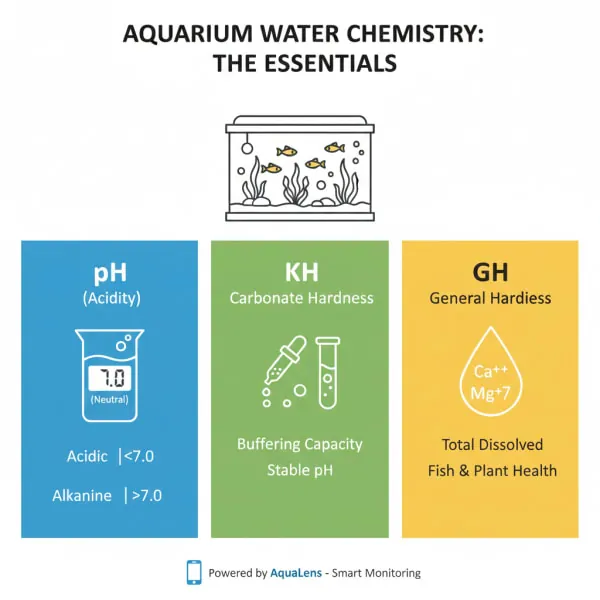
Aquarium water chemistry made simple: what pH, KH, and GH do, why stability beats chasing numbers, and how to keep them steady between water changes.
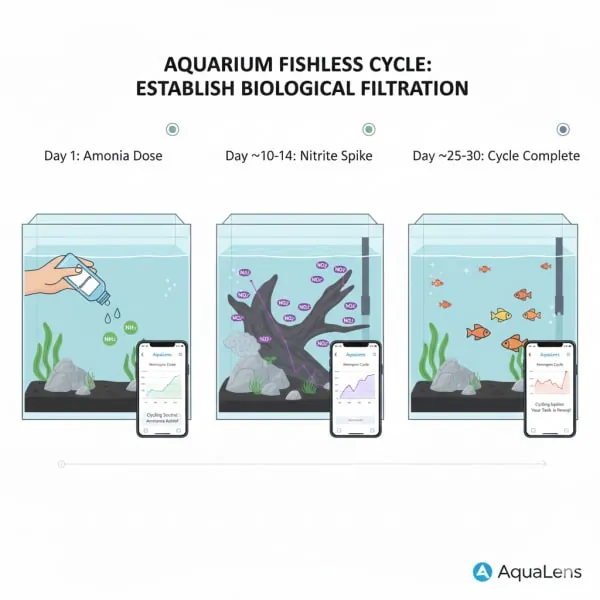
A step-by-step fishless cycle: dose ammonia, read the two spikes, and prove your filter is ready before a single fish goes in.