
Emergency Help: First 60 Minutes
Aquarium emergency triage for the first hour: gasping fish, ammonia spikes, dead filters, power outages, and exactly what to do minute by minute.
On this page
Something is wrong with your tank right now. Take a breath. Most aquarium emergencies are survivable if you act in the right order, and this page gives you that order. Scan it, find your scenario, and work the minutes.
You do not need to fix everything in the next hour. You need to stop the dying, buy time, and avoid making it worse. If you get stuck at any point, the AquaLens help page is the fastest route to support, and AquaGuide chat inside the app can answer questions about your specific tank while you work.
The One Rule: Oxygen First, Chemistry Second, Medication Last
Different problems kill on different clocks, and matching your urgency to the right clock is most of emergency response:
- Oxygen kills in minutes to hours. Fish cannot hold their breath. This is always the first thing you secure.
- Toxins like ammonia and nitrite kill in hours to days. Urgent, but you have time to test and respond in measured steps.
- Disease kills in days to weeks. It is never a first-hour problem, which is why medication comes last, after you know what you are treating.
There is a second rule hiding inside the first: avoid over-correction. As a rule of thumb, more fish are killed by panicked fixes (massive cleanouts, chemical cocktails, huge temperature swings) than by the original problem. Every action below is deliberately measured.
The First 5 Minutes: Do This for Any Emergency
These five steps are safe in every scenario, so do them before you even know what is wrong.
- Stop feeding. Uneaten food breaks down into ammonia, and digestion itself raises your fish's oxygen demand. Healthy fish can go a week without food. Skipping meals costs nothing.
- Max out aeration. Add an airstone, lower the water level so the filter output splashes, or point the outlet up to ripple the surface. Almost all gas exchange happens at the surface, so agitation is oxygen.
- Check your equipment. Put a hand near the filter output and look at the thermometer. Confirm the heater and filter are actually doing their jobs, not just plugged in.
- Dechlorinate any tap water before it touches the tank. Chlorine and chloramine burn gills and kill the beneficial bacteria you are about to depend on.
- Note the time and take a photo. You will re-check in 30 minutes and need a baseline, and a stressed memory is unreliable. AquaLens's journal is built for this: one photo and a note creates a timestamped incident log.
Find Your Scenario
- Fish gasping at the surface → Scenario A
- Ammonia or nitrite above zero → Scenario B
- Filter stopped or no flow → Scenario C
- Power outage → Scenario D
- Heater trouble, contamination, a dead fish, or an overdose → Quick Answers below
- Fish look sick but the water tests clean → usually not a first-hour emergency. Go to the fish health and quarantine guide instead.
Not sure which one you have? Test the water. Numbers beat guesses, and the water test interpretation guide explains what each reading means.
Scenario A: Fish Gasping at the Surface
Why it happens. Oxygen enters at the surface, so that is where desperate fish go. The usual causes: low dissolved oxygen from poor circulation, gill damage from ammonia, nitrite, or chlorine, or overheated water (warm water physically holds less oxygen). Nitrite deserves special mention: it binds to hemoglobin and blocks it from carrying oxygen, so nitrite-poisoned fish suffocate even in perfectly oxygenated water. Old-timers call it brown blood disease, and it is why gasping always earns a nitrite test.
Minutes 0 to 10
- Maximize surface agitation. Airstone, spray bar aimed up, strong ripple. This is the intervention that buys time for everything else.
- Check the temperature. If the tank is running hot, see the heater note in Quick Answers and cool it slowly. Never dump ice in.
- Test now: ammonia, nitrite, nitrate, pH, temperature. Point the AquaLens camera at the test strip or liquid vials and it reads the result and logs it with a timestamp, one less thing to write down with wet hands.
Minutes 10 to 30
- If ammonia or nitrite is above zero, do a 30 to 50% water change with temperature-matched, dechlorinated water. Matching temperature matters: a sudden swing adds thermal shock to fish already in respiratory distress.
- If nitrite specifically is elevated, a small dose of plain aquarium salt helps immediately: chloride competes with nitrite at the gills and blocks most of its uptake. About one teaspoon per 10 gallons, dissolved in tank water first, is a common rule of thumb. Go easy in tanks with scaleless fish or heavy planting.
- Remove decaying material: dead fish, rotting leaves, uneaten food. Decay consumes oxygen and produces ammonia at the same time.
Minutes 30 to 60
- Re-check every 10 minutes. Are fish leaving the surface? Is gill movement slowing? Those are your success signals.
- If nothing is improving, do a second controlled 20 to 30% change. Sequential moderate changes are gentler than one giant one.
- One chemistry detail worth knowing: the same ammonia reading is far more dangerous at high pH and temperature, because more of it exists as toxic free ammonia (NH₃) rather than the ionized form (NH₄⁺). The water chemistry guide explains this in depth.
Do not
- Do not add multiple medications "just in case." Gasping is almost never disease, and meds reduce oxygen exchange and stress the biofilter.
- Do not make large temperature swings in either direction.
- Do not scrub or replace filter media while fish are struggling to breathe.
Scenario B: Ammonia or Nitrite Spike
Why it happens. Your biological filter, the colony of bacteria that converts ammonia to nitrite and nitrite to nitrate, has been overwhelmed or damaged. Common triggers: overfeeding, a batch of new fish, a dead organism you have not found yet, rinsing media in tap water, or a medication that hit the bacteria. The filtration guide covers how this system works, and the fishless cycling guide explains how it is built in the first place.
How bad is it?
| Total ammonia reading | What it means | First-hour action |
|---|---|---|
| 0.25 ppm or less | Caution zone. Act early, before fish show stress. | Stop feeding, dose detoxifier, re-test in 12 to 24 hours |
| 0.25 to 1.0 ppm | Active stress. Gill damage is underway. | Detoxifier plus a 30 to 50% water change |
| Above 1.0 ppm | Emergency. | Detoxifier plus a 50 to 75% water change, then re-test |
These bands are practical triage, not hard science: true toxicity depends on pH and temperature, because kits measure total ammonia while only the free NH₃ fraction does the damage. When pH is above 7.6 or the tank runs warm, treat every band one level more seriously.
Minutes 0 to 15
- Stop feeding for 24 hours. Every meal is future ammonia.
- Dose a water conditioner that detoxifies ammonia, at the correct amount for your true water volume. Rated tank size overstates real volume once substrate and hardscape displace water, so run your dimensions through the tank volume calculator rather than guessing. One quirk to expect: most test kits still show detoxified ammonia for a day or two, so do not panic when the number does not instantly drop.
- Increase aeration. Ammonia stress and oxygen stress usually arrive together.
Minutes 15 to 40
- Water change by severity: 30 to 50% for readings up to 1.0 ppm, 50 to 75% above that, always temperature-matched and dechlorinated. The math is simple and useful: a 50% change cuts the reading roughly in half, and the water change calculator will tell you exactly how much to drain to hit a target.
- Vacuum visible waste pockets if you can reach them without tearing the tank apart. A gentle pass, not a full deep-clean.
Minutes 40 to 60
- Re-test ammonia and nitrite. Scanning the kit with AquaLens auto-logs the result, so your incident timeline builds itself.
- Set a daily testing reminder until you get two consecutive days at zero. Spikes that look resolved at hour one often echo for a week.
Do not
- Do not feed "to reduce stress." It does the opposite.
- Do not replace bio-media. Those bacteria are the cure, not the problem.
- Do not deep-clean the substrate and the filter on the same day, during or after the emergency. Stagger disturbances so the biofilter never takes two hits at once.
Scenario C: Filter Stopped or No Flow
Why the clock is real. A stopped filter costs you two things at once: circulation, which drives oxygen exchange, and biofiltration, because the bacteria in your media are aerobic and start oxygen-starving within hours in still water. Media that dries out dies faster still. Clear water tells you nothing here: ammonia is invisible.
Minutes 0 to 10
- Add aeration immediately. An air pump, a spare sponge filter, or manual agitation. This substitutes for the circulation you lost.
- Diagnose fast: power at the outlet, plug seated, impeller jammed with debris, intake blocked, airlock in the pump head.
- Prime and restart if you can.
Minutes 10 to 30
If the filter will not restart:
- Keep the biological media submerged in tank water in a bowl or bucket. Wet and warm keeps the colony alive while you troubleshoot.
- Rig backup circulation: a sponge filter, a small powerhead, or even periodic manual stirring.
- Clear debris out of intakes and hoses so a repaired filter does not clog again in an hour.
Minutes 30 to 60
- Test ammonia and nitrite. If elevated, do a controlled 30 to 50% water change.
- Plan for a possible mini-cycle over the coming week: daily tests, light feeding.
One advanced note: a canister filter that has sat dead for several hours becomes a sealed jar of oxygen-free, increasingly foul water. If yours was off that long, drain it and rinse the media in tank water before restarting. Never let that stagnant first flush pour into the tank.
Do not
- Do not rinse bio-media in tap water. Chlorine kills the colony you are trying to save.
- Do not let media dry out.
- Do not assume clear water means the biofilter is fine.
Scenario D: Power Outage
The goal: hold oxygen and temperature until power returns. Fish handle a dark day without complaint. They do not handle still, cooling water.
Minutes 0 to 15
- Confirm the scope. A tripped breaker is a two-minute fix. An area outage means settling in.
- Stop feeding. Less waste, less oxygen demand.
- Start a battery air pump if you own one. If you keep fish, a $15 battery pump is the single cheapest piece of insurance in the hobby.
- Trap the heat. Close the lid, wrap the tank sides in blankets or towels, block drafts. Water's thermal mass buys you hours before temperature becomes the problem. In a heatwave, do the reverse: shade the tank and float sealed cool packs.
- Unplug the filter and heater so nothing slams back on unattended when power returns.
Minutes 15 to 45
For outages that will run past an hour:
- Agitate the surface manually every 30 to 60 minutes if you have no battery pump: scoop a cup of tank water and pour it back from a height, a dozen times. Crude, and it works.
- Prioritize oxygen over light. Plants shrug off a dark day. Fish cannot skip oxygen.
Minutes 45 to 60, or whenever power returns
- Restart the filter first (see the canister warning in Scenario C if it sat for hours).
- Restore aeration.
- Plug the heater back in and confirm it is regulating.
- Watch the fish for a few minutes.
- Test ammonia and nitrite within 1 to 3 hours, because the biofilter may have taken a hit.
Do not
- Do not resume feeding the moment the lights come on. Wait until behavior is normal.
- Do not run lights at full intensity "to compensate." Nothing needs compensating.
- Do not stack chemistry corrections on top of an outage recovery.
Quick Answers for Other Emergencies
Heater stuck on. Unplug it, confirm the real temperature with a separate thermometer, and cool the tank slowly: float sealed bags or bottles of cool water, and crank the aeration, because warm water holds less oxygen. Aim for a few degrees per hour. Never add ice directly.
Heater failed, tank cold. Less urgent than it feels. Cold fish go sluggish long before they die. Rewarm slowly, about 1 to 2°F per hour, and watch closely for ich over the next week: temperature stress is its favorite opening. The fish health guide covers what to look for.
Suspected contamination (soap on hands, bug spray, air freshener, paint fumes, lotion). Do a 50 to 75% water change, run fresh activated carbon in the filter, and aerate heavily. One catch: if the contaminant is an airborne spray, ventilate the room first, because surface agitation pulls air into the water.
Dead fish found. Remove it now: decay produces ammonia and consumes oxygen. Test the water. One death in a stable tank is sad but not automatically an emergency. Multiple deaths, or one death plus any abnormal behavior, gets treated as Scenario B until the tests prove otherwise.
Medication overdose. Large water change plus fresh activated carbon, which strips most medications within hours.
For Saltwater and Reef Keepers
The oxygen-first rule is identical, but a few things change:
- Emergency water changes need pre-mixed salt water matched for salinity and temperature. The salt mix calculator gets the batch right, and the salinity converter settles any SG-versus-ppt confusion. Evaporation top-off is always fresh water, never salt.
- In an outage, flow matters even more. Corals suffocate in still water faster than fish do. A battery-powered pump earns its keep twice over in a reef.
- Heat is a lower threshold. Corals begin bleaching at temperatures fish barely notice, so act on a heat spike sooner.
- Do not chase alkalinity or calcium during an incident. Stabilize first, correct slowly later. The reef parameters guide covers safe correction rates.
- Marine disease moves fast, velvet especially. If the emergency turns out to be disease, go straight to the marine quarantine guide.
The Do and Do Not List
Pin this mentally. It covers 90% of first-hour decisions.
Do now
- Increase oxygenation immediately.
- Stop feeding for the duration of the incident.
- Test the core five: ammonia, nitrite, nitrate, pH, temperature.
- Make measured water changes with dechlorinated, temperature-matched water.
- Log the timeline: what you saw, what you did, what you measured.
- Re-test after every major intervention.
Do not
- Do not dose multiple medications blindly.
- Do not replace all your filter media.
- Do not reset substrate, filter, and chemistry all at once.
- Do not chase perfect numbers with rapid repeated corrections.
- Do not stop watching once symptoms improve. Trends after the incident matter as much as the incident.
After the First Hour: The Next 72 Hours
- Test daily until ammonia and nitrite hold at zero for two consecutive days.
- Feed lightly for a day or two, then return to normal. The feeding guide covers how little fish actually need.
- Find the honest root cause. New fish added too fast? A missed maintenance week? Overfeeding? An aging heater? Equipment that gave warning signs you ignored? Emergencies almost always have a paper trail.
- Watch for a mini-cycle if the biofilter took damage: small ammonia or nitrite blips over the next week or two are the colony rebuilding.
- Fix the process, not just the incident. Most emergencies announce themselves days early: nitrate creeping up, pH drifting, appetite fading. A tank with a logged history turns those whispers into visible lines on a chart, and the better logging guide shows how to build that habit without it becoming a chore.
Doing This With AquaLens
During an incident your hands are wet and your memory is unreliable, which is the exact problem AquaLens's camera logging solves.
- Build the incident timeline without writing anything down. Point the camera at a test strip or liquid kit, confirm the reading, and it lands in the per-tank journal with a timestamp, alongside every dose and water change you record as you go.
- See whether the number is truly falling. Because each re-test is on the same chart, the trend tells you if ammonia is genuinely dropping or just bouncing between changes, which is the difference between stopping and running one more controlled water change.
Emergency success is not fixing everything in one hour. It is restoring stability safely, then making sure the next problem shows up on a chart before it shows up in your fish.
Frequently Asked Questions
Why are my fish gasping at the surface of the tank?
Oxygen enters water at the surface, so fish gather there when they cannot get enough. The usual causes are poor circulation, overheated water which holds less oxygen, or gill damage from ammonia, nitrite, or chlorine. Increase surface agitation immediately, then test ammonia and nitrite, because nitrite blocks the blood from carrying oxygen even in well-aerated water.
What ammonia level is dangerous for aquarium fish?
Any reading above zero deserves action. Up to 0.25 ppm is a caution zone, 0.25 to 1.0 ppm causes active gill stress, and anything above 1.0 ppm is an emergency that calls for a large water change plus an ammonia-detoxifying conditioner. The same reading is more toxic in warm water and at pH above about 7.6, so treat it more seriously in those conditions.
How much water should I change in an aquarium emergency?
Match the change to the severity: 30 to 50 percent for moderate ammonia or nitrite readings, 50 to 75 percent for severe ones. Always use dechlorinated water matched to the tank's temperature. Two moderate changes an hour apart are gentler on stressed fish than one massive change, and each 50 percent change cuts a toxin reading roughly in half.
How long can aquarium fish survive a power outage?
A well-stocked tank is usually fine for a few hours, and often much longer if you keep oxygen moving and heat trapped. Close the lid, wrap the tank in blankets to hold temperature, and agitate the surface every 30 to 60 minutes by pouring cupfuls of tank water back in from a height. A battery-powered air pump extends that window to a day or more.
Should I feed my fish during a tank emergency?
No. Stop feeding the moment you notice trouble and hold off for at least 24 hours. Uneaten food and digestion both produce ammonia, and digestion raises the fish's oxygen demand at exactly the wrong time. Healthy fish can go a week or more without food, so skipping meals during an incident costs nothing.
How long do filter bacteria survive without power or flow?
The beneficial bacteria in filter media need oxygen, so they begin dying within hours in still water and faster if the media dries out. Keep media submerged in tank water while you troubleshoot, and never rinse it in chlorinated tap water. A canister filter that sat sealed and dead for several hours should be drained and rinsed in tank water before restarting.
Can a fish tank recover from an ammonia spike?
Yes, most tanks recover fully if you act within hours. Stop feeding, dose an ammonia-detoxifying conditioner, change 30 to 75 percent of the water depending on severity, and keep aeration high. Then test daily until ammonia and nitrite hold at zero for two consecutive days, because spikes often echo for a week while the biofilter rebuilds.
Should I add medication as soon as my fish look sick?
No. Medication is the last step, not the first, because most sudden fish distress is water quality rather than disease. Fix oxygen and test the water first; if ammonia, nitrite, and temperature check out and specific disease signs persist over days, then identify the disease and treat it deliberately. Dosing multiple medications blindly stresses fish and can damage the biofilter.
Be Ready Before the Next One
Emergencies are won in the weeks before they happen. AquaLens reads your test kits by camera, logs every result automatically, and warns you when a parameter starts drifting toward trouble, so the next problem shows up on a chart instead of in your fish.
Keep reading
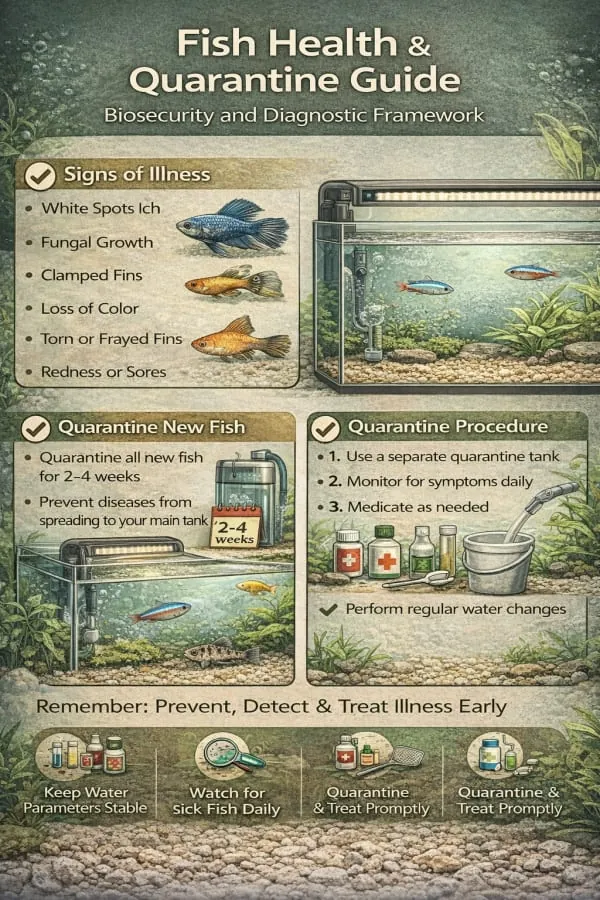
Quarantine new fish, spot the early warning signs, and treat disease without wrecking your tank. A practical freshwater fish health guide.
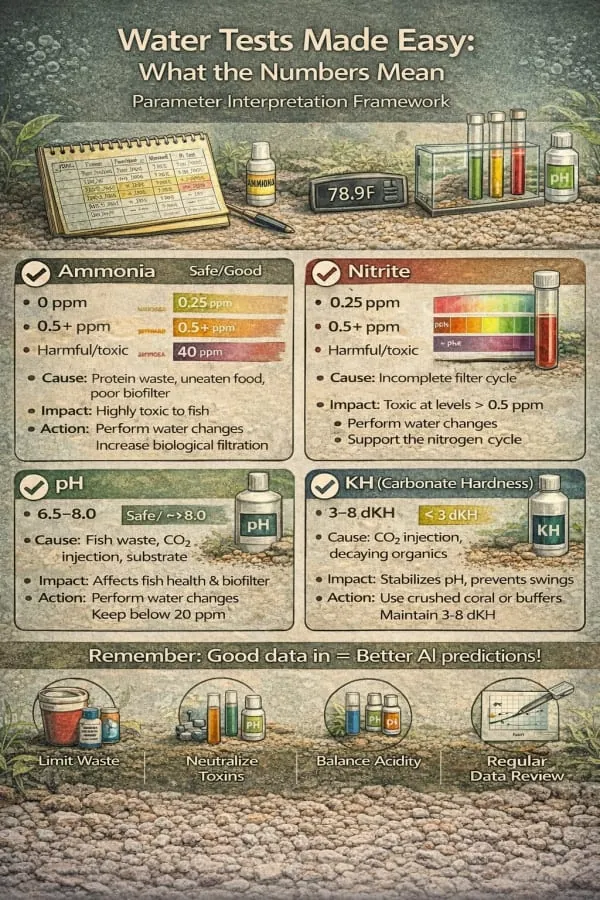
Aquarium water test results explained: read ammonia, nitrite, nitrate, pH, KH, GH, and temperature as one system, and what to do when a number spikes.
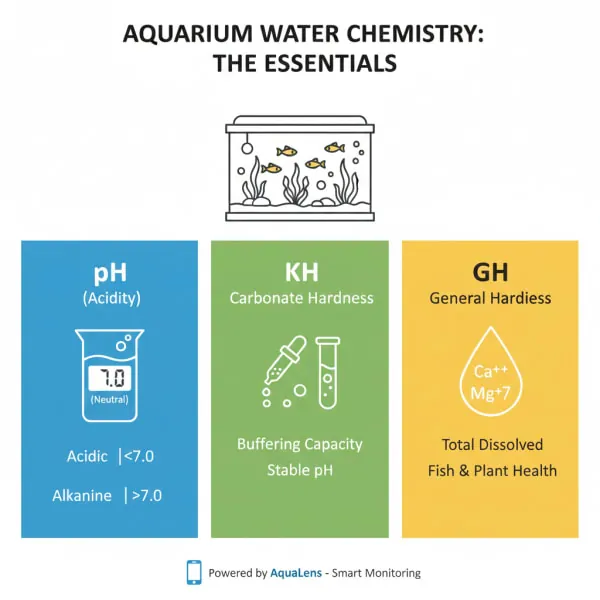
Aquarium water chemistry made simple: what pH, KH, and GH do, why stability beats chasing numbers, and how to keep them steady between water changes.