
CO2 Injection: Beginner-to-Pro Setup
Aquarium CO₂ injection made safe: how carbon, light, and nutrients balance, which system to buy, and how to dial it in without gassing your fish.
On this page
If you have ever looked at a lush, carpeted aquascape and wondered why yours grows algae instead, the answer is almost always carbon. Plants are roughly 40 to 50 percent carbon by dry weight, and in a closed glass box that carbon runs out fast. Injecting CO₂ is how you refill the tank's most important limiting nutrient, and it is the single biggest lever between a slow, patchy planted tank and a fast, dense, algae-resistant one.
It is also the part of the hobby that scares people, and for one good reason: the same gas that makes plants thrive can suffocate fish if you overdo it. The good news is that CO₂ injection is not hard once you understand the three variables at play and how to measure what you are doing. This guide walks you from "do I even need it?" through choosing hardware, dissolving the gas efficiently, and dialing it in safely. Beginners can follow it and keep their fish alive; experienced keepers should still pick up a few things about efficiency and stability along the way.
If you are still deciding what to grow, pair this with our guide to planted lighting and the broader planted tank walkthrough. They are the other two legs of the same stool.
Why Carbon Is the Bottleneck
In a wild river, an enormous volume of moving water constantly replenishes dissolved CO₂ around every plant. Your aquarium has none of that. A tank of actively growing plants can strip the available CO₂ out of the water within a couple of hours of the lights coming on. Once it is gone, photosynthesis grinds to a halt no matter how bright your light is or how many nutrients you dose.
That matters because of what happens next. When plants stall, they stop consuming light and nutrients, which leaves both sitting around for algae. Algae are far more adaptable than higher plants: many species can pull carbon from bicarbonate in the water when free CO₂ is scarce, so they keep growing while your plants sulk. This is why a bright tank without CO₂ so often turns into an algae farm. You gave the algae a feast and starved the plants that were supposed to outcompete them.
Injecting CO₂ removes that bottleneck. With carbon no longer limiting, healthy plants grow fast, use up the available light and nutrients, and release oxygen and natural compounds that suppress algae. The goal is not "more bubbles" for their own sake. It is removing the primary limiting factor of photosynthesis so the plants can do the algae-fighting for you.
The Light, CO₂, Nutrient Triangle
Think of a planted tank as an engine. Light is the accelerator pedal. Carbon and nutrients are the fuel. The most common beginner mistake is to floor the accelerator by buying a powerful light while leaving the fuel tank empty. The engine does not go faster. It stalls, floods, and, in aquarium terms, grows algae on every stagnant leaf.
The three variables have to move together:
- Light sets the maximum possible growth rate. More light demands more carbon and more nutrients to match.
- CO₂ is usually the first thing to run short, because it is consumed fastest and is hardest to replenish naturally.
- Nutrients (nitrogen, phosphorus, potassium, iron, and trace elements) are the rest of the fuel, delivered through fertilizer dosing.
Here is the counterintuitive part that separates people who understand this from people who chase symptoms: adding CO₂ often lets you run less light, not more. With carbon abundant, demanding carpet plants will grow tight and healthy at moderate light levels, around 40 to 50 micromoles of PAR at the substrate. Lower light with strong CO₂ is one of the most reliable, algae-resistant setups in the hobby. High light with strong CO₂ grows faster but punishes every mistake. When you are learning, aim the moderate-light, strong-CO₂ direction.
Do You Actually Need CO₂?
Not every planted tank needs injection, and it is worth being honest with yourself before spending the money. The dividing line is the kind of tank you want.
Low-Energy Tanks (No Injection)
Low-tech tanks rely on the small amount of CO₂ that enters at the water surface plus whatever fish and bacteria respire. Growth is genuinely slow, often five to ten times slower than an injected tank, but for many people that is a feature: less trimming, less dosing, less to go wrong.
These plants thrive without injected carbon:
- Anubias such as Anubias nana, which grows on wood and rock and asks for almost nothing.
- Java fern and its narrow-leaf and Windelov varieties.
- Crypts like Crypt parva, Vallisneria, and other rooted rosette plants.
- Mosses such as Java moss.
Expect darker green foliage and mostly vertical growth. Carpets that spread horizontally across the substrate are largely off the table without CO₂. If a no-injection tank is where you are headed, you can skip most of the hardware below, and our planted tank guide covers low-tech success in depth.
High-Energy Tanks (CO₂ Required)
If you want the lush "nature aquarium" look, dense stems, red plants, and a proper carpet, injected CO₂ is effectively mandatory. Consider it required for:
- Carpeting plants. Dwarf baby tears (HC Cuba), Monte Carlo, and Glossostigma need abundant carbon to grow low and spread across the floor instead of stretching upward for light.
- Red plants. High light triggers the red pigments (anthocyanins), but CO₂ is what supports the leaf density and size that makes the color read as a solid mass rather than a few sad stems. See Ludwigia super red.
- Fast stem plants. Rotala and Ludwigia grow "leggy," with long bare gaps between leaves, when carbon is short. With CO₂ they grow compact and bushy.
Before you commit, run the numbers on what a system costs to buy and refill so there are no surprises. Our CO₂ calculator helps you estimate injection rate and cylinder run time for your tank size.
A Word on Choosing Plants
Whichever route you take, the plants you buy matter as much as the carbon you inject. A CO₂ system will not rescue a plant that arrived half-melted or was never suited to your setup. Our two dedicated plant guides go deep here: the ultimate guide to choosing aquarium plants matches species to your light and CO₂ decision, and where to buy aquarium plants covers sourcing healthy stock. Start there and you will inject CO₂ into plants that can actually use it.
Choosing Your Hardware
There are three broad ways to get CO₂ into a tank. Only one of them is a real long-term answer for a demanding setup.
Pressurized Gas: The Gold Standard
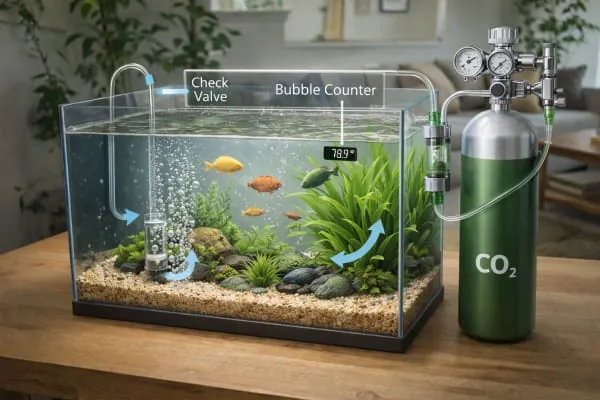
A pressurized system is a refillable cylinder of compressed CO₂ feeding a chain of components that step the pressure down and meter it precisely. In order, gas flows from:
- Cylinder. Refillable, sized from tiny paintball canisters up to 5 lb or 10 lb tanks. Bigger is cheaper per refill and needs filling less often.
- Regulator. Drops the cylinder's very high pressure down to a usable working pressure and shows you both on gauges.
- Solenoid. An electrically controlled valve that opens and closes the gas flow. Plug it into a timer so CO₂ runs only when the lights are on.
- Needle valve. The fine-tuning knob that sets your exact bubble rate.
The upfront cost is higher, but pressurized gas is consistent, fully automatable, and by far the cheapest to run over time. The consistency is the real prize: stable CO₂ is what keeps both plants and fish happy, and instability is what breeds the algae you were trying to avoid. If you are serious about a planted tank, buy pressurized and be done with it.
DIY Yeast and Citric Acid
DIY systems generate CO₂ through yeast fermentation or a citric-acid-and-baking-soda reaction inside soda bottles. The appeal is the near-zero upfront cost, and for a small, low-demand tank they can genuinely help.
The drawbacks are real, though. Output drifts constantly: strong when a fresh batch is bubbling, weak as it exhausts. That fluctuation is a classic trigger for black beard algae, which loves unstable carbon. DIY is also hard to shut off at night, and CO₂ that keeps flowing after the lights go out (when plants stop consuming it and fish keep respiring) can push levels into dangerous territory. Treat DIY as a learning tool or a stopgap, not a destination.
"Liquid CO₂" and Carbon Tablets
Here is the reality check the marketing will not give you: most "liquid CO₂" products are glutaraldehyde-based biocides, not a carbon source in any meaningful sense. They kill some algae on contact and provide a negligible amount of usable carbon. They cannot replace injected gas for carpets, red plants, or dense stems.
They also carry a risk. Overdosed, glutaraldehyde melts sensitive species like Vallisneria and some mosses, and it stresses shrimp and other sensitive invertebrates. If you like the idea, use it as a spot algae treatment, not as your plants' carbon supply, and dose conservatively.
Dissolving the Gas Efficiently
Here is the part beginners underestimate: getting gas into the tank is trivial. Getting it to dissolve into the water before it escapes at the surface is the actual engineering problem. A bubble that reaches the surface and pops delivered nothing. Your injection method determines how much of your gas (and money) actually reaches the plants.
| Method | How it works | Dissolution efficiency | Notes |
|---|---|---|---|
| Inline diffuser | Installed on a canister filter's outflow hose; gas mixes turbulently with water inside the plumbing | Near 100% | Best option. Hidden in the cabinet, no in-tank clutter. Needs a canister filter. |
| In-tank ceramic diffuser | A ceramic disc forces gas into a fine mist inside the tank | Moderate | Relies on flow to carry the mist around before it rises. Visible. Disc needs periodic bleaching. |
| Airstone or bubbler | Produces large bubbles that rise and pop | Near zero | Do not use for CO₂. The bubbles are too big to dissolve. |
Inline diffusers are the efficiency winner. Because the gas is forced to mix with the full water flow inside the hose under pressure, dissolution approaches 100 percent, and there is nothing ugly hanging inside the tank. The catch is that you need a canister filter to plumb it into.
In-tank ceramic diffusers are the affordable, popular choice. A fine mist of bubbles rises through the water, and good flow carries it around so more of it dissolves before it reaches the surface. Efficiency is only moderate, and the ceramic disc clogs with algae and mineral buildup over time, so plan on soaking it in a bleach solution every few weeks to keep the mist fine.
Airstones and standard bubblers are a trap. Their bubbles are far too large to dissolve, so nearly all your gas escapes instantly. Whatever else you do, do not run CO₂ through an airstone.
Good in-tank flow helps every method. Aiming your filter return or a small circulation pump to distribute the CO₂-rich water evenly means no dead spots and no leaf that misses out. Our filter flow calculator helps you check that your turnover is in a sensible range for a planted tank.
Dialing It In Without Gassing Your Fish
This is the section to read twice. CO₂ is safe when you measure and adjust slowly, and dangerous when you guess and rush.
How Fish Get Hurt
Fish continuously expel CO₂ from their blood across their gills, following the concentration gradient from their body into the water. When the water's CO₂ climbs too high, roughly above 30 to 40 ppm depending on the fish, that gradient weakens or reverses, and they can no longer offload it. Their blood acidifies, a condition called respiratory acidosis, and they suffocate even in water that is technically full of oxygen.
Watch for these warning signs:
- Fish gathered at the surface, gasping or gulping.
- Lethargy, sitting on the bottom, reluctance to move.
- Loss of color, rapid gill movement.
If you see these, act immediately. Turn off the CO₂, raise the filter outflow to break the surface hard, and switch on an air pump. Surface agitation and aeration drive excess CO₂ out of the water quickly. It is a good habit to run an air pump on a timer overnight anyway, when plants are not consuming CO₂ and it can otherwise accumulate.
The Drop Checker: Your Only Honest Gauge
You cannot eyeball dissolved CO₂, and bubble counters only tell you what is going in, not what is dissolved. A drop checker gives you a real reading. It is a small glass bulb you hang inside the tank, filled with a bromothymol blue reagent in a precise 4 dKH reference solution. The color tells you the CO₂ concentration:
- Blue: too little CO₂ (under about 15 ppm). Plants are starved, algae risk is high.
- Green: the target (around 30 ppm). Good for plants, safe for most fish.
- Yellow: too much (over about 45 ppm). Toxic. Reduce injection now.
The one thing everyone gets wrong: a drop checker has roughly a two-hour lag. It reflects the CO₂ level from a couple of hours ago, not this instant. So when you adjust the needle valve, make a small change, then wait two full hours before reading the result and adjusting again. Patience here is the whole skill. Rushing the adjustment is exactly how people overshoot into the yellow and lose fish.
A Safe Starting Routine
- Set the CO₂ to switch on via the solenoid one to two hours before the lights, so the tank reaches target concentration by the time photosynthesis begins.
- Set it to switch off one to two hours before lights-out, since the dissolved CO₂ lingers and the plants stop using it as light fades.
- Start low. Open the needle valve to a slow, countable bubble rate and let the tank run a full day.
- Read the drop checker in the afternoon. Nudge the rate up in small steps, waiting two hours between changes, until it sits green.
- Watch the fish at all times, especially in the last hour before the CO₂ shuts off, when levels peak. Fish behavior always overrides the drop checker. If they show stress, back off immediately.
Stability beats intensity. A tank held steadily at a safe green every day will outgrow and out-compete a tank that swings between blue and yellow, and it will do it without killing anything.
For Saltwater and Reef Keepers
Standard reef tanks do not inject CO₂; if anything, reefers work to keep CO₂ low, because excess CO₂ drives down pH and can stall calcification in corals. The carbon conversation on the reef side is about carbonate chemistry (alkalinity, calcium, and magnesium) rather than free CO₂ for plants. The exception is a planted refugium or a dedicated macroalgae setup, where the same light-carbon-nutrient logic applies. If you keep reef systems, the reef parameters guide and the reef dosing calculator are the tools built for your chemistry, and the saltwater hub collects the rest.
Doing This With AquaLens
Because dissolved CO₂ and pH move together, the drop checker's two-hour lag stops being a guessing game once every reading is on a chart instead of in your memory.
- Log the drop checker and pH by camera. Photograph the reading, confirm it, and it files into a timestamped per-tank record, so you can see where your CO₂ actually sits from one afternoon to the next.
- Read stability off the pH trend. The pH chart runs from a week to a year, and a flat, repeating daily swing is your proof that injection is steady. A drifting one is the early warning that a diffuser is clogging or a cylinder is running low, well before algae or gasping fish tell you.
Get AquaLens free and start logging your drop checker readings today.
The Short Version
CO₂ is the limiting nutrient in most planted tanks, and injecting it is what lets plants outgrow algae. Balance it with your light rather than maxing both. If you want carpets, red plants, or dense stems, buy a pressurized system; skip DIY as anything more than a stopgap, and do not mistake "liquid CO₂" for real carbon. Dissolve the gas efficiently with an inline or good ceramic diffuser, never an airstone. Then dial it in slowly with a drop checker, aim for green, respect the two-hour lag, and always let your fish's behavior have the final say. Do that and you get the lush tank without the loss.
Frequently Asked Questions
Do I need CO2 injection for a planted aquarium?
Not always. Low-light, hardy plants like Anubias, Java fern, crypts, and mosses grow fine without injected CO2, just slowly. You need CO2 if you want carpeting plants, dense red stems, or a fast-growing nature-aquarium look. The plants themselves tell you which camp you are in.
How much CO2 should a planted tank have?
Around 30 ppm is the standard target for a planted tank. That level supports strong plant growth while staying safe for most fish. Use a drop checker with 4 dKH reference solution and aim for a stable green color, not blue and not yellow.
Can CO2 kill my fish?
Yes, if it climbs too high. Above roughly 30 to 40 ppm, fish struggle to expel CO2 across their gills and can suffocate through blood acidosis. Watch for fish gasping at the surface or losing color, and if you see it, turn off the CO2, agitate the surface, and add an air pump immediately.
What is the difference between pressurized CO2 and liquid CO2?
Pressurized CO2 is real dissolved carbon dioxide gas that plants use directly, and it is the reliable choice for demanding tanks. Liquid CO2 products are mostly glutaraldehyde, a biocide that kills some algae but provides almost no usable carbon. Liquid CO2 cannot replace a gas system for carpets or red plants.
When should I turn my CO2 on and off?
Run CO2 on a timer or solenoid so it turns on one to two hours before the lights and off one to two hours before lights-out. Plants only use CO2 in light, and dissolved gas lingers after injection stops. Running CO2 overnight is dangerous because it accumulates while plants are dormant and fish keep respiring.
Why is a drop checker important for CO2 injection?
A drop checker is the only simple way to measure dissolved CO2 rather than guessing. It changes color with concentration: blue means too little, green means about 30 ppm and on target, and yellow means dangerously high. Remember it lags by about two hours, so wait that long after any adjustment before reading it.
What is the best CO2 diffuser for an aquarium?
An inline diffuser plumbed into a canister filter's outflow is the most efficient, dissolving close to 100 percent of the gas with nothing visible in the tank. In-tank ceramic diffusers are a good affordable alternative but need periodic cleaning. Never use an airstone, since its bubbles are too large to dissolve.
Does adding CO2 cause algae?
Stable, sufficient CO2 actually reduces algae by letting plants grow fast and outcompete it. Algae problems come from unstable or insufficient CO2, especially when light is high but carbon runs short. Fluctuating levels, common with DIY yeast systems, are a classic trigger for black beard algae.
Is DIY yeast CO2 good enough for a planted tank?
It can help a small, low-demand tank, but the output fluctuates as the yeast batch ages and it is hard to shut off at night. That instability encourages algae and can let CO2 build up dangerously after dark. For carpets, red plants, or any serious planted tank, a pressurized system is worth the upfront cost.
Tune Your CO2 With Real Data
Scan your drop checker and pH tests and AquaLens auto-logs them into trend charts, so you can see whether your injection is truly stable and catch drift before it becomes algae or a fish emergency.
Keep reading
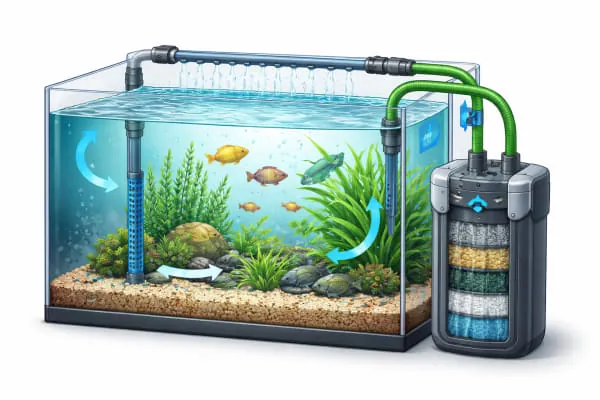
How aquarium filters work, how to pick the right type and flow for your tank, and how to clean the media without crashing your cycle.
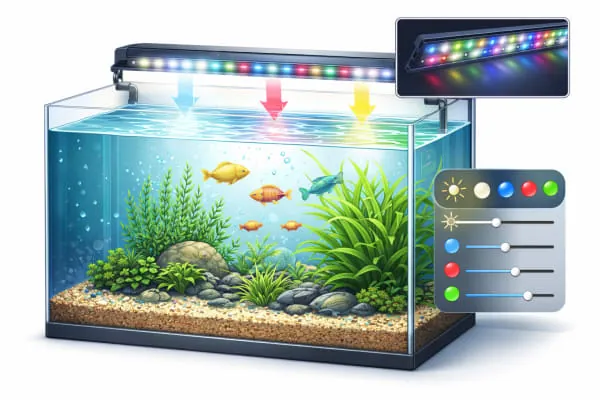
PAR-first planted tank lighting: choose intensity by what you grow, set photoperiod and spectrum, kill shadows, and hold algae back without overspending.
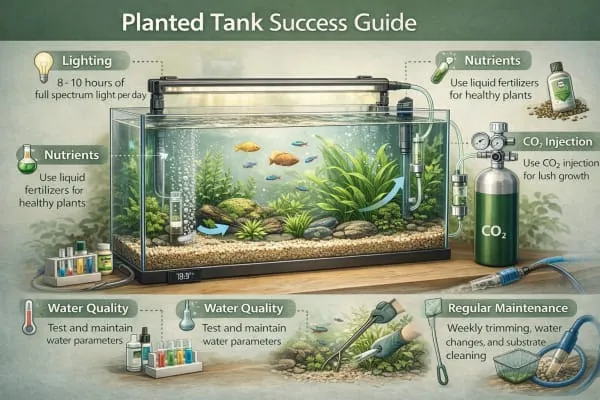
Grow a thriving planted aquarium: substrate, plant placement, feeding and dosing, pruning for density, and beating algae. Beginner-safe, expert-deep.