
Planted Tank Lighting Without Guesswork
PAR-first planted tank lighting: choose intensity by what you grow, set photoperiod and spectrum, kill shadows, and hold algae back without overspending.
On this page
If the filter is life support, light is the engine. It drives photosynthesis, and photosynthesis is what turns your CO₂ and fertilizers into new leaves. Get the light wrong and nothing else you do matters much: too little and plants stall while you wonder why the tabs and liquid ferts did nothing, too much and you hand algae a free lunch. The good news is that lighting a planted tank is not mysterious once you stop measuring the wrong things. This guide replaces watts-per-gallon folklore with the three factors that actually decide whether your plants thrive: how much usable light reaches the plants (PAR), what colors that light is made of (spectrum), and how evenly it lands across the tank (coverage).
Freshwater planted tanks are the main audience here. Reef keepers care about many of the same physics (PAR, depth, spread), so there are short notes for saltwater along the way.
The One Metric That Matters: PAR
Forget watts per gallon. Forget lumens. Forget the Kelvin number on the box. The only measurement that predicts plant growth is PAR, or Photosynthetically Active Radiation. PAR counts the photons between 400 and 700 nanometers, the wavelengths chlorophyll can actually use, that arrive at a given spot. The unit you will see is µmol of photons per square meter per second, usually written µmol/m²/s or just "µmols."
Why do the other numbers fail?
- Lumens weight brightness toward how the human eye sees green. Plants barely use green light, so a light can look blazingly bright and still grow plants poorly.
- Watts measure power draw, not output. A modern LED and an old fluorescent tube pulling the same wattage deliver wildly different PAR.
- Kelvin (like 6500K) describes the visual hue of the light, warm versus cool. It says nothing about how many usable photons reach the substrate.
PAR is always measured at a location, and location is everything, because light loses energy fast as it travels through water. A fixture can read 250 µmols an inch under the surface and 30 µmols at the substrate of a tall tank. That single fact explains most "my light should be strong enough" failures: the number on the marketing page was measured at the surface or a few inches down, not at your plants.
PAR Targets, Measured at the Substrate
Set your target by the most demanding plant you want to keep, and measure (or model) at the substrate where the plant's base sits.
| Light level | PAR at substrate | What it grows | Algae pressure |
|---|---|---|---|
| Low | 20 to 40 µmols | Anubias, Java fern, mosses, crypts, most floaters | Low, forgiving |
| Medium | 40 to 80 µmols | Most stems, easier carpets, decent reds | Moderate, manageable |
| High | 80 to 120 µmols | Demanding carpets, intense red coloration | High, needs discipline |
| Very high | 120+ µmols | Show-tank color, competition scapes | Severe without expert care |
These ranges are rules of thumb, not laws: plant tolerance overlaps and different sources cite slightly different cutoffs. Treat the boundaries as soft. The important pattern is the tradeoff: more light means faster growth and better color, but it also means faster algae if CO₂ and nutrients cannot keep up. High light is not "better," it is more demanding.
If you are choosing between a weak fixture run flat out and a strong fixture dimmed to 50 percent, buy the strong one and dim it. A powerful light gives you headroom: you can add plant mass or push color later by turning it up, instead of buying new hardware. Running a quality light at half power is also how you keep intensity in the sweet spot instead of blasting a low-tech tank into an algae farm.
For saltwater keepers: corals are also grown to PAR targets, but the numbers and the tool differ. Soft corals and LPS often sit around 50 to 150 PAR, SPS 200 to 400+, and the spectrum leans heavily blue for both growth and fluorescence. If reefs are your world, see our reef dosing tool for the chemistry side and the reef parameters guide for the full picture.
Light and Depth: Why Tall Tanks Are Hard
Light does not travel through water for free. Intensity falls off with distance, and it falls off faster than most people expect, so the deeper your substrate sits below the fixture, the more powerful the light has to be to deliver the same PAR down there. This is why a 12-inch cube and a 24-inch-tall tank with the same footprint need very different fixtures, and why carpeting plants (which live at the very bottom) are the first to suffer in a deep tank.
Two practical consequences:
- Match the fixture to the tank's height, not just its length. A light rated for a low rimless scape may starve the floor of a tall show tank.
- Hanging a light raises coverage but lowers intensity. Every inch you lift the fixture spreads the light wider and drops PAR at the substrate. Suspended lighting looks fantastic and reduces shadows, but you must start with a fixture powerful enough to survive the added distance.
Before you buy, it helps to model the PAR gradient for your exact tank depth so you are not guessing. AquaLens includes a Reef Light Lab that models PAR against depth, and while it is tuned for reef fixtures, the depth physics apply to any tank: it will show you how a light that reads high at the surface can still land in the low range at the substrate.
Photoperiod: How Long, Not Just How Bright
Intensity and duration are two separate dials, and beginners almost always over-run the second one. Plants do not need light all day, and long photoperiods are one of the most common causes of algae in an otherwise healthy tank.
A sane starting point for a new planted tank is 6 to 8 hours of light per day, run on a timer at the same time every day. Consistency matters more than the app-scheduled sunrise and sunset effects: plants entrain to a stable rhythm. Start on the shorter end, watch for a month, and only extend the photoperiod if plants are healthy and algae is absent.
A few photoperiod truths worth internalizing:
- A "siesta" (a midday off period) is optional, not magic. Splitting the photoperiod into two blocks with a gap can let CO₂ recover midday and can help some algae-prone tanks, but a single clean block on a timer works fine for most people. Do not treat the siesta as a fix for a tank that is simply over-lit.
- Ramping is for looks and fish comfort, not growth. Gentle fade-in and fade-out reduce the startle of lights slamming on and can look great. They do not meaningfully change how much plants grow.
- Longer is not stronger. If plants need more energy, raising intensity within your CO₂ limits usually beats extending hours, because every extra hour is also an extra hour of algae opportunity.
If you see algae, the two cheapest levers are almost always shortening the photoperiod and lowering intensity, before you spend a cent on chemicals.
Spectrum: How the Tank Looks, and a Little How It Grows
Once a light delivers enough PAR, spectrum mostly governs how the tank looks to your eye, and secondarily how well specific pigments show. Plants themselves are not fussy: they photosynthesize efficiently under red and blue light and can grow under a wide range of spectra. Astronauts grow plants on the ISS under mostly red and blue LEDs precisely because that is what chlorophyll wants.
So the spectrum conversation is really about aesthetics and pigment rendering:
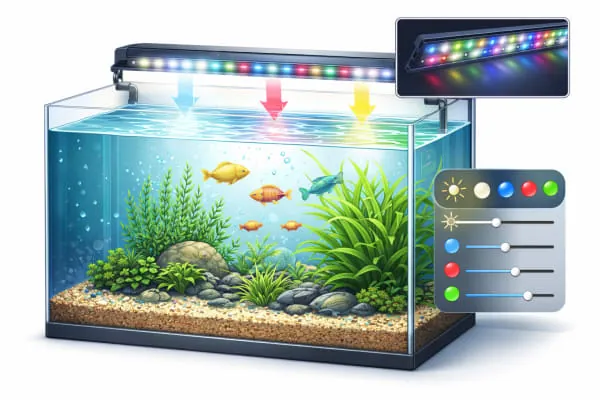
- RGB and tunable fixtures let you shift the balance of red, green, and blue diodes to change the mood of the tank and to make reds and greens pop. More red and blue tends to saturate plant colors; more white and green reads cleaner and more neutral.
- The diode itself matters more than the slider. A fixture built with "deep red" diodes renders red plants darker and richer than one using "bright red" diodes, no matter how you tune it. You cannot fully dial a cheap diode set into a premium look.
- Warm color often masks algae and tint, while high-Kelvin cool light can make a tank look sterile and show every speck. Pick what pleases you, then live with it for a week before judging.
Why cheaping out on the light hurts most. Lighting is the one component where a bargain shows immediately. Budget fixtures often wash out color, lack dimming and timer control (forcing you to run at 100 percent, which invites algae), and use diodes that cannot render the reds and blues in your fish and plants. A higher-end unit that you can tune and dim is not vanity, it is control over the single most powerful variable in the tank. Respected color-and-control brands include Chihiros, Twinstar, Week Aqua, Netlea, and ADA, among others; the point is not the logo but tunability and diode quality.
Coverage: Killing Shadows
A single point-source light creates a hotspot in the center and leaves the edges and the areas behind hardscape in shadow. In a planted tank, shadow means uneven growth: lush in the middle, leggy and pale at the ends, bare behind the big rock. Coverage is the fix, and it is easy to overlook because the tank looks bright to your eye even when the corners are starved.
How to get even coverage:
- Prefer a wide diode array or a fixture sized to the full tank length, not a small puck in the center of a long tank.
- Consider dual light bars (front and back) on deeper or wider tanks to attack shadows from two angles.
- Plan around hardscape. Tall wood and rock cast long shadows. Place shade-tolerant plants (Anubias, ferns, mosses, crypts) in those pockets on purpose, and reserve the bright open floor for carpets and demanding stems.
- Raising a hung fixture widens the spread but drops intensity, so it is a coverage-versus-PAR tradeoff, not a free win.
The elegant move is to design your planting to match the light map rather than fighting it: put the hungry plants where the light is strongest and let the tough species fill the shade.
Balancing the Triangle: Light, CO₂, and Nutrients
Here is the idea that ties the whole hobby together. Light sets the speed at which plants want to grow, and CO₂ plus nutrients determine whether they can grow at that speed. When light outruns the other two, plants cannot use all the energy, and the surplus feeds algae. Almost every stubborn algae problem in a healthy-looking tank is really a light-versus-CO₂ imbalance.
That gives you a clear rule for scaling up:
- Low light, no CO₂: the forgiving path. Keep intensity in the 20 to 40 µmol range, run 6 to 8 hours, choose hardy plants, and dose ferts lightly. Algae stays manageable because plant demand is modest.
- Adding intensity means adding CO₂. Once you push past medium light, injected CO₂ stops being optional. If you crank the light but not the carbon, you are building an algae reactor. Our CO₂ injection guide walks through regulators, diffusion, and drop checkers, and the CO₂ tool helps you dial in a target.
- Feed the growth you asked for. Faster growth burns through macro and micronutrients faster. If leaves show holes, pale tips, or stunting after a light upgrade, suspect a deficiency, not a light problem. Match symptoms to causes in our plant deficiencies guide, and calculate doses with the dosing tool.
The practical takeaway: raise light and CO₂ and ferts together, in small steps, and let the tank stabilize between changes. A new planted tank is most algae-prone in its first month or two while the biofilter matures and plants adjust from their emersed (grown-in-air) nursery form to submerged growth. Start conservative and earn your way up.
A Simple Setup Recipe
If you want a plan rather than a physics lecture, here it is.
- Decide what you want to grow first. The most demanding plant on your wish list sets your PAR target. Carpets and red stems mean high light and CO₂; Anubias, ferns, and crypts mean an easy low-light tank.
- Buy one quality fixture sized to your tank's length and height, with dimming and a timer, powerful enough to be run at partial output.
- Start at a modest photoperiod (6 to 8 hours) and modest intensity, especially for the first month. Run it on a timer at the same time daily.
- Watch for four weeks. Healthy new growth and no algae means you can nudge intensity or duration up. Algae or melting means dial back first, adjust CO₂ and ferts, and reassess.
- Scale the triangle together. Every increase in light gets matched by CO₂ and nutrient increases, in small steps.
This "start low, observe, adjust" loop is the whole game. Lighting rewards patience and punishes the urge to blast a young tank into instant lushness.
Choosing and Buying Your Plants
Lighting is only half the equation: the plants you pick have to match the light you built. If you are still deciding what to grow, our ultimate guide to choosing aquarium plants maps species to your light level, CO₂ decision, and how much maintenance you actually enjoy, so you do not buy a high-light carpet for a low-light tank. When you are ready to source them, where to buy aquarium plants covers the shops and sellers worth trusting and how to spot a healthy plant on arrival. For care specifics on individual species, the species library has detailed profiles for shade-lovers like Anubias nana and Java fern all the way to light-hungry carpets like dwarf hairgrass and Monte Carlo.
Doing This With AquaLens
The two lighting questions worth automating are whether a fixture will actually reach your substrate, and which change set off an algae bloom. AquaLens answers both.
- Model PAR before you buy. The Reef Light Lab models PAR against tank depth, so you can see a fixture's surface-to-substrate drop-off for your exact tank before you spend money. The physics of light through water are identical whether you grow plants or coral.
- Log the change, then read the result. When you shorten the photoperiod, dim the fixture, or add CO₂, note it in the tank's journal. Because that note sits on the same timeline as your pH and nitrate trends, an algae bloom or a recovery three weeks later points straight back to the change that caused it, instead of leaving you guessing.
Get AquaLens free and stop guessing whether the light or the CO₂ moved your tank.
Myth-Busting the Old Advice
- "Watts per gallon." A relic of the fluorescent era. LED efficiency broke the relationship between wattage and usable output. Ignore it and use PAR.
- "Lumens tell you if it is strong enough." Lumens measure human-perceived brightness, weighted toward green. Plants do not care how bright it looks to you.
- "You need full-spectrum light." "Full spectrum" is mostly marketing. Plants grow beautifully on red and blue. Spectrum is about looks and pigment rendering, not survival.
- "6500K is the plant number." Kelvin is a visual hue, not a growth rating. Plants grow across a wide Kelvin range.
- "High CRI means better plant color." CRI measures color accuracy, not saturation. Many aquascapers deliberately prefer a saturated, less accurate look that makes reds and greens pop.
- "More hours equals more growth." Beyond a point, extra hours mostly grow algae. Adjust intensity within your CO₂ limits before you extend the photoperiod.
Lighting stops being guesswork the moment you measure the right thing, match the fixture to your plants and tank depth, and change one variable at a time while the log tells you what happened. Do that, and the powerhouse of your ecosystem works for you instead of for the algae.
Frequently Asked Questions
How many hours a day should aquarium plant lights be on?
Start a new planted tank at 6 to 8 hours per day on a timer, run at the same time every day. Longer photoperiods mainly grow more algae, not more plants. Only extend the duration after a month of healthy growth with no algae, and raise intensity within your CO₂ limits before adding hours.
What is PAR and why does it matter more than watts or lumens?
PAR, short for Photosynthetically Active Radiation, counts the light photons between 400 and 700 nanometers that plants can actually use for photosynthesis. Watts measure power draw and lumens measure brightness as the human eye sees it, so neither predicts plant growth. PAR is the only metric that reliably tells you whether a light is strong enough at the substrate.
How much PAR do aquarium plants need?
Measured at the substrate, low-light plants like Anubias, Java fern, and crypts want roughly 20 to 40 µmols, most stems and easier carpets want 40 to 80, and demanding carpets and intense red plants want 80 to 120 or more. These are rules of thumb with soft edges. Higher PAR grows plants faster and colors them better, but it also raises algae pressure and demands more CO₂ and nutrients.
Why are my plants not growing even though the light looks bright?
Brightness to your eye is not the same as usable light at the substrate, and light loses intensity quickly with depth, so a tall tank may starve its floor. Growth also depends on CO₂ and nutrients keeping pace with the light. If a bright tank stalls, check the PAR reaching the substrate, verify CO₂ and fertilizer levels, and rule out a nutrient deficiency.
Do I need CO₂ for a planted tank?
No, if you keep light low and choose hardy plants like Anubias, Java fern, mosses, and crypts, a low-tech tank without injected CO₂ works well. You need CO₂ once you push past medium light, because high light without matching carbon lets algae exploit the surplus energy. As a rule, raise light and CO₂ together, never light alone.
What light spectrum is best for a planted aquarium?
Once a light delivers enough PAR, spectrum is mostly about how the tank looks and how well plant pigments show, not about survival. Plants photosynthesize efficiently under red and blue light and tolerate a wide range of spectra. Tunable RGB fixtures with quality diodes let you saturate reds and greens, but the diode quality matters more than the color slider.
Is more expensive aquarium lighting worth it?
Lighting is the one component where cutting costs shows immediately, so a quality fixture usually pays off. Cheap lights often wash out color, lack dimming and timers, and use diodes that render plants and fish poorly. A powerful, tunable light you can dim gives you headroom to add plants later and lets you keep intensity in the sweet spot instead of running flat out and inviting algae.
Does the color temperature (Kelvin) of my light affect plant growth?
No, Kelvin describes the visual hue of the light, warm versus cool, not its ability to grow plants. Plants grow successfully across a wide Kelvin range. Choose the color temperature that looks best to you, then judge the tank after living with it for a week.
How do I stop algae caused by too much light?
The two cheapest levers are shortening the photoperiod and lowering intensity, and you should try both before buying any chemical treatment. Algae usually means light is outrunning CO₂ and nutrients, so also check that carbon and fertilizers keep pace with the light. Make one change at a time and give the tank a few weeks to respond.
How do I light a deep or tall aquarium?
Match the fixture to the tank's height, not just its length, because light intensity drops sharply with depth and the substrate of a tall tank can fall into the low range even under a strong-looking light. Carpeting plants at the very bottom suffer first. Choose a more powerful fixture, and remember that raising a hung light widens coverage but lowers PAR at the substrate.
Dial In Your Light Without Guesswork
AquaLens models PAR against your tank depth, auto-logs every lighting and dosing change, and charts the parameters that light stress moves, so you can see what worked instead of guessing. Predictive alerts warn you before algae takes hold.
Keep reading
How aquarium filters work, how to pick the right type and flow for your tank, and how to clean the media without crashing your cycle.
Aquarium CO₂ injection made safe: how carbon, light, and nutrients balance, which system to buy, and how to dial it in without gassing your fish.
Diagnose aquarium plant deficiencies by leaf age and symptom: yellowing, pinholes, twisting, and stunting. Read the pattern, then fix it safely.