
Choose the Right Filter and Flow
How aquarium filters work, how to pick the right type and flow for your tank, and how to clean the media without crashing your cycle.
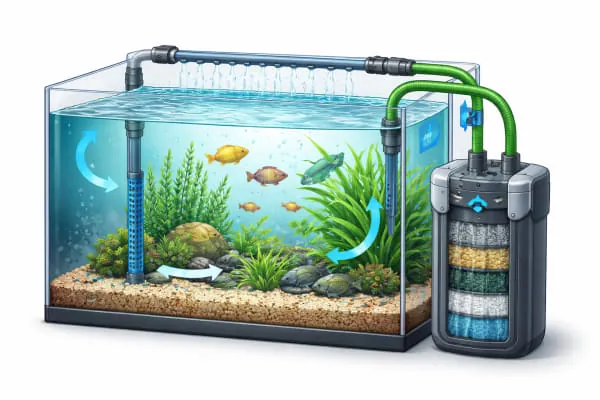
On this page
The filter is the single most misunderstood piece of gear in the hobby. Most people buy one thinking it "cleans the water," pick whatever the box says matches their tank size, and never think about it again until something goes wrong. That is a shame, because your filter is doing the most important job in the aquarium: it is the home of the invisible bacteria that keep your fish from being poisoned by their own waste.
Get filtration right and everything downstream gets easier. Water stays clear, ammonia and nitrite stay at zero, algae has less to feed on, and your fish are calmer. Get it wrong and you fight a losing battle against cloudy water, waste buildup, and stressed livestock no matter how often you do maintenance. This guide walks you through what a filter really does, how to choose the right one, how much flow you actually want, and how to maintain it without the classic mistake that resets your tank to day one.
What a Filter Actually Does
Every healthy aquarium filter performs three separate jobs at once. Understanding them individually is the key to everything else here.
Biological filtration is the one that matters most. Fish produce ammonia (NH₃) through their gills and waste, and ammonia is toxic even in tiny amounts. Colonies of beneficial bacteria living on your filter media convert that ammonia first into nitrite (NO₂⁻), which is also toxic, and then into nitrate (NO₃⁻), which is far safer and removed by water changes. This is the nitrogen cycle, and your filter is where most of it happens. If you have not cycled your tank yet, stop and read the fishless cycling guide first, because a filter with no established bacteria is just a water pump.
Mechanical filtration is the part people picture: trapping floating debris, fish waste, and uneaten food in sponges or floss so the water looks clear. It is genuinely useful, but it is secondary. Clear water is not the same as clean water. A tank can be crystal clear and still have lethal ammonia, or slightly hazy and perfectly healthy.
Chemical filtration uses media like activated carbon or specialized resins to pull dissolved substances out of the water: tannins that tint the water, medications you want to remove after treatment, or phosphates that feed algae. It is optional for most tanks and something you reach for when you have a specific problem to solve, not a permanent fixture.
The reason this ordering matters: when you clean your filter, protect the biological layer above all else. Everything in this guide comes back to that one principle.
The golden rule of filtration: you can never have too much biological capacity, but you absolutely can have too much flow. Aim for a large, stable bacterial home with current you can control.
Sizing a Filter: Turnover and the Numbers That Matter
Filters are rated in gallons per hour (GPH), the volume of water they move in an hour. The common rule of thumb is to turn your tank's water over four to six times per hour for a typical community tank. A 40 gallon tank, then, wants a filter moving roughly 160 to 240 GPH.
But two important caveats make that rule less tidy than it sounds. First, the GPH printed on the box is a best-case figure measured with no media, no hoses, and no head height. Real-world flow through a loaded filter is often 30 to 50 percent lower. Second, turnover needs change with your fish. High-waste animals want more; delicate slow swimmers want much less.
Here is a realistic starting point by fish type:
| Tank type | Target turnover | Why |
|---|---|---|
| Delicate slow swimmers (bettas, dwarf gouramis, shrimp) | 2 to 4x | Strong current exhausts weak swimmers and can literally wear them out |
| Standard community tank | 4 to 6x | Balances water quality with comfortable flow |
| High-waste fish (goldfish, cichlids, plecos) | 6 to 10x | Heavy waste must be pushed to the filter before it rots |
| River species (hillstream loaches, danios) | 10 to 20x | These fish evolved in fast rivers and need it |
Because the box rating overstates real flow, buy a filter rated a step above your tank rather than exactly at it. It is easy to turn a strong filter down with a valve or a spray bar. It is impossible to make a weak filter stronger. To skip the mental math on your specific setup, the filter flow calculator converts tank volume and stocking into a realistic GPH target, and the tank volume calculator gives you an accurate starting number if you are not certain how much water your tank actually holds (the printed size is usually generous).
The Main Filter Types, and Who Each One Suits
There is no single best filter, only the best filter for your tank, your fish, and how much maintenance you enjoy. Here are the types you will actually encounter.
Hang-On-Back (HOB)
The classic beginner filter. It hangs on the rim and pumps water up through a chamber before it cascades back in.
HOBs are inexpensive, easy to access, and the waterfall return oxygenates the water nicely. Their weaknesses are real, though. Many models ship with disposable cartridges, and the manufacturers want you to replace them monthly. Do not. Throwing out the cartridge throws out most of your bacteria and can restart your cycle. Instead, keep the cartridge in place long-term and add extra biological media (ceramic rings or a small sponge) to the chamber so your colony has a permanent home. The other quirk: that splashing return off-gasses CO₂, which is fine for most tanks but works against you in a high-tech planted tank running CO₂ injection.
Best for: community tanks, beginners, quarantine and hospital tanks.
Canister Filters
The workhorse of serious freshwater keeping. A sealed canister sits in the cabinet below the tank, connected by intake and return hoses, and pushes water through several trays of media you choose yourself.
Canisters hold an enormous volume of media, which means huge biological capacity and long stretches between cleanings. Flow is fully adjustable, they run silently, and they pair beautifully with inline CO₂ reactors and heaters that keep equipment out of the display. The tradeoffs are cost and the fact that maintenance means disconnecting hoses and hauling the unit to a sink, which is a bigger chore than rinsing an HOB sponge. For planted aquascapes, heavily stocked tanks, and anything over about 40 gallons, a canister is usually the right long-term answer.
Best for: planted tanks, large display tanks, high stocking, anyone who wants to "set it and forget it" for weeks.
Sponge Filters
Deceptively simple: a foam block driven by air bubbles from an air pump. As bubbles rise through a lift tube, they drag water through the sponge, and the sponge becomes both a mechanical trap and a massive bacterial surface.
Sponge filters cannot suck up fry, shrimplets, or long betta fins, and they create gentle, diffuse flow that delicate species love. They are cheap, nearly silent apart from the air pump, and give shrimp a grazing surface. What they do not do is polish water to gin-clarity or provide meaningful mechanical filtration for messy fish. They also sit visibly inside the tank, which some keepers dislike.
Best for: breeding and fry tanks, shrimp colonies, betta tanks, and as a supplementary bio-filter to seed a new setup.
Undergravel, Internal, and Sump Filters
A few others round out the field. Internal filters are compact powered units that sit inside the tank, handy for small setups and quarantine. Undergravel filters pull water down through the substrate; they are old-school and largely superseded, but still work. Sumps, an extra tank plumbed below the display, are the standard for larger and saltwater systems because they add water volume, hide equipment, and offer unlimited media space. If you are heading toward a reef, the sump conversation lives in the saltwater setup guide.
Flow Quality: Turnover Is Not the Whole Story
Getting enough turnover is only half the job. Where that water goes matters just as much as how much of it moves.
Dead spots are the silent problem. These are pockets, usually behind hardscape, in dense plant corners, or in the substrate under a rock, where water velocity drops to nearly zero. Detritus settles there and decomposes anaerobically, producing hydrogen sulfide (that rotten-egg smell when you disturb old substrate) and feeding localized ammonia and nitrate. You can have a filter with textbook turnover and still have a filthy dead corner quietly polluting the tank. The fix is not always a bigger filter; often it is redirecting your existing return or adding a small circulation pump or wavemaker to keep solids suspended until the filter can catch them.
The washing machine effect is the opposite failure. Oversize your flow relative to the tank and shy fish spend their days pinned against the glass or hiding, unable to swim naturally or feed comfortably. Water quality can be flawless while your fish are miserable. This is why raw GPH is a trap: a filter rated for 75 gallons dumped onto a 20 gallon betta tank produces perfect chemistry and a thoroughly stressed fish.
The goal to aim for is high volume, controlled velocity: a filter with plenty of biological capacity, with its output softened so the current is gentle and well distributed. Practical tools for this include a spray bar (spreads the return across a wide, soft sheet), a flow control valve (canisters), pointing the outflow at the glass or along the surface, and lily pipes or duckbill nozzles for aquascapes. For saltwater and reef keepers the equation flips: corals generally want strong, turbulent, variable flow, so reefers deliberately run high total flow with wavemakers, and coral placement depends on matching each species to a flow zone.
Filter Media: Building the Bacterial House
Inside almost any filter, water should pass through media in a deliberate order, from coarsest to finest, then across biological media.
- Coarse mechanical (a rough sponge or filter pad) catches the big debris first so it does not clog the finer stages.
- Fine mechanical (filter floss or a fine pad) polishes out the small particles that make water look hazy. This is the stage you replace or rinse most often.
- Biological media (ceramic rings, porous bio-blocks, or a dedicated sponge) is where the bulk of your bacteria live. This is the media you protect at all costs and effectively never replace.
- Chemical media (carbon or resin), if used, usually goes last, and only when you have a reason to run it.
The single most important media rule: biological media is not a consumable. Ceramic rings and mature bio-sponges do not wear out. The porous surface is coated in the exact bacteria keeping your fish alive, and every manufacturer that tells you to replace it monthly is selling replacement media. Keep it for years. Rinse it gently when flow slows, and only ever replace a portion at a time if it is genuinely disintegrating, so the colony can repopulate the new material.
Maintaining a Filter Without Crashing Your Cycle
More established tanks are wrecked by bad filter cleaning than by almost anything else. Here is how to do it safely.
Rinse in old tank water, never tap water. When you clean biological media, swish it in a bucket of water you just siphoned out during a water change. Tap water contains chlorine or chloramine, which is added specifically to kill bacteria, and it will do exactly that to your filter colony in seconds. This one habit prevents most accidental cycle crashes.
Rinse, do not scrub, and do not aim for spotless. Your goal is to restore flow by removing the gunk that is physically clogging the media, not to sterilize it. A bio-media that looks a little brown and biofilmy is a bio-media doing its job. Give it a few gentle squeezes until the worst of the sludge releases, then put it back.
Stagger your cleaning. Never deep-clean or replace all your media at once. If you have multiple sponges or trays, clean roughly half now and the rest in two or three weeks. That way a healthy bacterial reserve always survives to recolonize whatever you disturbed.
Clean the mechanical stage on its own schedule. Filter floss and fine pads clog fastest and hold the least bacteria, so those are the parts you can rinse frequently or replace outright without worrying much about your cycle.
How often? Watch the flow, not the calendar. When the output visibly weakens, it is time. For a typical community tank that tends to land every four to six weeks, but a heavily stocked or high-waste tank may need attention every two to three weeks, and a lightly stocked planted tank can go months. If you clean the filter and your fish suddenly show stress or you see an ammonia reading afterward, that is the classic sign you took out too much bacteria at once. Test, do a water change, and stagger more gently next time.
Doing This With AquaLens
You can never eyeball whether a filter is keeping up, and that is where AquaLens earns its place. Scan a test strip, liquid kit, or digital tester and it reads the result, you confirm it, and the ammonia, nitrite, and nitrate land in that tank's logbook automatically.
Two things then do the real work for filtration:
- The nitrite trend line. If nitrite ever lifts off zero on your trend charts, your biological filtration is behind your bioload, and it is time to add media, feed less, or slow down stocking, well before your fish show it.
- Maintenance notes on the same timeline. Log each filter clean or media swap as a note, so when a parameter shifts weeks later you can see at a glance whether you took out too much bacteria.
Get AquaLens free and do all the core logging with no account, on your phone or any browser.
Common Filtration Mistakes to Avoid
- Replacing all media on a schedule. The number-one cycle killer. Keep biological media; only swap disposable floss.
- Buying to the exact box rating. Real flow is lower than advertised. Size up and turn it down.
- Cleaning the filter and doing a big water change on the same day. You disturb the two biggest bacterial reserves at once. Space them out.
- Ignoring dead spots. Textbook turnover with a rotting corner is not a clean tank. Add circulation where water stalls.
- Blasting delicate fish. Match flow to your livestock. Confirm stocking fit with the stocking compatibility guide before you commit to a filter.
- Forgetting the filter feeds algae control. A strong, well-maintained filter that keeps nitrate and waste down is your first line of defense against nuisance algae, covered fully in the algae control guide.
Where Filtration Fits in the Bigger Picture
No single piece of gear works in isolation. Your filter, your stocking level, your feeding habits, and your water change routine are one connected system. Overfeed and even a great filter falls behind. Overstock and you need far more biological capacity than the tank size suggests. If you are just getting oriented, the aquarium basics guide puts all these pieces in context, and the water chemistry guide explains what the numbers your filter influences actually mean. Filtration is the engine, but you are the one steering.
Get the filter right, protect the bacteria that live in it, keep the flow appropriate to your fish, and clean it gently and on time. Do that and your tank rewards you with the thing every keeper is really after: quiet, boring, stable water that just works.
Frequently Asked Questions
What does an aquarium filter actually do?
A filter does three jobs: biological filtration, where beneficial bacteria convert toxic ammonia and nitrite into safer nitrate; mechanical filtration, which traps visible debris and waste; and optional chemical filtration, which removes dissolved substances like tannins or medications. The biological job is by far the most important because it keeps fish from being poisoned by their own waste. Clear water is not the same as clean water.
How do I size a filter for my aquarium?
A common rule of thumb is to turn your tank's water over four to six times per hour for a standard community tank, so a 40 gallon tank wants roughly 160 to 240 gallons per hour. Because the flow rating printed on the box is measured with no media or hoses, real-world flow is often 30 to 50 percent lower, so buy a filter rated a step above your tank. It is easy to turn a strong filter down and impossible to make a weak one stronger.
How often should I clean my aquarium filter?
Watch the flow rather than the calendar. Clean it when the output visibly weakens, which for a typical community tank is usually every four to six weeks. Heavily stocked or high-waste tanks may need it every two to three weeks, while lightly stocked planted tanks can go months. Cleaning too often or too aggressively removes beneficial bacteria and can stress your fish.
Should I replace my filter media every month?
No. Never replace biological media like ceramic rings or mature bio-sponges on a schedule, because that is where your beneficial bacteria live and throwing it out can crash your cycle. Manufacturers who tell you to replace it monthly are selling replacement media. Only disposable filter floss or fine polishing pads should be replaced regularly, and even biological media only when it is physically disintegrating, and then only a portion at a time.
Why should I rinse filter media in old tank water instead of tap water?
Tap water contains chlorine or chloramine, which is added specifically to kill bacteria and will wipe out your filter's beneficial colony within seconds. When you clean biological media, swish it gently in a bucket of water you just siphoned out during a water change. This single habit prevents most accidental cycle crashes.
What is the best type of aquarium filter?
There is no single best filter, only the best one for your tank and fish. Hang-on-back filters are cheap and easy for beginners and community tanks. Canister filters hold huge media volumes and suit planted, large, or heavily stocked tanks. Sponge filters are gentle and safe for shrimp, fry, and bettas. Sumps are standard for large and saltwater systems.
Can a filter have too much flow?
Yes. While you can never have too much biological capacity, too much current stresses fish. Delicate slow swimmers like bettas, gouramis, and shrimp can be exhausted or pinned against the glass by strong flow, even when the water chemistry is perfect. Aim for high biological volume with the output softened using a spray bar, flow valve, or by aiming the return along the glass or surface.
What is a dead spot in an aquarium?
A dead spot is an area where water velocity drops to near zero, usually behind hardscape, in dense plant corners, or in substrate under rocks. Debris settles there and decomposes without oxygen, producing hydrogen sulfide and localized ammonia and nitrate. The fix is to redirect your filter's return or add a small circulation pump or wavemaker to keep solids suspended until the filter can catch them.
Do I need a filter if I have a planted tank?
Yes, in almost all cases. Plants help absorb nitrate and add oxygen, but they do not replace the biological filtration that converts toxic ammonia and nitrite, especially in a stocked tank. Heavily planted, lightly stocked tanks can run smaller filters, but you still want reliable water movement and a stable bacterial home. Canister filters are popular for planted tanks because they keep equipment hidden and pair well with CO2 systems.
Know If Your Filter Is Keeping Up
AquaLens reads your test photos and auto-logs ammonia, nitrite, and nitrate, so you can see at a glance whether your biological filtration is winning. Trend charts and predictive alerts catch a struggling filter before your fish do.
Keep reading
PAR-first planted tank lighting: choose intensity by what you grow, set photoperiod and spectrum, kill shadows, and hold algae back without overspending.
Aquarium CO₂ injection made safe: how carbon, light, and nutrients balance, which system to buy, and how to dial it in without gassing your fish.
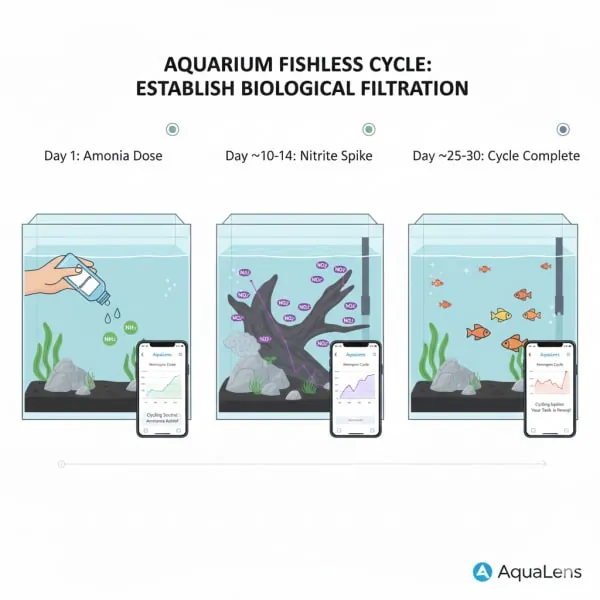
A step-by-step fishless cycle: dose ammonia, read the two spikes, and prove your filter is ready before a single fish goes in.