
Fish Health & Quarantine Guide
Quarantine new fish, spot the early warning signs, and treat disease without wrecking your tank. A practical freshwater fish health guide.
On this page
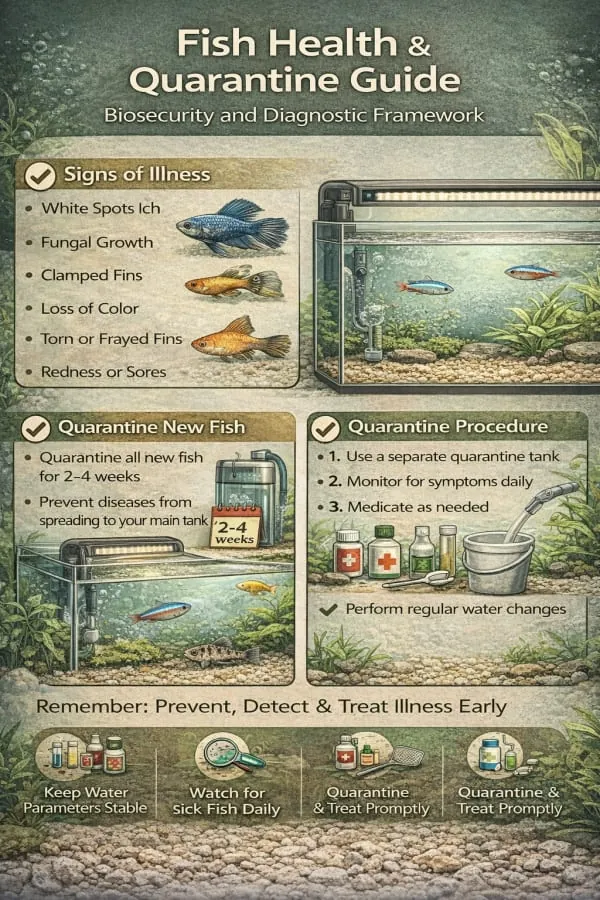
Most fish disease is preventable, and most of the rest is treatable if you catch it early. The keepers who almost never lose fish are not luckier than you. They quarantine new arrivals, they watch behavior daily, and they fix water quality before reaching for medication. This guide walks you through all three, from the quarantine tank that protects your display to the treatment plan for the disease you are staring at right now.
If you are in an active emergency, a fish gasping at the surface or a tank crashing, jump to the First Response section below and see the Emergency First 60 Minutes guide. Everyone else, start at the top: quarantine is the single highest-value habit in the hobby.
This guide is freshwater-focused. Saltwater and reef disease behaves differently, ich and velvet are far more aggressive in marine tanks, so reef keepers should read the Marine Quarantine guide alongside this one.
Why Quarantine Is Non-Negotiable
An aquarium is a closed system. In a lake, a parasite that drops off a fish drifts away into thousands of gallons and rarely finds another host. In your 40-gallon tank, it lands right back on a fish. Pathogens that would fizzle out in the wild multiply into an outbreak in a glass box, and by the time you see symptoms on one fish, the water already carries the next generation.
New fish are the number one way disease enters a healthy tank. A fish can look perfect in the store and still carry ich, flukes, or a low-grade bacterial infection that flares once shipping and rehoming stress knock down its immune system. Store systems often share water across dozens of tanks, so one sick fish three tanks over can mean the one you bought is already exposed. Quarantine gives that hidden infection somewhere to show itself, somewhere that is not your main display.
The rule is simple: never add a new fish, plant, shrimp, or snail straight into your display tank. Everything gets a holding period first.
Setting up a quarantine tank
A quarantine (QT) tank is deliberately basic. You want something cheap, easy to strip down and disinfect, and gentle on medications.
- Size: A 10-gallon or 20-gallon tank covers most community fish. Bigger fish or a large batch need more room.
- Bare bottom: No substrate. Uneaten food and waste are easy to siphon, and there is no gravel to absorb medication or harbor parasites.
- Sponge filter: Run an air-driven sponge filter in your display tank for a few weeks before you need it, or squeeze established filter media into the QT. This seeds beneficial bacteria so the quarantine tank is cycled and safe from day one. Carbon and chemical media must come out, they strip medication straight back out of the water.
- Heater and lid: Match the fish's temperature needs. A tight lid matters because stressed new fish jump.
- Hides: A few plastic plants or a piece of PVC pipe. A fish that feels exposed stays stressed, and stress is what lets disease win.
Because a bare QT tank has little biological buffer, test the water often and do water changes to keep ammonia and nitrite at zero. The Nitrogen Cycle Guide explains how to get that sponge filter cycled before the fish arrive.
The quarantine protocol
Plan on four weeks minimum. Most parasite life cycles and incubation periods play out inside that window; cut it short and you defeat the point.
- Week 1, observe. Watch eating, breathing, swimming, and droppings. Healthy fish eat eagerly and produce solid, colored waste. Stringy white feces, refusal to eat, or hiding are early flags. Do not medicate yet, you are gathering a baseline.
- Week 2, treat as needed. Many experienced keepers run a prophylactic deworming with praziquantel here, since internal parasites are common and often invisible. Otherwise, treat only what you actually see.
- Weeks 3 to 4, confirm. If the fish is eating well, active, and symptom-free, it has earned its place. If anything appeared, restart the clock after the fish fully recovers.
Quarantine your plants too. Plants can ferry snails, snail eggs, and parasite stages. A separate plant-only holding period, or a dip, keeps hitchhikers out. If you are adding plants, our friends' guides on choosing and where to buy aquarium plants are the place to start.
Water Quality Comes First, Always
Here is the single most important idea in this entire guide: the large majority of "diseases" hobbyists panic over are really symptoms of bad water. Ammonia and nitrite are directly toxic. They burn gills, damage tissue, and crush the immune system, and a suppressed immune system is an open door for parasites and bacteria that a healthy fish would have shrugged off.
So before you dose a single drop of medication, test your water. Ammonia and nitrite should read zero. Nitrate should be low, generally under 20 to 40 ppm for most community tanks. Check that temperature, pH, and hardness match what your species actually needs, and that nothing swung suddenly. If you find a problem here, fixing the water is the treatment. A large water change often does more for a sick fish than any bottle on the shelf.
AquaLens's test-kit scanning reads your test photo, whether a strip, a liquid kit color, or a digital checker, and logs the numbers automatically so you can see at a glance whether water quality is the real culprit. When you are unsure what a reading means, the Water Test Interpretation guide breaks down each parameter, and /tools/water-change tells you exactly how much to change to hit your target.
Only once the water is confirmed clean should you conclude you are dealing with an actual pathogen.
First Response: When a Fish Looks Sick
Move through these steps in order.
- Test the water. Zero ammonia, zero nitrite, sensible nitrate. If not, big water change now.
- Observe and identify. What exactly do you see? Match it against the symptoms below before choosing a treatment. Guessing wrong wastes days you may not have.
- Isolate if you can. Move the affected fish to your hospital or quarantine tank. This protects the rest and lets you medicate without harming your display's biological filter.
- Treat the specific problem. Not a shotgun of every medication at once. Combining medications can poison fish and stall your cycle.
- Log it. Note the date, the symptom, and what you did. Progression over days is often the only way to tell a fast bacterial infection from a slow parasite.
Reading the Signs: A Diagnostic Guide
Fish cannot tell you what is wrong, but they show clear clinical signs. Learn to read them.
Behavioral signs
- Flashing: Rubbing or scraping against decor, rocks, or substrate. Usually external parasites (ich, flukes) irritating the skin, sometimes ammonia irritation.
- Gasping at the surface: Hanging near the top gulping. Low oxygen, ammonia poisoning, or gill flukes. Add surface agitation immediately and test the water.
- Clamped fins: Fins held tight to the body. A general distress signal, poor water quality, chilling, or early infection.
- Lethargy or hiding: A normally active fish sitting on the bottom or wedged in a corner. Nonspecific but real; something is wrong.
- Loss of appetite: Often the first sign of anything, from stress to internal parasites.
Physical signs
| What you see | Likely cause | First move |
|---|---|---|
| Fine white "salt grains" on fins and body | Ich (Ichthyophthirius multifiliis), a protozoan parasite | Heat and/or ich medication; treat the whole tank |
| Fuzzy white cottony patches | Saprolegnia fungus or Columnaris bacteria | Isolate; antifungal or antibacterial per appearance |
| Gray-white film, frayed mouth or fins, fast progression | Columnaris (bacterial) | Isolate and treat quickly; it kills fast |
| Ragged, receding, red-edged fins | Fin rot (bacterial), usually water-quality driven | Fix water first, then antibacterial if it spreads |
| Bulging eye(s) | Popeye, bacterial infection or injury | Improve water; antibacterial for infection |
| Scales sticking out like a pinecone | Dropsy, internal bacterial or organ failure | Isolate; often fatal, treat early if at all |
| Red streaks, ulcers, open sores | Bacterial septicemia or injury | Isolate; antibacterial and pristine water |
| Rapid gilling, one gill flared | Gill flukes or ammonia | Test water; praziquantel for flukes |
| Velvety gold-dust sheen | Velvet (Oodinium), more common in marine | Dim lights; see marine guide for reef tanks |
When you are not sure, AquaLens's photo ID can scan the fish and point you toward likely conditions with honest uncertainty, and AquaGuide chat can talk through symptoms with you, free for a few questions a day or with your full tank context on Pro.
The Medicine Cabinet: What to Keep on Hand
Disease moves faster than shipping. Do not wait for a sick fish to place an order, keep a small kit ready. A sensible freshwater starter set:
- Antiparasitic for ich and external protozoans. Products with malachite green and formalin are the common standard and are generally plant- and snail-safe at label doses.
- Broad antibacterial. Covers fin rot, popeye, and columnaris. Read whether a product targets gram-positive or gram-negative bacteria; columnaris in particular needs the right one.
- Praziquantel. The go-to dewormer for internal and gill flukes and tapeworms. Gentle and widely used prophylactically in quarantine.
- Aquarium salt. A cheap, versatile tool covered below.
The golden rule of medication: treat one thing at a time, follow the dosage exactly, and never mix medications unless a trusted source explicitly says the combination is safe. More is not better; overdosing and cocktails kill fish and stall cycles. Always remove chemical filtration (carbon) before dosing, or the medication is pulled straight out of the water.
Aquarium salt: powerful but not universal
Aquarium salt (sodium chloride, not marine salt mix) is a mild antiseptic and stress reliever, and it helps block nitrite toxicity in an emergency. A common dose is one tablespoon per 5 gallons, added gradually.
Use it carefully. Salt does not evaporate, so you only remove it with water changes. And it is hard on many plants and on scaleless or salt-sensitive fish, corydoras, loaches like the kuhli loach and clown loach, and many tetras, so dose low and watch them, or dose in a separate hospital tank.
Treatment Playbooks
Ich (white spot)
The most common freshwater disease, and very beatable if you act early. Ich has a life cycle: only the free-swimming stage is vulnerable, so you must keep treating past the point where visible spots disappear.
- Heat method: Slowly raise the temperature to about 86°F (30°C) over a day or two. Warmth speeds the parasite's life cycle so it hits the treatable free-swimming stage faster. Hold for at least two weeks. Warm water holds less oxygen, so add an airstone and confirm your fish tolerate the heat first.
- Medication: An ich treatment kills the free-swimming stage. Combine with modest heat for stubborn cases, following label directions.
- Whole-tank: Because the parasite is in the water and substrate, treat the entire tank, not just the spotted fish.
Fin rot and bacterial infections
Fin rot almost always starts with water quality. Fix the water and mild cases often heal on their own as the immune system recovers. If fins keep receding or you see red edges, add a broad antibacterial in a hospital tank. Ulcers, popeye, and red streaking are more serious bacterial infections; treat early with clean water and the right antibiotic.
Fungus and columnaris
True fungus (Saprolegnia) looks like distinct cottony tufts, often on an existing wound. Columnaris is bacterial, looks more like a gray-white film or saddle, and moves alarmingly fast, so when in doubt treat for columnaris urgently. Both prefer stressed fish and warmer water, so with columnaris do not raise the temperature.
The hospital tank approach
When a fish in your display gets sick, move it to your QT tank and treat there, for two reasons. First, you protect the healthy fish. Second, and this trips up a lot of beginners, antibiotics and many medications kill the beneficial bacteria in your biological filter. Dose your main display and you can trigger an ammonia spike that harms every fish in it. Never medicate the whole display unless the entire population is clearly infected and isolation is impossible.
Prevention: The Real Secret
Everything above is damage control. The keepers who rarely deal with disease build these habits instead.
- Quarantine everything. Fish, plants, shrimp, snails. Every time.
- Keep water pristine. Regular water changes, a filter sized for your stock, and never overstock. Stable, clean water is the foundation of fish immunity. See the Filtration and Water Chemistry guides.
- Stock compatibly and don't crowd. Aggression and overcrowding are chronic stressors. Check pairings with /tools/stocking and read Stocking & Compatibility.
- Feed well, don't overfeed. Good nutrition builds immunity; excess food rots and fouls water. The Feeding Guide covers the balance.
- Acclimate gently. Temperature and chemistry shock weakens new fish right when they are most vulnerable. See Acclimation.
- Observe daily. Two minutes at feeding time to watch everyone eat and move is the best early-warning system there is.
Doing This With AquaLens
Two parts of this guide are really record-keeping problems, and that is where AquaLens fits.
- Rule out water first. Scan a strip, liquid kit, or digital checker and your ammonia, nitrite, and nitrate are read and logged in seconds, so the opening question of every health scare, is this actually a water problem, gets a real answer instead of a guess.
- Tell a fast infection from a slow parasite. Every scan, symptom note, and dose lands on one dated timeline, so the log remembers when the first spot appeared and how quickly it spread.
- Stay on the treatment cadence. Dosing schedules with phone reminders hold you to the every-day or every-other-day rhythm ich medication demands, and auto-log each dose so you never lose your place mid-course.
Get AquaLens free and let your logbook do the remembering.
When to Accept a Loss
Not every fish can be saved. Advanced dropsy, late-stage columnaris, and severe organ failure are often past the point where medication helps, and prolonging a suffering fish is not kindness. If you must euthanize, clove oil is the widely accepted humane method for aquarium fish. Losing a fish is part of the hobby; what matters is learning from the log why it happened, so the next one does not.
For saltwater and reef disease, which plays out faster and differently, continue with the Marine Quarantine guide.
Frequently Asked Questions
How long should I quarantine new fish?
Plan on a minimum of four weeks. Most parasite life cycles and disease incubation periods play out within that window, so a shorter period can let a hidden infection slip through into your display. If any symptoms appear during quarantine, treat the fish and restart the clock once it has fully recovered.
Do I really need a separate quarantine tank?
Yes, if you value the fish already in your display. A new fish can look healthy in the store and still carry ich, flukes, or a bacterial infection that flares under the stress of moving. A simple bare-bottom 10 or 20 gallon tank with a sponge filter and heater is inexpensive and pays for itself the first time it stops an outbreak.
What are the first signs a fish is sick?
Watch for loss of appetite, clamped fins, lethargy or hiding, and flashing where the fish scrapes against surfaces. Physical signs include white spots, fuzzy patches, ragged fins, bulging eyes, and scales sticking out like a pinecone. A daily two-minute watch at feeding time is the best early warning you have.
Why does my fish keep getting sick?
The most common cause is poor or unstable water quality, which suppresses the immune system and lets parasites and bacteria take hold. Test for ammonia and nitrite, which should read zero, and keep nitrate low with regular water changes. Overstocking, aggression, and poor acclimation are the other usual culprits.
How do I treat ich in a freshwater tank?
Ich has a life cycle and only its free-swimming stage is vulnerable, so you must keep treating past the point where spots disappear. Slowly raising the temperature to about 86°F speeds the cycle, and an ich medication kills the free-swimming stage. Treat the whole tank because the parasite lives in the water and substrate, and add an airstone since warm water holds less oxygen.
Can I put medication directly in my main display tank?
Avoid it when you can. Many antibiotics and medications kill the beneficial bacteria in your biological filter, which can trigger an ammonia spike that harms every fish in the tank. Move sick fish to a hospital or quarantine tank and treat there. Only medicate the whole display if the entire population is clearly infected and isolation is impossible.
Is aquarium salt safe for all fish?
No. Aquarium salt is a useful mild antiseptic and helps block nitrite toxicity, but it is hard on live plants and on scaleless or salt-sensitive fish such as corydoras, loaches, and many tetras. Dose low, add it gradually, and watch sensitive species closely, or use it only in a separate hospital tank.
Should I quarantine live plants too?
Yes. Plants can carry snails, snail eggs, and parasite stages from the systems they were grown in. A separate plant-only holding period or a plant dip keeps those hitchhikers out of your display. This matters most if the plants were kept in tanks that also held fish.
What medications should I keep on hand for fish disease?
A sensible freshwater kit includes an antiparasitic for ich, a broad antibacterial for fin rot and other bacterial infections, praziquantel for internal and gill flukes, and aquarium salt. Disease moves faster than shipping, so buy these before you need them. Always treat one problem at a time and never mix medications unless a trusted source confirms the combination is safe.
Is fish quarantine different for saltwater tanks?
Yes, marine disease is generally more aggressive, and diseases like ich and velvet behave differently and can kill faster than in freshwater. Reef keepers often use copper-based treatments and dedicated protocols that this freshwater guide does not cover. See the dedicated marine quarantine guide for saltwater and reef disease management.
Catch Fish Disease Before It Spreads
AquaLens scans your test kits, auto-logs every reading, and charts the trends that reveal trouble early, so you can tell a water problem from a real disease and treat the right thing fast.
Keep reading
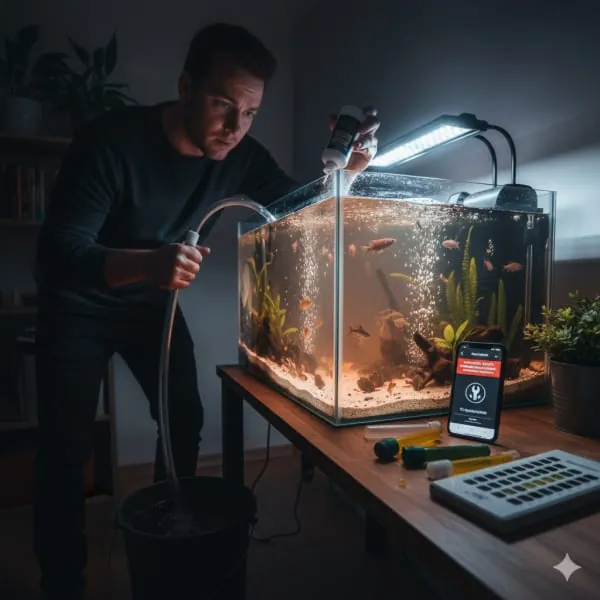
Aquarium emergency triage for the first hour: gasping fish, ammonia spikes, dead filters, power outages, and exactly what to do minute by minute.
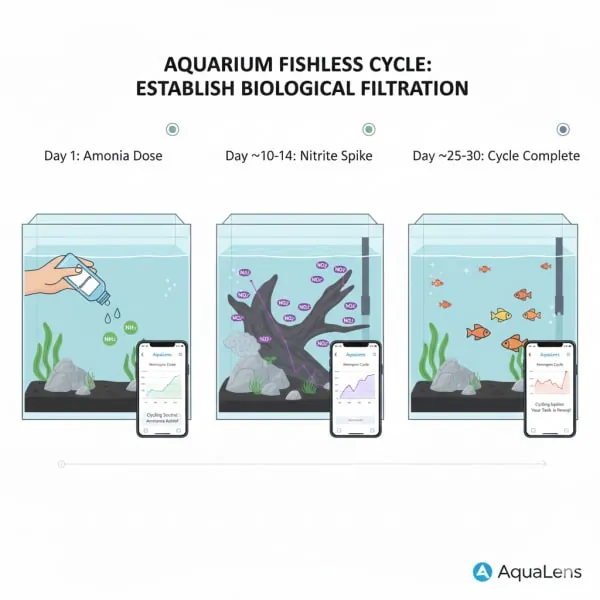
A step-by-step fishless cycle: dose ammonia, read the two spikes, and prove your filter is ready before a single fish goes in.
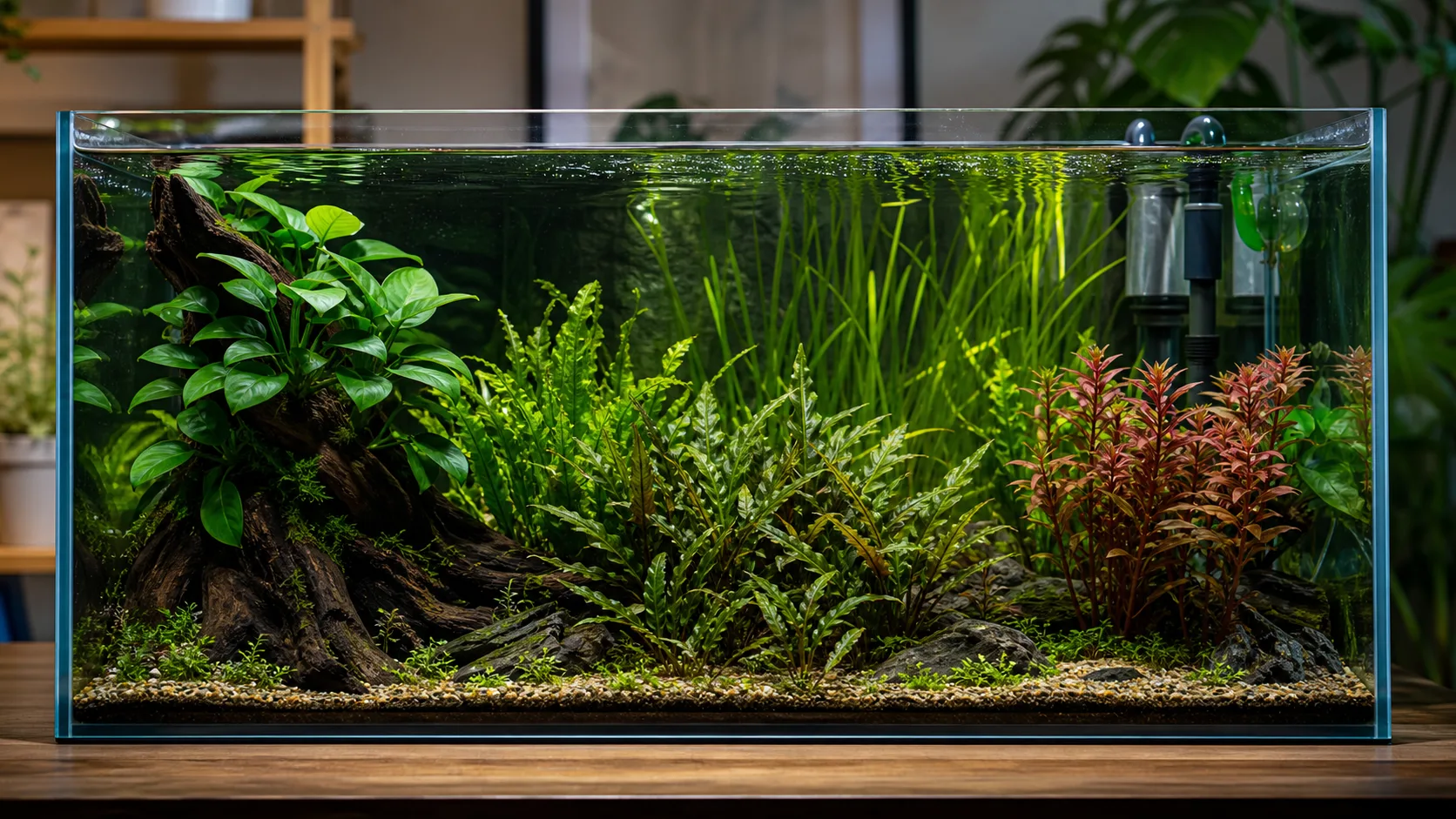
A practical planted-aquarium guide to choosing easy, advanced, low-light, CO₂, foreground, stem, shrimp-safe, and aquascaping plants.