
Plant Deficiency Atlas: Visual Diagnosis
Diagnose aquarium plant deficiencies by leaf age and symptom: yellowing, pinholes, twisting, and stunting. Read the pattern, then fix it safely.
On this page
Sick plants almost never announce themselves. A tank rarely crashes overnight. Instead you get pale new tips one week, a few pinholes in older leaves the next, some twisted growth, a little color loss creeping in over 1-3 weeks. By the time it looks obvious, the cause has usually been in place for a while.
This guide teaches you to read those signals the way an experienced planted-tank keeper does: by where the symptom appears, which leaves it hits first, and which direction the trend is moving. Get that right and most deficiencies are cheap and quick to fix. Get it wrong and you can chase iron for a month while the real problem is unstable CO₂.
One principle sits above everything else here, so read it twice.
Diagnose by pattern plus leaf age plus trend over time. Never by a single photo of a single leaf.
The one idea that makes diagnosis easy: mobile vs immobile nutrients
Almost everyone who struggles with plant diagnosis is missing this. Nutrients fall into two groups based on whether the plant can move them around inside its own tissue, and that single fact tells you where to look first.
Mobile nutrients (nitrogen, potassium, magnesium, phosphorus) can be pulled out of old leaves and shipped to new growth. So when a plant runs short, it cannibalizes its oldest leaves to feed the tips. Old growth suffers first.
Immobile nutrients (iron, calcium, boron, and most trace elements) are locked in place once a leaf is built. The plant cannot rob an old leaf to save a new one. So a shortage shows up in the youngest tissue while old leaves stay green. New growth suffers first.
That is the whole trick. Before you name a specific nutrient, answer one question: are the newest leaves or the oldest leaves showing the problem?
- New growth first = suspect an immobile nutrient (iron, calcium, trace).
- Old growth first = suspect a mobile nutrient (nitrogen, potassium, magnesium).
Everything below is just refinement on top of that split.
The five-step workflow
Step 1: Find where symptoms appear first
Look at the whole plant, not the worst leaf. Are the tips pale and the base green (immobile) or the base yellowing and the tips fine (mobile)? If you genuinely cannot tell, wait two days and look again. Direction of spread is more informative than any single frame.
Step 2: Name the symptom type
Be specific. "Yellowing" is not a diagnosis. Which of these is it?
- Uniform yellowing of a whole leaf?
- Veins staying green while the tissue between them yellows (interveinal chlorosis)?
- Pinholes, sometimes ringed with a yellow halo?
- Twisted, crumpled, or deformed new tips?
- Dead brown spots (necrosis)?
- Short internodes and stunted, stalled growth?
Step 3: Check the system context
Most "deficiencies" are actually a delivery problem, not a supply problem. Before you touch fertilizer, note your light intensity and photoperiod, CO₂ consistency, flow and distribution, any recent dosing or water-change changes, and your test trends for NO₃, PO₄, and KH/GH. A tank with plenty of nitrate in the water can still show nitrogen deficiency if CO₂ or light is limiting uptake.
Step 4: Apply ONE controlled correction
Change a single variable. If you adjust light, CO₂, and three nutrients at once and the plant improves, you have learned nothing and cannot repeat it. Pick your single best hypothesis and dose conservatively. The dosing calculator turns a target concentration into an actual dose for your exact water volume, so "increase nitrate a little" becomes a real, repeatable number instead of a guess.
Step 5: Track the response over 7-14 days
Judge success by the quality of brand-new growth, not by whether damaged old leaves heal. They usually will not, and that is fine. Photograph the same plant weekly and log the dose and date so you can actually see the trend. This is exactly the loop AquaLens automates, and there is a section on that near the end.
Rapid field triage
When you need a fast first pass, this table gets you to a hypothesis in seconds. Confirm it with the full profiles below before committing.
| What you see | Leaf age | First suspect |
|---|---|---|
| Yellow new leaves, veins still green | New | Iron / trace |
| Old leaves yellowing evenly, then dropping | Old | Nitrogen |
| Pinholes in older leaves | Old | Potassium |
| Interveinal yellowing, veins green | Old | Magnesium |
| Twisted, malformed new tips | New | Calcium / boron |
| Dark, stunted, dull growth | Mixed | Phosphate limitation |
| Everything looks bad at once | All | Non-nutrient system issue (CO₂/light/flow) |
Deficiency profiles
Nitrogen (N)
Visual signature: Oldest leaves yellow uniformly and evenly, the whole plant pales over time, and lower leaves thin out, weaken, and shed. Because nitrogen is highly mobile, the plant strips its old leaves to keep the tips growing, so growth may continue at the top while the bottom hollows out.
Common context: Lean dosing pushed too far, a heavy plant mass outrunning macro replenishment, or a lightly stocked high-light tank where fish waste no longer covers demand.
Correction: Raise your NO₃ target gradually. Avoid a single large spike, which stresses shrimp and feeds algae without helping the plant faster. Recheck growth rate and color over 7-10 days. A little residual nitrate in the water column is healthy in a planted tank; chasing zero is a classic beginner mistake.
Phosphorus (P)
Visual signature: Stunted growth, dull and darkened foliage instead of vibrant color, patchy deterioration on older leaves, and slow recovery after trimming. Green spot algae on glass and slow-growing leaves is a frequent companion.
Common context: Very aggressive nitrate dosing with little or no phosphate support, or high light and fast growth with limited PO₄ input.
Correction: Add a modest PO₄ increase, watch the algae response, and keep your nitrogen-to-phosphorus relationship roughly stable rather than swinging one without the other.
Potassium (K)
Visual signature: Small pinholes in older leaves, often ringed with a yellow halo, sometimes with necrotic spots and transparent patches spreading from the edges. New growth usually looks fine at first, which helps separate it from iron.
Common context: High growth demand with an incomplete macro profile, or frequent large water changes that strip potassium without replacing it.
Correction: Add potassium in controlled increments. Remove badly holed leaves only after new growth comes in clean, and judge success by whether new leaves emerge intact.
Iron (Fe)
Visual signature: New leaves pale or yellow while the vein network stays distinctly greener than the tissue around it (interveinal chlorosis on young growth). Red plants lose saturation and wash out to pale green or peach. Old leaves stay green because iron cannot be relocated.
Common context: Infrequent or erratic trace dosing, high-pH water reducing iron availability, or fast new growth outpacing micronutrient supply.
Correction: Dose small, regular iron and trace amounts rather than occasional large slugs. Consistency beats intensity here. Reassess tip color in 5-10 days. Red plants also need strong light and stable CO₂ to color up, so do not blame iron alone if those are shaky.
Magnesium (Mg)
Visual signature: Interveinal chlorosis on older leaves. Veins stay green while the tissue between them yellows, and it progresses from the lower, older leaves upward. It looks like iron deficiency but appears on old leaves instead of new, which is the whole distinction.
Common context: Soft or freshly remineralized water with a low magnesium balance, or heavy potassium and calcium levels competing with magnesium uptake.
Correction: Raise magnesium carefully, especially in low-GH systems, and fix it as part of a stable GH strategy rather than a one-off dose. A common target is a calcium-to-magnesium ratio around 3 or 4 to 1, treated as a rule of thumb rather than a hard law.
Calcium (Ca)
Visual signature: New growth is deformed, twisted, crumpled, or fragile, and shoots emerge malformed. Roots may be weak in rooted species. Because calcium is immobile and also structural, shortages hit the youngest, fastest-building tissue hardest.
Common context: Very soft water with insufficient calcium, or an inconsistent remineralization routine that lets GH drift.
Correction: Correct your GH and mineral profile gradually and, above all, consistently. Stable source-water prep matters more than any single dose. Track whether the newest growth points normalize.
Sulfur (S), less common
Visual signature: Yellowing in newer growth that closely resembles iron deficiency, plus a general pale look in young tissue.
Common context: Very restrictive fertilization or extremely low-input tanks with rapid biomass expansion.
Correction: Reassess the whole micro and macro program rather than isolating sulfur first. Rule out iron and light/CO₂ limits before you decide sulfur is the culprit; it rarely is in a normally fertilized tank.
Manganese and other trace limitations
Visual signature: Chlorosis in new growth, irregular pale speckling or patches, and slow, distorted recovery even after you correct the macros.
Common context: Macros are present but the trace schedule is inconsistent, or the fertilizer product does not match the plant demand for your light level.
Correction: Rebuild the trace routine around smaller, more frequent doses, and log responses by species since some react much faster than others.
Non-nutrient look-alikes (read this before dosing anything)
This is where most people go wrong. A large share of "deficiencies" are system instability wearing a deficiency costume. Adding fertilizer to these will not help and can make algae worse.
CO₂ instability
Looks like: Twisted tips, stalled growth, and algae blooming on stressed leaves. The tell: symptoms fluctuate quickly and track your photoperiod and injection consistency. Fix: stabilize CO₂ timing and distribution before any major nutrient change. If you inject CO₂, the CO₂ calculator helps you target a sane, stable level using the pH/KH relationship. New to injection? The CO₂ injection guide covers doing it safely.
Too much or mismatched light
Looks like: Bleaching near the top of the tank, algae pressure, and lower plants declining. The tell: damage concentrates by depth and exposure zone rather than by leaf age. Fix: dial intensity and photoperiod down first, then rebalance nutrients. Light is the accelerator pedal for the whole system, so the planted lighting guide is worth a read before you crank fertilizers to keep up with a too-bright fixture.
Transition melt on newly bought plants
Looks like: Rapid leaf melt within days of introduction. The tell: old emersed-grown leaves die off while new submerged-form leaves push out from the crown. Fix: do not over-correct your chemistry. This is normal adaptation, not a deficiency. Wait for the new growth pattern. Most farmed aquarium plants are grown out of water, so this is expected, not a defect. The where to buy aquarium plants guide explains emersed vs submerged growth in depth.
Poor flow and dead spots
Looks like: Decline confined to one zone of the tank. The tell: the same species grows well elsewhere in the same tank. Fix: improve circulation so nutrients and CO₂ actually reach the struggling area. The filter flow calculator helps you check whether your turnover is adequate for the tank size.
Root-zone depletion in heavy root feeders
Looks like: The water column tests fine but rooted plants still decline. The tell: stem plants and epiphytes look okay while crypts and swords suffer. Fix: address substrate and root feeding (root tabs, nutrient-rich substrate), not only water-column dosing.
Use your plants as instruments
Different species report trouble at different speeds. Learn which of yours are the sensitive gauges and you get an early-warning system for free.
- Fast stems (Rotala, Ludwigia): show tip and color shifts within days. Great early indicators. See Rotala rotundifolia and Ludwigia super red.
- Carpeting plants: quickly expose light, CO₂, and macro mismatches because they are pushed hard.
- Crypts and swords: often signal root-zone deficits first. See Cryptocoryne wendtii and the Amazon sword.
- Epiphytes (Anubias, Bucephalandra, Java fern): slow responders. Do not over-correct based on them alone. See Anubias nana, Bucephalandra, and Java fern.
For per-species light, CO₂, and difficulty notes across 1,750 plants and animals, browse the species library.
The 7-14 day correction protocol
Discipline here is what separates people who fix problems from people who fight them forever.
Day 0. Record symptoms with photos and notes. Choose ONE primary hypothesis. Calculate a conservative dose with the dosing calculator and write it down.
Days 1-3. Dose consistently. Do not stack a second major change on top. Resist the urge to "help it along."
Days 4-7. Evaluate new growth quality, the most reliable signal. Log the trend direction.
Days 8-14. If new growth is improving, continue. If nothing has changed, your hypothesis was probably wrong. Move to the next candidate (usually CO₂, light, flow, or mineral balance before a second nutrient).
The operator rule: Judge success by new growth, never by damaged old leaves "healing." Old damage is a receipt for a past problem, not a live signal.
Do now / do not do
Do now
- Diagnose by leaf age plus symptom pattern first, nutrient name second.
- Correct one variable at a time with a measured, repeatable dose.
- Keep dosing consistent day to day.
- Track with weekly photos and dated notes.
- Reassess after 7-14 days, not overnight.
Do not do
- Do not change light, CO₂, and nutrients all at once.
- Do not chase perfect test numbers every day.
- Do not assume every yellow leaf is iron. Leaf age tells you more.
- Do not judge recovery by old, damaged tissue.
- Do not overdose traces to force fast color; you will get algae, not color.
Choosing and buying the right plants
Deficiency-proofing starts before the plant is even in the tank. A species matched to your light, CO₂ decision, and water is far more forgiving than a demanding plant fighting the wrong conditions, and the most common "deficiency" of all is a high-tech plant in a low-tech tank. If you are still deciding what to grow, the ultimate guide to choosing aquarium plants matches species to your setup, and where to buy aquarium plants helps you source healthy stock that establishes fast instead of melting on arrival.
For saltwater and reef keepers: this atlas is a freshwater planted-tank tool. Macroalgae in a refugium (chaeto, for instance) can show nutrient limitation too, but corals are a different world entirely. Coral "health" tracks alkalinity, calcium, magnesium, and light/flow, not plant fertilizers. Start with the reef parameters guide and the reef hub, and use the reef dosing calculator for two-part maintenance.
Doing This With AquaLens
Two parts of this workflow are the ones people quietly drop: keeping a correction consistent, and judging it by new growth instead of by old damage. AquaLens is built to hold both.
- Confirm it is really a deficiency. Scan a struggling plant and AquaLens IDs it (with honest uncertainty) and links to its care requirements, so you can separate a genuine shortage from a demanding species in the wrong tank before you dose anything.
- Make the correction repeatable. Set a repeating fertilizer schedule with phone reminders and every dose auto-logs to that tank, so "increase nitrate a little" becomes the same measured dose on the same days, with weekly photos of the same plant showing whether new growth is turning the corner.
Get AquaLens free and turn plant care from anxious guesswork into calm, repeatable iteration.
You are succeeding when
- New growth quality improves week over week.
- Symptom spread slows, then stops.
- Dosing has become boring and repeatable.
- You are making small, early corrections instead of big emergency ones.
That last one is the real goal. Expert planted-tank keepers do not have better fertilizer. They just notice the pale tip in week one instead of week four.
Frequently Asked Questions
How do I know which nutrient my aquarium plant is deficient in?
Start by checking whether the problem appears on new leaves or old leaves. New-growth problems point to immobile nutrients like iron, calcium, and trace elements. Old-growth problems point to mobile nutrients like nitrogen, potassium, and magnesium. Then match the exact symptom, whether uniform yellowing, pinholes, interveinal yellowing, or twisting, to narrow it down.
Why are my aquarium plant leaves turning yellow?
Yellowing has several causes depending on which leaves are affected. Old leaves yellowing evenly usually means nitrogen shortage, while old leaves yellowing between green veins points to magnesium. New leaves yellowing with green veins suggests iron. If everything yellows at once, the cause is more often unstable CO₂, light, or flow than a nutrient.
What causes pinholes in aquarium plant leaves?
Pinholes in older leaves, often ringed with a yellow halo, are the classic sign of potassium deficiency. They tend to show up in tanks with heavy plant growth or frequent large water changes that remove potassium without replacing it. Add potassium in small, controlled increments and judge recovery by whether new leaves emerge intact.
How long does it take to fix a plant nutrient deficiency?
Plan on 7 to 14 days to see whether a correction is working. You judge success by the quality of brand-new growth, not by whether damaged old leaves recover, because they usually will not. If new growth still looks bad after two weeks, your hypothesis was probably wrong and you should test a different cause.
Is it iron deficiency or magnesium deficiency?
Both show yellowing between green veins, so the difference is leaf age. Iron deficiency hits the newest leaves because iron cannot move within the plant. Magnesium deficiency hits the oldest leaves first and works upward because magnesium is mobile. Check where the symptom started before dosing either one.
Should I add more fertilizer if my plants look unhealthy?
Not automatically. Many problems that look like deficiencies are actually CO₂ swings, too much light, poor flow, or normal transition melt on newly bought plants. Adding fertilizer to those will not help and can trigger algae. Confirm the cause is a genuine shortage before you increase dosing, and change only one variable at a time.
Why do my new plants melt after I add them to the tank?
Most farmed aquarium plants are grown out of water, so their emersed leaves often die back after being submerged while new underwater-form leaves grow from the crown. This transition melt is normal and is not a deficiency. Keep conditions stable, resist over-correcting your water chemistry, and wait for the new growth to establish.
Do low-tech aquarium plants get nutrient deficiencies?
They can, but far less often, because slow-growing hardy plants like Anubias, Java fern, and crypts demand very little. When a low-tech tank shows problems, the cause is more often too little light, root-zone depletion in heavy root feeders, or simply a demanding species that needs more than the tank provides. Match the plant to your setup to avoid most trouble.
How do I tell a nutrient deficiency from a CO₂ problem?
CO₂ problems tend to cause twisted tips, stalled growth, and algae on stressed leaves, and the symptoms fluctuate quickly with your photoperiod and injection consistency. Nutrient deficiencies follow a steadier pattern tied to leaf age. If symptoms come and go with your lights and CO₂ schedule, stabilize the gas before touching fertilizer.
Catch Plant Problems In Week One
AquaLens IDs the plant, auto-logs every dose and test into trend charts, and flags a parameter drifting toward trouble before your leaves ever show it. That is how small, early corrections replace big emergency ones.
Keep reading
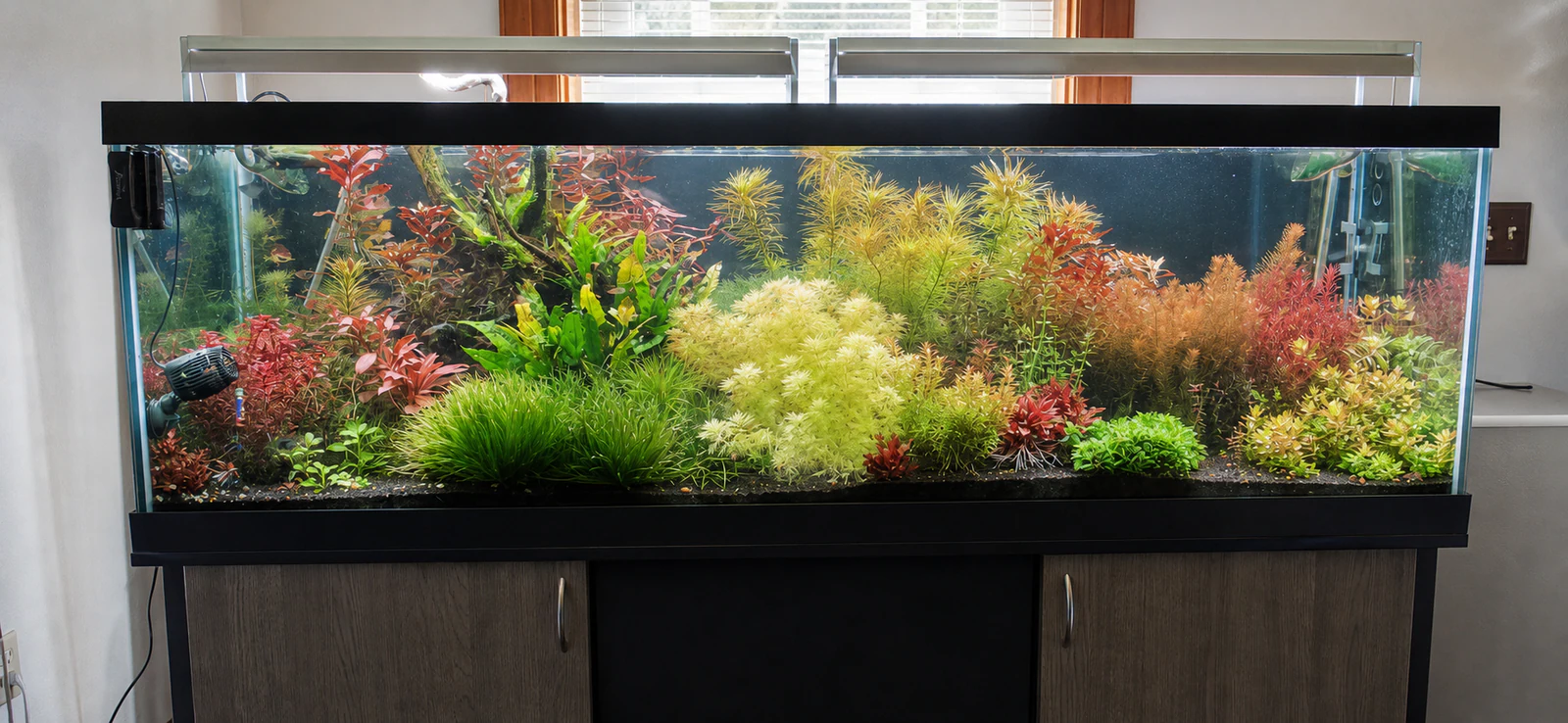
Compare online aquarium plant stores, local hobbyists, tissue culture, prices, pests, shipping, quarantine, and how to choose healthy plants.
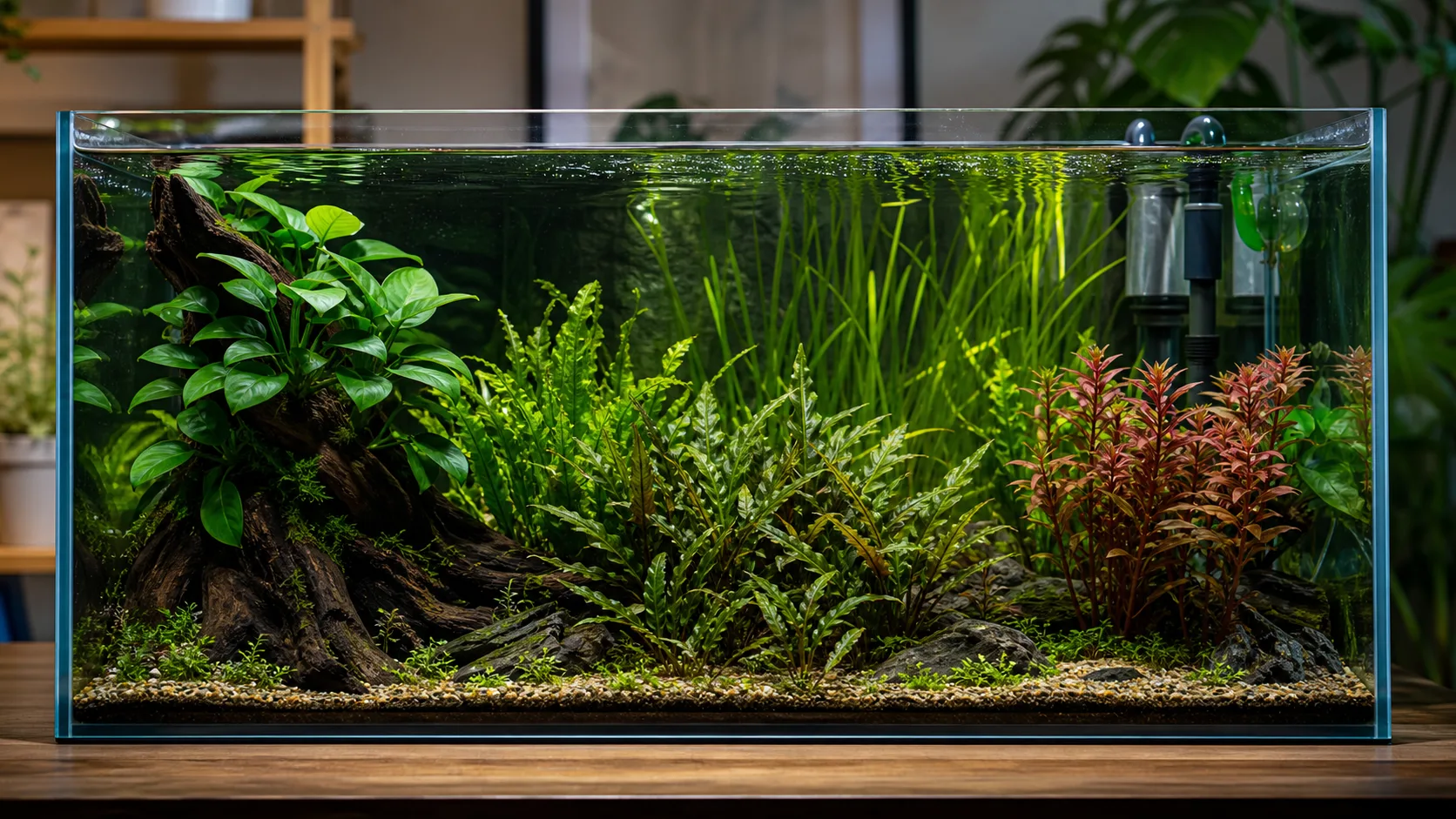
A practical planted-aquarium guide to choosing easy, advanced, low-light, CO₂, foreground, stem, shrimp-safe, and aquascaping plants.
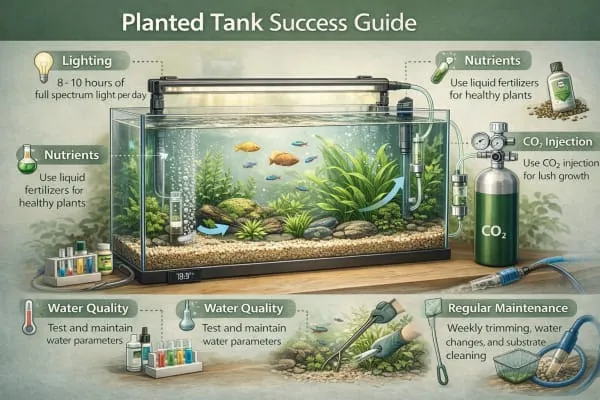
Grow a thriving planted aquarium: substrate, plant placement, feeding and dosing, pruning for density, and beating algae. Beginner-safe, expert-deep.