
Planted Tank Success Guide
Grow a thriving planted aquarium: substrate, plant placement, feeding and dosing, pruning for density, and beating algae. Beginner-safe, expert-deep.
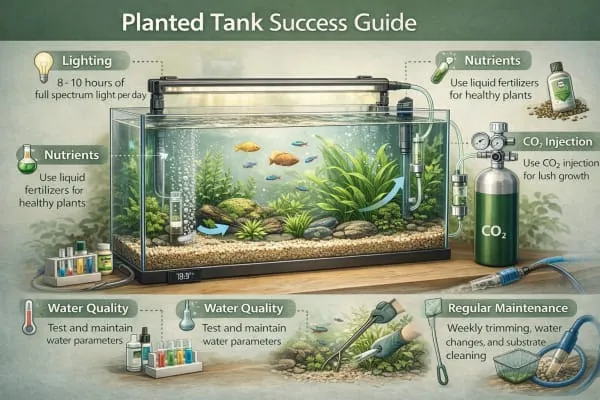
On this page
A planted tank is a garden that happens to be underwater, and like any garden it rewards a keeper who understands what the plants actually want. Get the foundation right and the whole system tips in your favor: plants outcompete algae for nutrients, roots and leaves pull waste out of the water, and the tank settles into a stable rhythm that is genuinely easier to maintain than a bare one. Get it wrong and you spend months fighting melt, leggy stems, and algae you can never quite explain.
This guide walks the full arc, from the substrate up: what to put on the bottom, which plants go where, how to plant them so they survive week one, how to feed them, and how to prune so a single stem becomes a bush. Beginners can follow it safely start to finish. If you have kept plants for years, the sections on cation exchange, apical dominance, and anthocyanin production are where you will find the parts nobody explains out loud.
If you are still deciding which plants to grow, pair this with The Ultimate Guide to Choosing Aquarium Plants. This guide is about growing them well once they are in the tank.
The Foundation: Choosing Your Substrate
In a planted tank the substrate is not just a floor for the plants to sit on. It anchors roots, and depending on what you choose, it either feeds those roots or does nothing at all. This single decision shapes how you fertilize for the life of the tank, so it is worth understanding before you buy a bag of anything.
Active Soil: The Planted-Tank Standard
Aquarium soils, often called "aqua soils," are manufactured clay granules baked at low temperature to keep their organic content intact. They are called active because they chemically interact with the water, and that interaction is what makes them so effective.
- They store nutrients (cation exchange capacity). Think of active soil as a rechargeable battery for plant food. The granules carry a negative surface charge, so they grab and hold positively charged nutrient ions: ammonium (NH₄⁺), calcium (Ca²⁺), magnesium (Mg²⁺), and potassium (K⁺). The soil banks these nutrients and trades them to roots on demand, delivering food exactly where a heavy root feeder needs it. This is why crypts and swords explode in soil and sulk in plain gravel.
- They buffer the water slightly acidic. Active soils release humic and fulvic acids that pull pH into the roughly 6.0 to 6.5 range. That mildly acidic, soft water keeps iron and other trace metals dissolved and available, instead of precipitating out the way they do in hard alkaline water. Most stem plants and carpets grow faster here.
- Their buffering runs out. The pH-lowering capacity is finite. Most soils exhaust it after roughly 12 to 18 months, though the granules keep their physical structure and cation exchange far longer. When the buffer fades, your pH drifts back up toward your tap water. That is normal aging, not failure.
One warning worth its own line: fresh active soil leaches ammonia for the first few weeks. That is a gift during a fishless cycle because it feeds your bacteria, but it means you should not add livestock to a brand-new soil tank until testing confirms the ammonia spike has cleared. Track it with a proper fishless cycling run.
Inert Substrate: Sand and Gravel
Silica sand and epoxy-coated gravel are chemically neutral. They have essentially zero cation exchange capacity, so they cannot store or supply nutrients at all. That is not a dealbreaker, but it changes your whole fertilizing plan.
- You must add root tabs. Because the substrate holds no food, heavy root feeders like Cryptocoryne and Echinodorus (Amazon swords) will slowly starve on liquid fertilizer alone. Push root tabs, which are compressed fertilizer capsules, into the root zone every three to four months to give those plants a point source of nutrition.
- Watch for compaction. Fine sand can pack down tight, sealing oxygen away from the roots. Anaerobic pockets form, and hydrogen sulfide (a toxic gas that smells like rotten eggs) can build up. Keep sand beds shallow, under about two inches, and let a cleanup crew stir the top layer. Malaysian trumpet snails (Malaysian trumpet snail) burrow constantly and keep the bed aerated for you.
A common and effective middle path is a nutrient-rich base layer capped with an inert top: dirt or a mineralized layer underneath, sand or fine gravel over it. You get long-term root feeding without a soil surface that clouds every time you replant. It is more work to set up and unforgiving to tear apart, so plan the layout before you commit.
Botanical Architecture: Placing Plants by Zone
Aquascaping is really the art of arranging living biomass to build depth. Plants are grouped not only by height but by how much light and what kind of nutrition they demand, so placing them by zone puts each species where it can actually thrive.
The Foreground: Carpets
Low, creeping species that spread into a lawn across the front of the tank.
- Good choices: Monte Carlo (Micranthemum), dwarf hairgrass (Eleocharis parvula), and Glossostigma.
- The high-light myth. People assume carpets need blinding light. In practice, most carpet down nicely under medium light, roughly 40 to 50 PAR at the substrate, as long as CO₂ is stable. Carbon, not brightness, is usually the limiting factor. Chasing brightness without stable CO₂ just grows algae on the leaves you are trying to protect.
- They spread by runners. Carpeting plants send out horizontal stolons just under the surface. Trim them often. If they pile up tall, the lower layer gets shaded, detaches, and floats off in a sheet.
The Midground: The Transition
The zone that bridges the flat carpet and the tall background, often built around hardscape.
- Rhizome plants, the epiphytes. Species like Anubias, Bucephalandra, and Java fern grow from a thick horizontal stem called a rhizome. Never bury that rhizome. It needs direct contact with oxygenated water, and buried it will rot and take the plant with it. Instead, tuck the roots into a crevice or attach the rhizome to rock or driftwood with a dab of gel superglue (cyanoacrylate). These plants are also the most forgiving in the hobby, which makes them ideal starters and perfect for low-light tanks.
- Cryptocoryne. These heavy root feeders are famous for "crypt melt," where the leaves dissolve after a change in water conditions. Do not pull the plant. The root system is almost always alive and busy growing new leaves adapted to your water. Leave it be and it comes back, often stronger.
The Background: The Canvas
Fast-growing stem plants that set the color and texture of the upper tank.
- Stems reach for light. Rotala and Ludwigia grow vertically toward the surface. If light is too weak, they go "leggy," with long bare gaps between leaves as they stretch for energy. Leggy growth is a light or CO₂ complaint, not a fertilizer one.
- Getting reds (anthocyanin). Red pigment is essentially plant sunscreen. To push deep reds in species like Ludwigia and red Rotala, you generally blast them with high PAR (often above 90 PAR) and keep nitrogen lean. The mild stress triggers protective red pigment. This is an advanced move: high light plus lean dosing plus stable CO₂ is a narrow window, and missing on any of the three feeds algae instead of color.
For a full breakdown of how light intensity and spectrum drive all of this, see Planted Tank Lighting.
Planting Protocol: Surviving Week One
The first week decides whether a plant establishes or melts. Most aquarium plants are grown emersed, meaning out of water, at the farm, so nearly every new plant has to convert its leaves from an air form to a submerged form. Some old leaves melting away in the first two weeks is normal transition, not a bad plant.
Prepping What You Bought
- Tissue culture. These are clones grown in sterile agar gel, so they arrive with no algae spores, no snail eggs, and no pests. Rinse off 100% of the gel before planting. Any leftover gel becomes food for white fungus and mold in the tank.
- Potted and bunched plants. Grown in rock wool or lead-wrapped bunches. Remove the rock wool completely; it restricts roots and rots in the substrate. Trim roots down to about an inch to trigger fresh branching.
The Tweezers Technique
Finger-planting is clumsy and stirs up the substrate. Long aquascaping tweezers change everything.
- Section the plants. Break carpets into dime-sized clumps and stems into bunches of two or three. Smaller clumps spread faster than large plugs.
- Grip the base. Hold the plant at the crown, where roots meet leaves, with the tweezer tips.
- Plunge at an angle. Insert at about 45 degrees, pushing deep until the tips nearly touch the bottom glass. A deep, angled plant resists floating far better than a shallow vertical one.
- Release and slide out. Open the tweezers slowly, then withdraw at a shallow angle with a slight wiggle. The substrate friction holds the plant while the tool slips free.
Expect a settling-in period. Growth often stalls for one to three weeks while roots establish before new submerged leaves appear. Resist the urge to keep replanting things that look sad; disturbed roots restart the clock every time.
Feeding Plants: Fertilizer Without the Guesswork
Aquatic plants obey Liebig's Law of the Minimum: growth is capped by whatever nutrient is scarcest, not by the total amount available. Pour on all the iron you like; if potassium is the bottleneck, the plant grows at the speed of potassium. Diagnosing which nutrient is short is most of the game, and Plant Nutrient Deficiencies is the visual field guide for reading the leaves.
The Macronutrients (Used in Bulk)
- Nitrogen (N): the backbone of chlorophyll and amino acids. Shortage shows as older leaves yellowing and dissolving first, because the plant moves this mobile nutrient to new growth.
- Phosphorus (P): drives energy transfer and root development. Shortage stunts leaves and can darken them to green or purple.
- Potassium (K): runs osmotic balance and enzyme activation. Shortage shows as pinholes in older leaves, often ringed with yellow.
The Micronutrients (Trace Amounts)
- Iron (Fe): needed to build chlorophyll even though it is not part of the molecule. Shortage causes chlorosis (yellowing) of new leaves while the veins stay green.
- Carbon (C): the one that outweighs all the rest. In high-tech tanks, injected CO₂ supplies it. In low-tech tanks, plants make do with the trickle of atmospheric CO₂ that diffuses into the water, which is why low-tech growth is slower and why easy species matter there.
Two Dosing Philosophies
- Estimative Index (EI): deliberately dose more than the plants can use so no nutrient ever hits zero, then do a large water change (around 50%) weekly to reset levels and prevent buildup. Simple, forgiving, and the default for fast high-light tanks.
- Lean dosing: supply just enough, keeping nutrients (especially nitrogen) low to limit algae and coax reds out of red plants. More precise, less forgiving, and best once you can read your tank.
Whichever you choose, dose to a schedule, not to a vibe. The dosing calculator turns a target concentration into an actual gram or milliliter amount for your exact water volume, and the CO₂ calculator estimates injection from your drop checker and pH readings. For the deeper theory on CO₂, from drop checkers to the risk of gassing your fish, read CO₂ Injection.
Maintenance: Pruning for Density
Trimming is not just cosmetic. It is a physiological trigger that turns thin plants into thick ones, and doing it right is the difference between a hedge and a handful of bare stalks.
Breaking Apical Dominance (Stem Plants)
A stem plant makes a hormone called auxin at its growing tip, and that auxin actively suppresses the buds lower down the stem. Cut the top off and you remove the auxin source. The plant responds by waking those dormant lower buds, so one stem splits into two new shoots. Repeat over several trims and a single stem becomes a dense, bushy column. Do not throw the cut tops away: strip the lower leaves and replant them, because the tips carry the most vigorous growth energy and root quickly.
Carpet Maintenance (The Thatch Risk)
Carpets grow in stacked layers. Once the mat passes roughly an inch and a half, the bottom layer is starved of light and dies. The dead layer rots and releases its grip, and the whole healthy top sheet detaches and floats up like a rug peeling off the floor. Prevent it by mowing aggressively, back to about half a centimeter, every couple of months. It looks rough for a week, then comes back denser and better anchored than before.
A quick word on cleanup crews: Amano shrimp, otocinclus, and nerite snails graze soft algae off leaves and hardscape without eating healthy plants. They are not a fix for a broken tank, but in a balanced one they keep leaves clean and buy you time between trims.
Troubleshooting: Reading the Tank
Most planted-tank problems are the plant or the algae telling you which input is off. Learn the common signals and you stop guessing.
- Leggy, thin stem growth: almost always insufficient PAR at the substrate, or unstable CO₂. The light may look bright at the surface but fall off sharply by the time it reaches the bottom. Raise intensity or lower the fixture, and stabilize CO₂ before touching ferts.
- Green spot algae (GSA) on glass and slow leaves: usually points to low phosphate or low CO₂. Nudge phosphate up and confirm CO₂ is steady.
- Black beard algae (BBA), the dark tufts on leaf edges and hardscape: the classic sign of fluctuating CO₂ or weak flow, often from a dirty filter. Clean the filter, stabilize injection, and improve circulation. Chasing it with fertilizer changes rarely works.
- Algae on lower leaves only: typically organic waste settling in a dead spot with poor flow. Increase circulation in the lower third of the tank.
For the complete algae playbook, cause by cause, work through Algae Control. And because so much of this traces back to water chemistry, a solid grasp of Water Chemistry Fundamentals pays off across every symptom above.
For saltwater keepers: planted freshwater and reef tanks share the same underlying logic of light, flow, and nutrient balance, but the players are different. In a reef, corals replace plants, alkalinity and calcium replace macros, and PAR targets and flow patterns are their own discipline. If you are running or planning a reef, start at the saltwater hub and Coral Placement, Flow, and Lighting.
Choosing and Buying Plants
Everything above assumes you are working with healthy plants suited to your setup. Two companion guides handle that half of the job. The Ultimate Guide to Choosing Aquarium Plants matches species to your light level, CO₂ decision, livestock, and how much maintenance you actually enjoy, so you do not buy a demanding carpet for a low-tech tank. Where to Buy Aquarium Plants covers sourcing: which retailers pack and ship well, why submerged-grown local plants adapt faster, and how to spot a healthy crown before you pay. Buying the right plant from the right source prevents most week-one melt before it starts.
Doing This With AquaLens
A planted tank is a slow-motion experiment, and the keepers who win are the ones who remember what they changed and when. AquaLens keeps that record for you.
- Place plants with confidence. Photograph a plant you are unsure about and its ID links straight to a care guide, so you know whether you are holding a light-hungry stem or a shade-loving epiphyte before you decide where it goes.
- See the deficiency before the algae does. Scan a test kit (strips, a liquid kit, or a digital tester) and AquaLens logs the reading to trend charts for nitrate, phosphate, KH, and GH. A slow phosphate slide toward zero shows up as a falling line weeks before green spot algae shows up on your glass.
- Never forget a dose or a trim. Set repeating dosing and trim reminders that log the moment you confirm them, so the fertilizer routine every plant above depends on stays on schedule.
Get AquaLens free and start logging your planted tank today; the core logging and photo ID cost nothing and need no account.
The Short Version
Build on active soil if you want fast, forgiving growth, or inert substrate with root tabs if you prefer sand. Place plants by zone: carpets in front, rhizome plants and crypts in the middle, stems in back, and never bury a rhizome. Plant deep at an angle with tweezers, expect a settling-in stall, and let crypt melt recover on its own. Feed to a schedule with EI or lean dosing, keep CO₂ stable above all else, and prune stems to break apical dominance so they branch. Read algae as a diagnostic, not an enemy. Do that, log it, and the tank does most of the work for you.
Frequently Asked Questions
What is the best substrate for a planted tank?
For most planted tanks, an active aquarium soil is the best choice because it stores nutrients through cation exchange and buffers the water slightly acidic, which suits the widest range of plants. Inert sand or gravel also works but has no nutrient capacity, so you must add root tabs every three to four months for heavy root feeders. Beginners who want the easiest path usually do best starting with a quality active soil.
Do I need CO2 for a planted tank?
No, you do not need CO2 to keep a planted tank, and many beautiful tanks run without it. Low-tech tanks rely on the small amount of CO2 that diffuses from the air, so they grow more slowly and do best with easy species like Anubias, Java fern, and crypts. Injected CO2 unlocks demanding carpets, red stems, and fast growth, but only if it is kept stable, since fluctuating CO2 is a leading cause of algae.
Why are my aquarium plants melting after I planted them?
Most aquarium plants are grown out of water at the farm, so their leaves are built for air and must convert to a submerged form once planted. During that conversion the old leaves often dissolve while new submerged leaves grow, which looks alarming but is normal transition. Leave the plant alone, keep conditions stable, and give it two to three weeks. Crypts in particular melt after any change and almost always regrow from a living root system.
How much light does a planted tank need?
It depends on the plants, not a single number. Easy low-tech plants thrive in low to medium light, while carpets and red stems want medium to high light measured as PAR at the substrate, not brightness at the surface. A common mistake is adding more light without stable CO2 and nutrients, which grows algae instead of plants. Match your light level to your plant choices and your CO2 decision rather than buying the brightest fixture available.
How do I make my aquarium stem plants bushy instead of leggy?
Bushiness comes from trimming, not from a special fertilizer. When you cut the top off a stem you remove the auxin hormone that suppresses lower buds, so the plant splits into two new shoots below the cut. Repeated trimming turns one stem into a dense column. Leggy growth with long gaps between leaves is a separate problem caused by too little light or unstable CO2, so fix those before you blame nutrients.
Can I bury the roots of Anubias and Java fern?
You can bury the fine roots, but you must never bury the rhizome, which is the thick horizontal stem the leaves and roots grow from. A buried rhizome loses contact with oxygenated water and rots, killing the plant. Instead, wedge these plants into hardscape crevices or attach the rhizome to rock or driftwood with gel superglue, leaving the rhizome exposed to the water.
What causes black beard algae in a planted tank?
Black beard algae is almost always a symptom of fluctuating CO2 or weak water flow, often from a filter that needs cleaning. It appears as dark tufts on leaf edges, hardscape, and equipment. The fix is to stabilize your CO2 injection, clean the filter to restore flow, and improve circulation, rather than adjusting fertilizer dosing. Existing patches can be spot-treated, but they will return unless the underlying flow or CO2 instability is corrected.
How often should I do water changes on a planted tank?
It depends on your dosing method. Tanks using the Estimative Index approach deliberately overdose nutrients and rely on a large weekly water change of about 50 percent to reset levels. Lean-dosed and low-tech tanks can go longer between changes because far less nutrient accumulates. In all cases, water changes also remove organic waste and dissolved compounds that feed algae, so a regular schedule is worth keeping even in a stable tank.
Do I need fertilizer if I use active soil?
Active soil supplies root-zone nutrients for a long time, but fast-growing stem plants and floating plants feed heavily from the water column, so most planted tanks still benefit from liquid dosing. Early on, fresh soil provides plenty, but as plant mass grows the demand outpaces what the soil releases into the water. Watching for deficiency signs, such as yellowing new leaves or pinholes, tells you when it is time to start or increase liquid fertilizer.
Grow It, Log It, Keep It Thriving
AquaLens reads your test kits, auto-logs every dose and trim, and charts the trends that predict algae and deficiencies before they show on your leaves. Turn your planted tank into a system you can actually see.
Keep reading
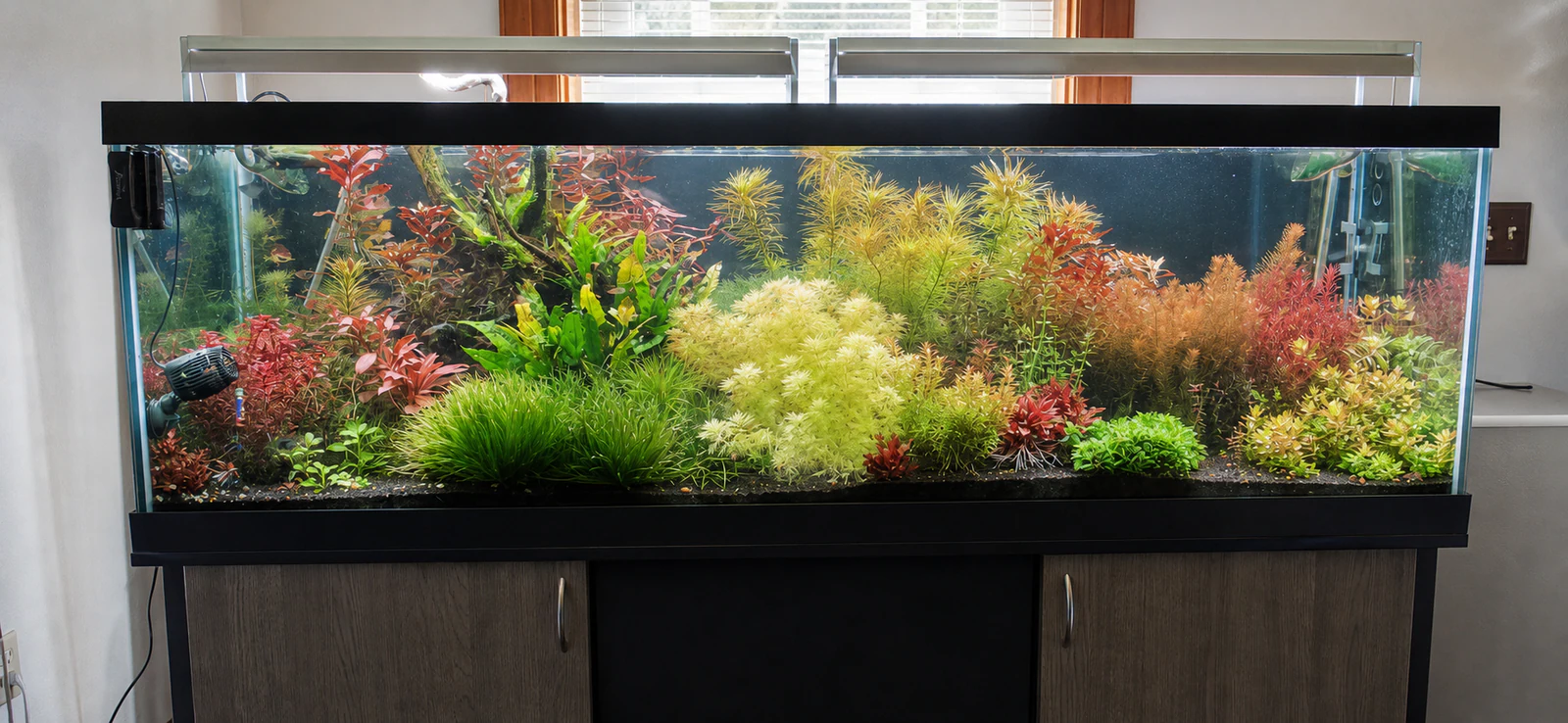
Compare online aquarium plant stores, local hobbyists, tissue culture, prices, pests, shipping, quarantine, and how to choose healthy plants.
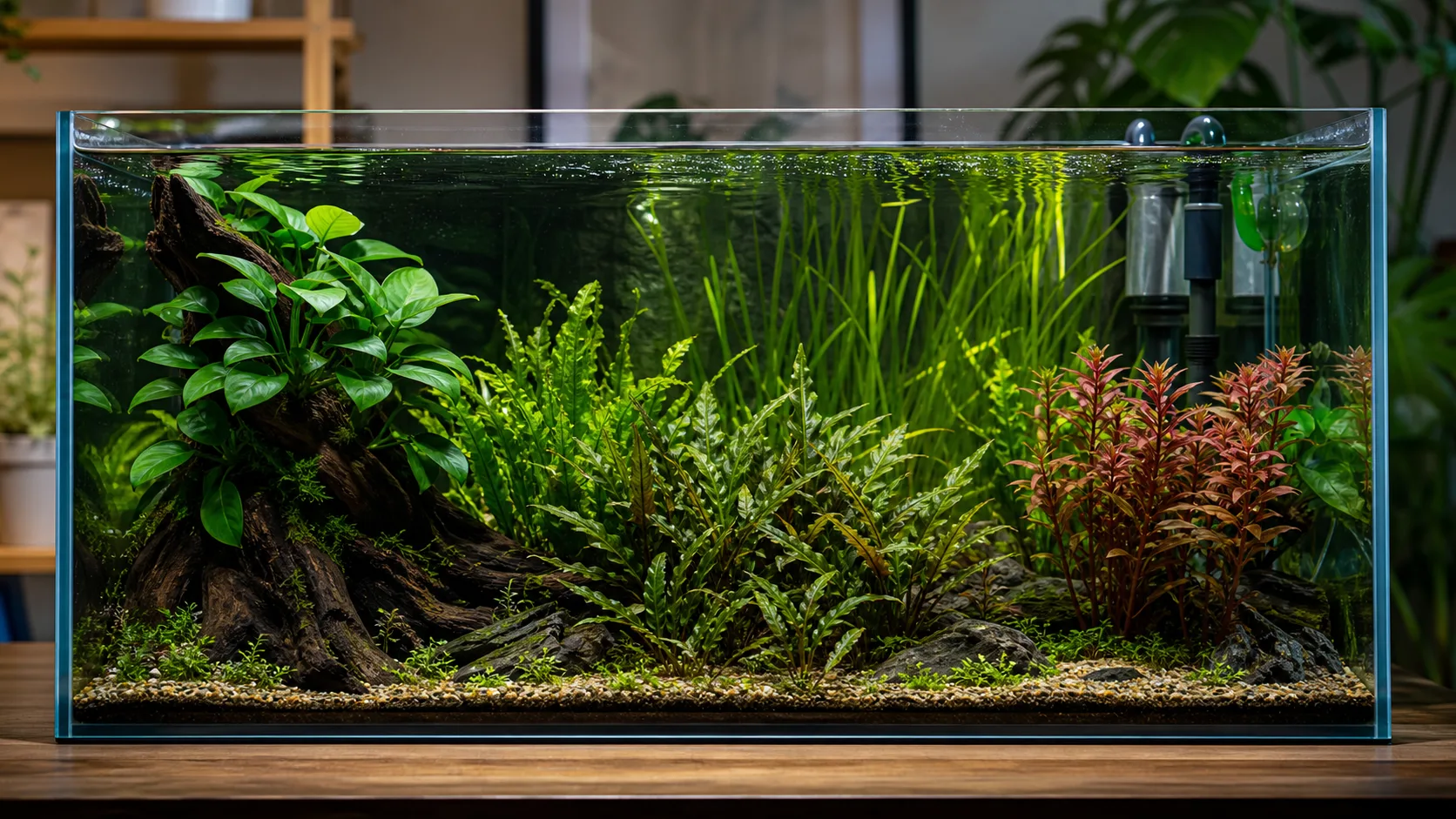
A practical planted-aquarium guide to choosing easy, advanced, low-light, CO₂, foreground, stem, shrimp-safe, and aquascaping plants.
Diagnose aquarium plant deficiencies by leaf age and symptom: yellowing, pinholes, twisting, and stunting. Read the pattern, then fix it safely.