Amazon Frogbit Care Guide
Limnobium laevigatum · Freshwater Plant
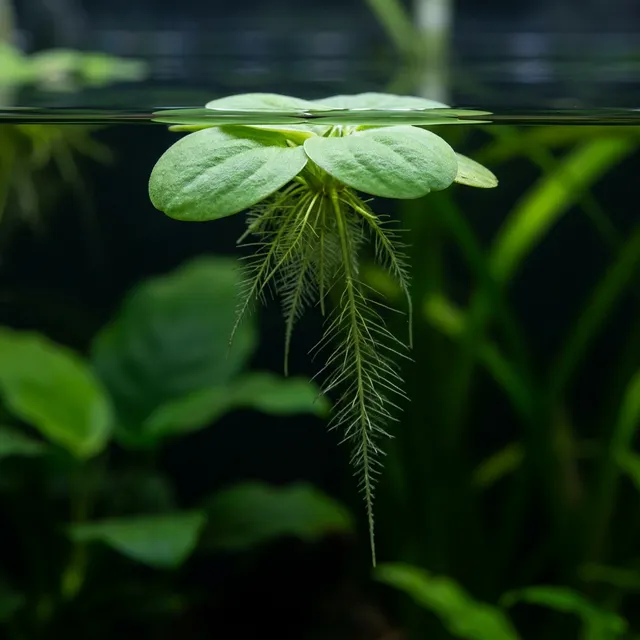
What Amazon Frogbit look like
Limnobium laevigatum, commonly known as Amazon Frogbit, exhibits a distinctive morphology characterized by its floating leaves that are ovate to elliptical in shape, measuring approximately 5 to 15 cm in length. The leaves are glossy green, with a smooth surface and a prominent midrib, which aids in buoyancy. The plant can produce small, white to pale lavender flowers that emerge above the water surface, supported by slender stalks. Its roots are fibrous and can extend several centimeters into the water column, providing anchorage and nutrient absorption. As a member of the Hydrocharitaceae family, it possesses a unique adaptation of being able to thrive in a variety of freshwater habitats, often forming dense mats on the water surface. This species does not exhibit sexual dimorphism, but its reproductive structures can be observed during flowering periods. The Amazon Frogbit's defensive adaptations include rapid growth and the ability to cover water surfaces, which can inhibit light penetration and deter herbivory.
Behavior & temperament
Amazon Frogbit is primarily a floating aquatic plant that thrives in still or slow-moving waters, often found in the upper water column. It exhibits a clonal growth habit, forming extensive colonies through vegetative propagation, which can create a significant surface cover. This species does not have a social hierarchy as it is a plant; however, it can compete with other aquatic plants for light and nutrients. The Amazon Frogbit reproduces through both vegetative means and flowering, with flowers that are pollinated by insects. Its temperament is passive in the context of aquatic ecosystems, providing shelter and habitat for various aquatic organisms while also serving as a food source for herbivorous fish.
Diet & feeding
In its natural habitat, Limnobium laevigatum is an omnivorous plant, deriving nutrients from both water and sediment. In captivity, it requires a nutrient-rich substrate and may benefit from supplemental fertilization to support its growth and maintain vibrant foliage.
Behind the name
Limnobium (from Greek 'limnion' meaning 'lake' or 'pond'; 'bios' meaning 'life') and laevigatum (from Latin 'laevigatus' meaning 'smooth' or 'polished').
Plan your tank
Check the numbers before you buy: tank volume, a stocking plan, cycle progress, water changes, and your ongoing care routine.
Keep reading
Diagnose aquarium plant deficiencies by leaf age and symptom: yellowing, pinholes, twisting, and stunting. Read the pattern, then fix it safely.

PAR-first planted tank lighting: choose intensity by what you grow, set photoperiod and spectrum, kill shadows, and hold algae back without overspending.

Aquarium CO₂ injection made safe: how carbon, light, and nutrients balance, which system to buy, and how to dial it in without gassing your fish.
Keeping Amazon Frogbit?
AquaLens identifies your fish and plants from a photo, tracks water chemistry, and flags health issues early — free on iOS and Android.