
Coral Placement, Flow, and Lighting
How to place corals by light and flow, PAR targets for softies, LPS, and SPS, dipping new corals for pests, and acclimating them without bleaching.
On this page
A coral is a living animal that spent millions of years evolving for a very specific slice of a reef: a particular depth, brightness, and current. Keeping it well is mostly a matter of reproducing that slice in your tank and then leaving it alone to adjust. Get placement, flow, and light roughly right and most corals are forgiving; get them badly wrong and even a hardy coral will slowly recede. This guide covers how to read a coral's needs and settle it in without shocking it.
Know your coral's category
Corals sort into three broad groups by demand, and knowing which you have tells you most of what you need:
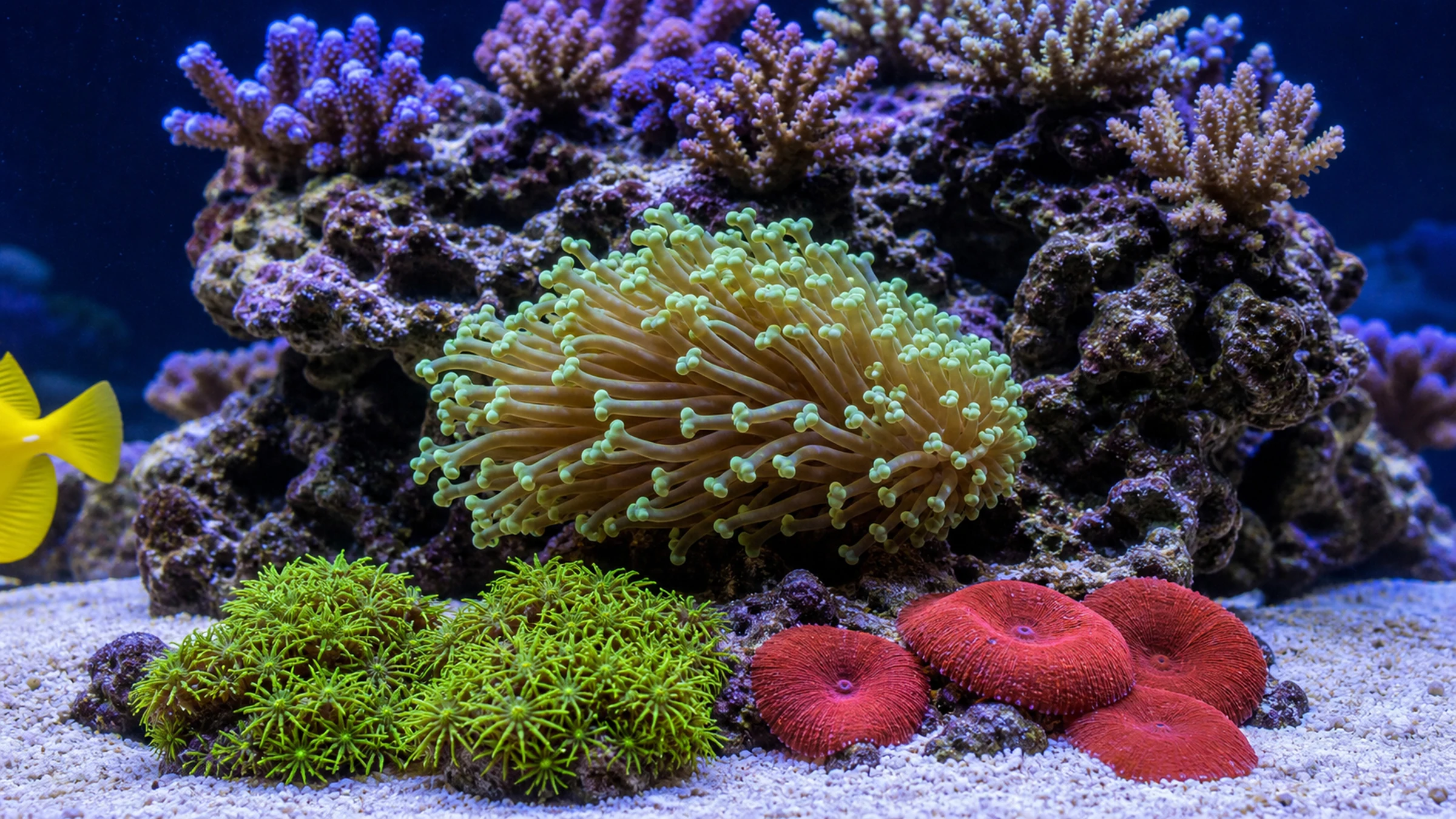
- Soft corals (zoanthids, mushrooms, leathers, Xenia, green star polyps). The beginner's friends: forgiving of light, flow, and nutrients, and often fast-growing. Low to moderate light and flow.
- LPS: large polyp stony (hammer, torch, frogspawn, acan, duncan, favia). Fleshy, colorful, generally hardy. Moderate light and gentle-to-moderate flow. Many have long stinging sweeper tentacles, so give them room.
- SPS: small polyp stony (Acropora, Montipora, birdsnest). The demanding, high-reward group: they want strong light, strong turbulent flow, clean stable water, and steady alkalinity above all. Save these for a mature, stable tank.
Lighting: start low, raise slowly
Corals photosynthesize through symbiotic algae in their tissue, so light is food, but too much, too fast, bleaches them. Light is measured as PAR (the usable light actually reaching the coral). Rough starting targets:
| Coral group | Approximate PAR |
|---|---|
| Soft corals & low-light LPS | 50–150 |
| Most LPS | 100–200 |
| SPS | 200–350+ |
The golden rule is acclimate to light gradually. Place a new coral low in the tank, away from the brightest spot, and move it up over two to four weeks. If you just upgraded a fixture or raised intensity, ramp it over weeks, not days. A coral that browns out has usually been under-lit; one that pales or bleaches from the tips has usually been blasted too soon.
Flow: moving, random, and gentle enough
Flow brings corals food and oxygen and carries away waste and detritus, and it keeps a film from settling on their tissue. But the quality of flow matters as much as the amount:
- Random and alternating beats a single steady jet. Wave-making powerheads that pulse and alternate mimic a reef far better than one laminar stream, which scours the near side and starves the far side.
- Match intensity to the coral. Softies and LPS want moderate, indirect flow: enough to sway their tissue gently. If an LPS can't fully inflate, it is usually getting too much direct flow. SPS want strong, turbulent flow that keeps their tight branches clean.
- Watch the corals, not the numbers. Polyps extended and tissue gently moving is right. Polyps clamped shut, or tissue being visibly stripped, means move the coral or redirect the pump.
Placement: give everyone room
Corals compete. Many sting their neighbors with sweeper tentacles or chemical warfare, so placement is about spacing as much as light and flow:
- Leave gaps between colonies for growth and to keep aggressive corals from reaching each other. LPS like hammers and torches can extend surprisingly far at night.
- Put aggressive and fast-growing corals where you can trim or move them.
- Place corals securely on the rock with reef putty or glue so a snail or a current can't tumble them onto a neighbor.
Always dip a new coral
Corals do not carry fish diseases, but they bring pests: Acropora-eating flatworms, montipora-eating nudibranchs, red bugs, and various flatworms and hitchhikers that can spread through a whole tank from one frag. So every new coral gets a dip before it goes in (a short bath in a reef-safe pest solution such as CoralRx, a Bayer-based dip, or a gentle rinse like ReVive) followed by a careful inspection of the coral and its plug or base.
One important limit: dips knock off adult pests but do not kill their eggs. For the worst offenders (AEFW, nudibranchs), a single dip is not enough. You need a coral quarantine with repeated dips over several weeks, or you risk seeding the pest anyway. The where-to-buy corals and marine fish guide covers dipping and pest control in more depth.
Acclimation, step by step
- Temperature-float the sealed bag in your tank for 15–20 minutes.
- Dip and inspect the coral in a separate container of tank water with your chosen dip, then rinse in clean tank water.
- Place it low and shaded: the bottom of the tank, out of the strongest light and direct flow.
- Move it toward its final spot over 2–4 weeks, watching color and polyp extension as you go.
- Feed the ones that eat. Many LPS and some softies take target feeding, which speeds growth, just don't foul the water doing it.
The pattern behind all of it
Every part of coral care comes back to the same idea that runs through reef keeping: match the animal to conditions it evolved for, then change things slowly. A coral placed thoughtfully and acclimated with patience will adapt to a surprisingly wide range of tanks. A coral shocked with sudden light, blasted with the wrong flow, or dropped in un-dipped is the one that fails. Keep the water stable (the reef parameters guide covers the chemistry corals depend on) and give each new addition time to settle.
Frequently Asked Questions
Where should I place corals in my reef tank?
Match the coral to the light and flow it evolved for. Soft corals and most LPS go lower down in moderate light and gentle-to-moderate flow; SPS go higher in strong light and strong flow. Give each coral space to grow and to avoid its neighbors' stinging sweeper tentacles, and always acclimate a new coral to your lighting gradually rather than dropping it straight into full intensity.
How much flow do corals need?
Enough to keep detritus from settling on them and to gently move their tissue, but not so much that polyps can't open. Softies and LPS prefer moderate, indirect flow; SPS want strong, turbulent flow. Random, alternating flow from wave pumps beats a single laminar jet, which can strip tissue on the near side and starve the far side.
What is coral dipping and do I need to do it?
Coral dipping is a short bath in a reef-safe pest solution to knock off flatworms, nudibranchs, and other hitchhikers before a new coral enters your display. Yes, you should dip every new coral: a single pest colony can spread through a tank. Common dips include CoralRx, a Bayer-based dip, and a gentle rinse product like ReVive; a dip does not kill pest eggs, so quarantine or repeat dips are needed for the worst pests.
What are PAR levels for corals?
PAR measures the usable light reaching a coral. As a rough guide, soft corals and low-light LPS are happy around 50–150 PAR, most LPS around 100–200, and SPS around 200–350+ depending on species. Start new corals low and raise the light over weeks; too much light too fast bleaches a coral faster than too little.
How do I acclimate new corals?
Temperature-float the bag, then dip and inspect the coral, then place it low in the tank and out of the strongest light. Over two to four weeks, move it toward its final spot as it adjusts. Sudden changes in light or flow are the fastest way to bleach or brown out an otherwise healthy coral.
Give every coral its own record
AquaLens identifies corals from a photo, links each to a care profile with placement, flow, and lighting, and logs how they respond over time, so you learn what your specific reef likes.
Keep reading
The honest trade-offs between a fish-only (FOWLR) saltwater tank and a full reef: cost, difficulty, equipment, and the order to buy things in.
How to cycle a saltwater or reef tank with live rock: the nitrogen cycle, an ammonia source, what to test, and how to know it's safe to add your first fish.
What every reef parameter means and where to keep it: salinity, temperature, pH, alkalinity, calcium, magnesium, nitrate, and phosphate.