
The Chemistry of the Nitrogen Cycle
The chemistry under aquarium cycling: why pH decides how toxic your ammonia reading is, and why nitrification quietly consumes your carbonate hardness.
On this page
Most cycling advice tells you what to do: dose ammonia, wait, test, wait longer. That is enough to get a tank running, and if you want the procedure rather than the reasoning, the fishless cycling guide is the place to start.
This guide is the layer underneath. It covers what the bacteria are actually doing, what that process costs your water, and why two tanks with identical test results can be in completely different amounts of trouble. It is the difference between following a protocol and being able to diagnose one that has gone wrong.
The two reactions
Ammonia does not disappear from an aquarium. It gets oxidised, in two steps, by two different groups of bacteria living on your filter media and every other surface in the tank.
Step one, ammonia to nitrite. Carried out by ammonia-oxidising bacteria and archaea:
NH₃ + 1.5 O₂ → NO₂⁻ + H⁺ + H₂O
Step two, nitrite to nitrate. Carried out in aquariums mostly by Nitrospira, despite the hobby's long habit of naming Nitrobacter:
NO₂⁻ + 0.5 O₂ → NO₃⁻
Add them together and the whole cycle is:
NH₃ + 2 O₂ → NO₃⁻ + H⁺ + H₂O
Three consequences fall straight out of that equation, and they are what the rest of this guide is about. The process consumes oxygen. It produces acid. And nitrate is where it stops, because nothing in that chain removes nitrogen from the tank.
Ammonia and ammonium: the number your test kit does not show you
In water, ammonia exists in equilibrium between two forms: free ammonia (NH₃) and ammonium (NH₄⁺). Free ammonia is uncharged, crosses gill membranes easily, and is the toxic one. Ammonium is charged, crosses poorly, and is far less dangerous at the concentrations aquariums see.
Your test kit does not distinguish them. It reports the sum, usually called total ammonia nitrogen. The split between the two is set by pH, and it is not a gentle relationship: the equilibrium has a pKa of about 9.25 at 25 C, which means the free ammonia fraction changes roughly tenfold for every pH unit.
At 25 C (77 F):
| pH | Free NH₃ | 1 ppm total ammonia is really |
|---|---|---|
| 6.5 | 0.2% | 0.002 ppm free NH₃ |
| 7.0 | 0.6% | 0.006 ppm free NH₃ |
| 7.5 | 1.7% | 0.017 ppm free NH₃ |
| 8.0 | 5.3% | 0.053 ppm free NH₃ |
| 8.5 | 15% | 0.15 ppm free NH₃ |
| 9.0 | 36% | 0.36 ppm free NH₃ |
Long-term exposure above roughly 0.02 ppm free NH₃ is generally treated as harmful, and the gap between the top and bottom of that table is a factor of nearly 200. This is the single most useful thing on this page: a total ammonia reading is meaningless until you pair it with your pH. One ppm in a soft, mildly acidic planted tank is a nuisance you fix at the next water change. The same one ppm in a hard African cichlid tank at pH 8.5 is an emergency.
Temperature pushes the same lever in the same direction, though less dramatically. Warmer water shifts the equilibrium toward free ammonia, so a summer heatwave makes an existing ammonia problem worse without the reading changing at all.
The practical rule this creates: never chase pH upward while ammonia is present. A buffer dose that takes a tank from 7.2 to 8.2 multiplies the free ammonia roughly tenfold in the time it takes to mix. If your pH has fallen and you need it back, a water change restores buffer and dilutes the ammonia at the same time. A bag of buffer only does the first one.
One unit caveat worth knowing: kits differ on whether they report the result as nitrogen or as ammonia. The two differ by a factor of about 1.2, since ammonia's molar mass is 17 against nitrogen's 14. It rarely changes a decision, but it is why two kits on the same water can disagree by about twenty percent and both be right.
What nitrification costs: oxygen
Both steps are aerobic, and the oxygen bill is larger than most keepers expect. Oxidising 1 mg of ammonia-nitrogen all the way to nitrate consumes about 4.57 mg of oxygen, split roughly 3.43 mg for the ammonia step and 1.14 mg for the nitrite step.
For a fish-in tank that is rarely the limiting factor. For a heavily dosed fishless cycle it can be, especially in a warm tank with a still surface, because warm water holds less dissolved oxygen precisely when the bacteria are working hardest. The usual symptom is a cycle that processes ammonia fine and then sits at the nitrite step for weeks. Before assuming a bacterial problem, point a powerhead at the surface. Gas exchange happens at the surface, not in the bulk water, so agitation matters more than volume of flow.
What nitrification costs: alkalinity
This is the mechanism behind more stalled cycles than anything else, and it is almost never mentioned in the basic instructions.
Look again at the overall reaction: it produces H⁺. Acid. Your carbonate hardness (KH) is the buffer that neutralises it, and doing so consumes the buffer. The standard figure is about 7.1 mg/L of alkalinity as CaCO₃ consumed per 1 mg/L of ammonia-nitrogen oxidised, which in hobby units is roughly 0.4 dKH per 1 ppm of ammonia processed.
Run that forward on a typical fishless cycle. Dosing to 2 ppm consumes about 0.8 dKH each time. Eight doses over the course of a cycle consume about 6.4 dKH. A tank filled from soft tap water at 4 dKH runs out of buffer well before the cycle completes.
What happens then is a cascade, and it looks like this from the outside:
- KH falls toward zero as the buffer is spent.
- With nothing left to neutralise the acid, pH falls, and it falls fast once KH is gone, because a tank with no buffer has nothing holding it anywhere.
- Below about pH 6.5 nitrification slows sharply, and near pH 6.0 it very nearly stops.
- Ammonia stops moving. The keeper concludes the bacteria died.
The bacteria did not die. They ran out of the buffer they needed to keep working. The fix is to restore KH, usually with a water change against harder water, or with a carbonate source if your tap is soft. What does not work is adding more bacteria, and what actively hurts is trying to correct the pH directly with acid or base while the underlying buffer problem is untouched.
The same process runs in slow motion in an established tank. Months of nitrification with too few water changes gradually strips KH, pH drifts down, and the tank arrives at what the hobby calls old tank syndrome: low pH, high nitrate, and fish that have adapted to conditions that will now hurt them if you correct everything at once. The water chemistry guide covers managing that safely; the short version is that the answer is small, repeated water changes rather than one large one.
Two things follow for anyone cycling a tank. Test KH alongside ammonia, nitrite, and nitrate, because it is the parameter that predicts the stall before it happens. And keep KH above roughly 4 dKH for the duration, which is comfortably enough headroom to finish.
Temperature, and why warmer is not simply better
Temperature pulls two levers at once. Bacterial metabolic rate rises with temperature across the aquarium range, so a warmer tank does cycle faster. But the ammonia equilibrium also shifts toward the toxic free form as temperature rises.
For a fishless cycle, where nothing is breathing the water, running warm is a straightforward win. For a fish-in cycle it is a genuine trade-off, and the safer choice is to hold a normal temperature and accept a slower cycle rather than speed up the bacteria and raise toxicity for the fish at the same time.
Where the nitrate goes
Nothing in the two reactions above removes nitrogen from the tank. It ends up as nitrate, and nitrate accumulates until something takes it out. There are only really four routes:
- Water changes. The reliable one. The water change calculator works out what percentage actually gets you to a target, accounting for whatever nitrate is already in your tap water.
- Plant uptake. Plants take up ammonium and nitrate both, and generally prefer ammonium. In a densely planted tank the plants compete directly with the bacteria for ammonium, which is why heavily planted tanks so often show no measurable ammonia at all.
- Denitrification. In low-oxygen zones, other bacteria reduce nitrate to nitrogen gas, which leaves the water entirely. This is what deep sand beds, thick porous media, and refugia are exploiting. It needs both an anoxic zone and a carbon source, which is why it works reliably in some setups and not at all in others.
- Export as biomass. Algae scrubbers and harvested fast-growing plants remove nitrogen physically when you take the growth out of the tank.
What to take away
The cycle is not a mysterious biological event you wait out. It is an oxidation reaction with a known cost, and almost everything that goes wrong with it is one of three things: not enough oxygen, not enough buffer, or a pH that has moved somewhere the bacteria cannot work.
If you track one extra number during a cycle, make it KH. If you interpret one number more carefully, make it ammonia, and always read it next to your pH. And judge everything on trend rather than a single test, because one reading is a snapshot of a process that is only meaningful as a direction of travel. The nitrogen cycle helper will place a set of readings against the expected stages, and the water test interpretation guide covers reading the full panel together.
Frequently Asked Questions
Why is the same ammonia reading dangerous in one tank and not another?
Because your test kit measures total ammonia, and only the free ammonia (NH₃) fraction of it is seriously toxic. That fraction is set by pH and temperature. At 25 C, about 0.6% of total ammonia is free NH₃ at pH 7.0, but about 5.3% at pH 8.0 and about 15% at pH 8.5. A reading of 1 ppm in a soft, slightly acidic planted tank and 1 ppm in a hard, alkaline African cichlid tank are genuinely different situations.
Why did my pH crash in the middle of cycling?
Nitrification produces acid, and neutralising that acid consumes carbonate hardness. Oxidising 1 ppm of ammonia-nitrogen consumes roughly 0.4 dKH. A fishless cycle dosed to 2 ppm eight times works through about 6.4 dKH, so a tank starting at 4 dKH runs out of buffer before the cycle finishes. Once KH is gone, pH falls fast, and below about pH 6.5 the bacteria slow sharply. Test KH during a cycle, not just the nitrogen readings.
Should I raise pH to make my tank healthier during a cycle?
Not while there is ammonia in the water. Raising pH by one unit multiplies the free ammonia fraction by roughly ten. Taking a tank from 7.2 to 8.2 with a buffer while it reads 1 ppm total ammonia can turn a tolerable situation into gill damage within the hour. If KH has bottomed out, restore it with a water change, which dilutes the ammonia at the same time as it restores buffer.
Does my cycle need extra oxygen?
It uses a surprising amount. Complete oxidation consumes about 4.57 mg of oxygen for every mg of ammonia-nitrogen, and warm water holds less dissolved oxygen to begin with. A heavily dosed fishless cycle in a warm tank with a still surface can genuinely run short, which shows up as a cycle that stalls at the nitrite step. Good surface agitation is close to free and it removes the whole question.
Why does my heavily planted tank never show any ammonia?
Plants take up ammonium directly and generally prefer it to nitrate, so in a densely planted tank the plants and the bacteria are competing for the same ammonium and the plants are fast. That is real uptake, not a broken test kit. It also means a planted tank can lose that capacity quickly if the plants melt back, so it is worth keeping a test kit rather than trusting the plants indefinitely.
Is it Nitrobacter or Nitrospira doing the second step?
In aquariums it is mostly Nitrospira. Nitrobacter is the name in older hobby literature, but sequencing work on real aquarium filters found Nitrospira-like organisms dominating the nitrite-oxidising step. More recently, complete ammonia oxidisers (comammox) have been found that carry out both steps in one organism. None of this changes what you do, but it does explain why a bottled product listing only Nitrobacter is not necessarily doing what the label implies.
Read your ammonia against your pH automatically
AquaLens logs your full test panel from a photo of the kit, tracks KH alongside the nitrogen readings, and flags a buffer that is running down before your cycle stalls.
Keep reading
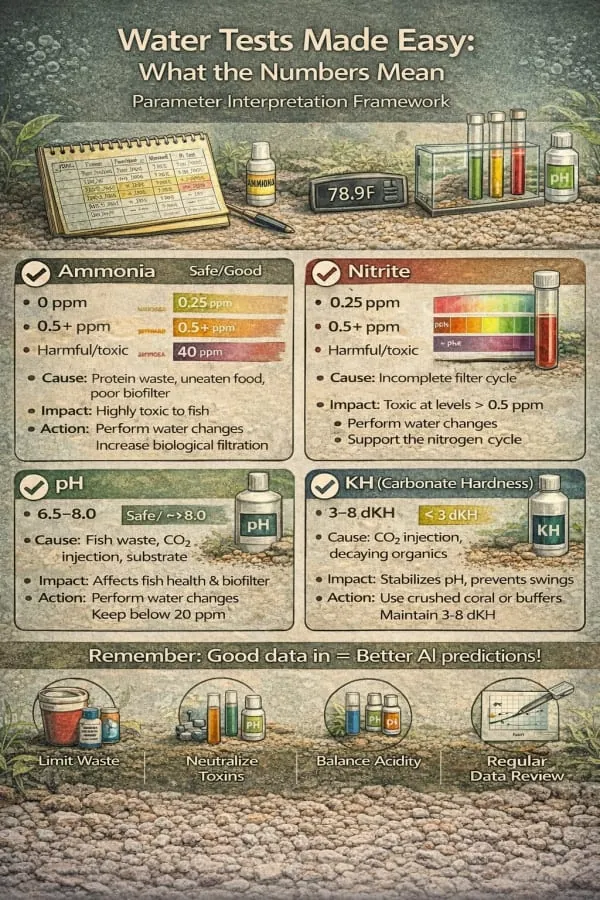
Aquarium water test results explained: read ammonia, nitrite, nitrate, pH, KH, GH, and temperature as one system, and what to do when a number spikes.
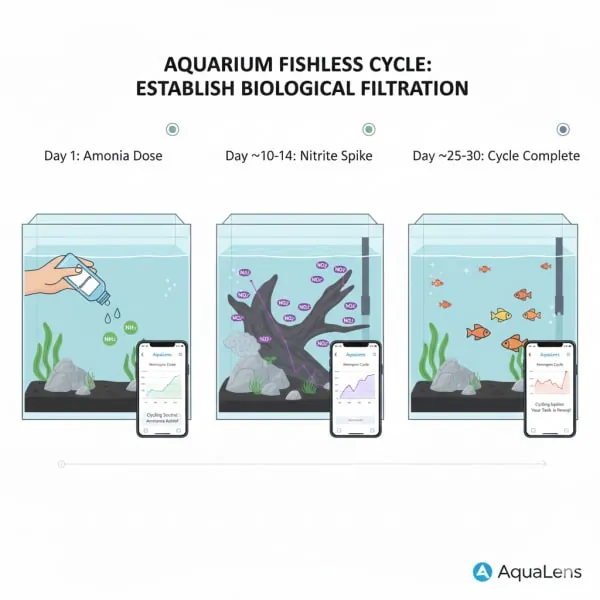
A step-by-step fishless cycle: dose ammonia, read the two spikes, and prove your filter is ready before a single fish goes in.
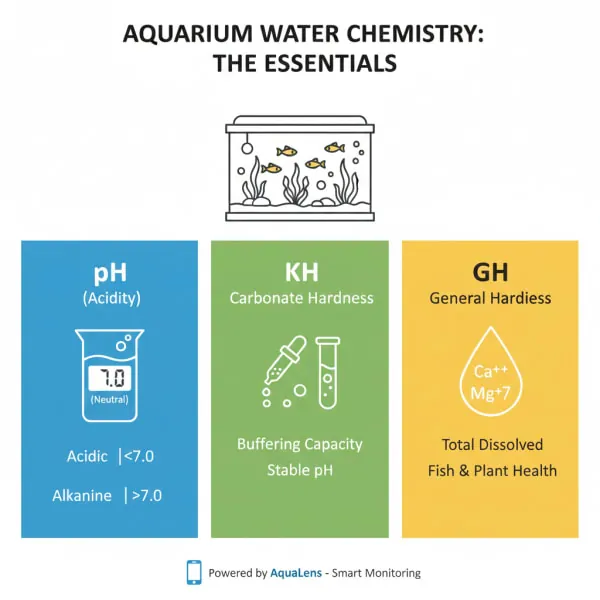
Aquarium water chemistry made simple: what pH, KH, and GH do, why stability beats chasing numbers, and how to keep them steady between water changes.